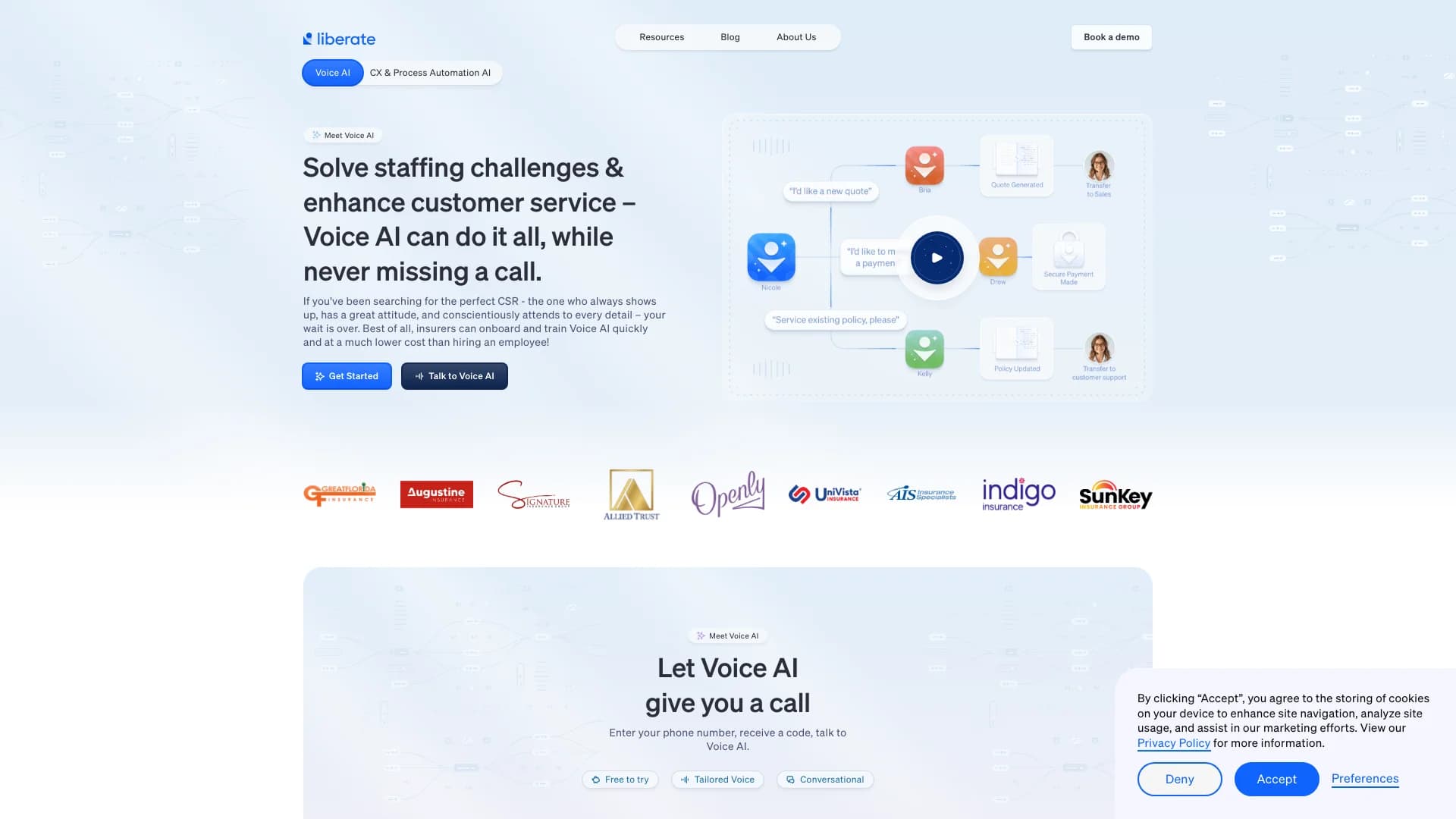
Liberate
Revolutionizes insurance with AI-driven CX and process automation.
Key Takeaways
- What it is
- Revolutionizes insurance with AI-driven CX and process automation.
- Best for
- Claims Automation
- Underwriting Workbench
- Digital Quote & Bind
- Rating
- 4.5/5
What is Liberate?
Liberate is a revolutionary AI tool that specializes in CX and Process Automation, particularly within the insurance sector. This platform is designed to streamline and automate key processes such as claims handling, underwriting, and customer interactions, ensuring efficiency and a significant reduction in operational costs. With its robust features, Liberate aims to transform how insurance companies operate by integrating advanced AI with existing systems to deliver seamless customer experiences.
Liberate stands out with its comprehensive automation capabilities that cover both front-end customer interactions and back-end process workflows. Its unique selling point is the ability to integrate deeply with existing insurance platforms, which allows for a smoother transition and enhanced functionality without the need to replace legacy systems.
Liberate excels in providing comprehensive automation solutions for the insurance industry, significantly enhancing operational efficiency and customer satisfaction. Its ability to integrate seamlessly with major insurance platforms offers an unmatched advantage in upgrading legacy systems with minimal disruption. This makes Liberate an indispensable tool for insurance companies aiming to modernize their operations and improve service delivery.
Who is Using Liberate?
Insurance Companies
Utilizing the tool for automating claims processing and underwriting tasks.
Brokers and Agencies
Employing the platform to improve customer service and operational efficiency.
Commercial Auto Insurers
Leveraging the tool to handle large volumes of claims and underwriting data.
Home and Property Insurers
Using the tool for rapid claims settlement and risk assessment.
Uncommon Use Cases
Educational institutions adopt Liberate for research and training in insurance technology; tech startups integrate Liberate for backend insurance process automation.
Key Features
Rating Breakdown
Pricing Plans
Custom Pricing Model
- Liberate offers tailored pricing based on the specific needs and scale of the business
Subscription-Based Tiers
- Pricing varies depending on the modules and features required by the organization
Liberate Use Cases
First notice of loss
Customers file claims through voice, SMS, or digital intake while Liberate verifies identity, captures details, and writes structured data to the claims core.
Outcome: Faster FNOL with less manual entry and fewer handoffs.
Claims status and document collection
Liberate sends status updates, requests missing documents, follows up automatically, and routes submitted materials.
Outcome: Shorter cycle times and fewer status calls.
Policy servicing
The platform handles billing questions, payment processing, endorsements, mortgagee changes, coverage inquiries, and ID-card requests.
Outcome: Routine servicing is resolved without adding staff.
Insurance quoting and lead response
Voice and digital agents collect submission information, enter data into raters, respond to leads, and provide quotes or warm transfers.
Outcome: Faster response times and improved speed-to-bind.
Email and document automation
Liberate classifies inbound emails and attachments, extracts structured information, routes requests, and sends routine responses.
Outcome: Shared mailboxes become prioritized, auditable workflows.
Workflow Ideas with Liberate
Automated FNOL to vendor dispatch
- 1Verify the claimant's identity and collect loss details.
- 2Write structured claim data to the claims core.
- 3Apply rules, dispatch vendors, and send confirmation.
Document request and follow-up
- 1Identify missing claim or submission documents.
- 2Send an SMS or email request to the claimant or broker.
- 3Classify incoming attachments and route them to the appropriate team.
Lead-to-quote workflow
- 1Respond to a web or phone lead immediately.
- 2Collect structured submission data and enter it into the rater.
- 3Deliver a quote or warm-transfer the qualified lead to a producer.
How Liberate fits into your stack
Guidewire and Duck Creek
Integrates smoothly for enhanced data management and workflow automation.
API Access
Offers extensive APIs for custom integrations, allowing businesses to tailor functionalities to their specific needs.
Cloud-Based Infrastructure
Supports robust, scalable, and secure cloud-based operations.
Third-Party Integrations
Extensive support for integrating with other tools like DocuSign, Xactware, and major analytics platforms.
Pros
- +End-to-end automation for sales, servicing, and claims workflows
- +Multilingual voice support in English, French, and Spanish
- +Pre-built integrations with major insurance systems and providers
- +Encryption for data in transit and at rest
- +No-code workflow and escalation-rule configuration
Cons
- −Initial Setup Complexity: The integration process can be complex, requiring substantial initial setup and customization.
- −Training Requirement: New users require training to fully utilize all the features and capabilities of the platform.
- −Dependency on Third-Party Platforms: While integration is a strength, it also creates dependency on other systems for full functionality.
Limitations & when to consider alternatives
Known limitations
- Enterprise sales process. The site directs prospective customers to request a demo rather than presenting self-serve signup or public pricing.
- Voice call duration. The platform page states that voice agents handle calls up to 20 minutes.
- Insurance-specific focus. Liberate is positioned specifically for insurance carriers, agencies, brokers, TPAs, MGAs, and BPOs.
- Core-system integration dependency. Many workflows depend on integrations and write-back to claims, policy, rating, or agency-management systems.
Look elsewhere when
- You need a consumer-facing mobile app.
- You need a downloadable desktop application.
- You need a public developer API with published documentation.
How to Use Liberate
- 1
Choose an initial workflow
Select a focused use case such as FNOL, policy servicing, email triage, quoting, or claims status automation.
- 2
Map the target systems
Identify the claims, policy, rating, CRM, AMS, or analytics systems that Liberate must read from and write to.
- 3
Configure rules and escalation
Use the low-code or no-code interface to define routing, escalation rules, validation logic, and human handoffs.
- 4
Connect communication channels
Deploy the workflow through voice, SMS, email, digital forms, portals, or a combination of channels.
- 5
Monitor outcomes
Review transcripts, recordings, sentiment, smoothness scores, response times, resolution rates, and agent performance in the reporting dashboard.
- 6
Expand automation
After validating one workflow, extend Liberate to additional claims, servicing, sales, document, or renewal processes.
Who is Liberate For?
Insurance carriers
Carriers can automate claims, servicing, sales, and customer-contact-center workflows.
Agencies and brokers
Agencies and brokers can automate lead response, quoting, servicing, renewals, and client communications.
TPAs, MGAs, and BPOs
These organizations can manage high-volume insurance interactions and client-specific workflows with governed automation.
Claims teams
Claims organizations can automate FNOL, status inquiries, document intake, vendor dispatch, and correspondence.
Insurance servicing and sales teams
Servicing and sales teams can use AI agents for billing, policy changes, quoting, renewals, and lead follow-up.
Frequently Asked Questions
What is Liberate?
Liberate is an insurance-native AI platform for sales, servicing, and claims across voice, SMS, email, and digital channels.
Which insurance workflows can Liberate automate?
Liberate automates claims intake, policy servicing, sales, document handling, status updates, payments, and downstream workflow execution.
Does Liberate integrate with existing insurance systems?
Yes. It offers pre-built and custom integrations with systems including Guidewire, Duck Creek, Snapsheet, Salesforce, Applied, and Microsoft Outlook.
Does Liberate support multilingual conversations?
Yes. Its voice and SMS agents can automatically detect language preferences and support more than 100 languages.
How does Liberate handle security?
Liberate states that data is encrypted in transit and at rest, supports role- and project-based permissions, and offers SSO.
How is Liberate configured?
Teams can use low-code or no-code interfaces to adjust workflows, escalation rules, and AI behavior without IT support.
Community reviews
Be the first to share your experience.
Sign in to leave a review for Liberate.
Liberate Alternatives
Looking for alternatives to Liberate? Here are similar tools in the same category: