
Vertex AI
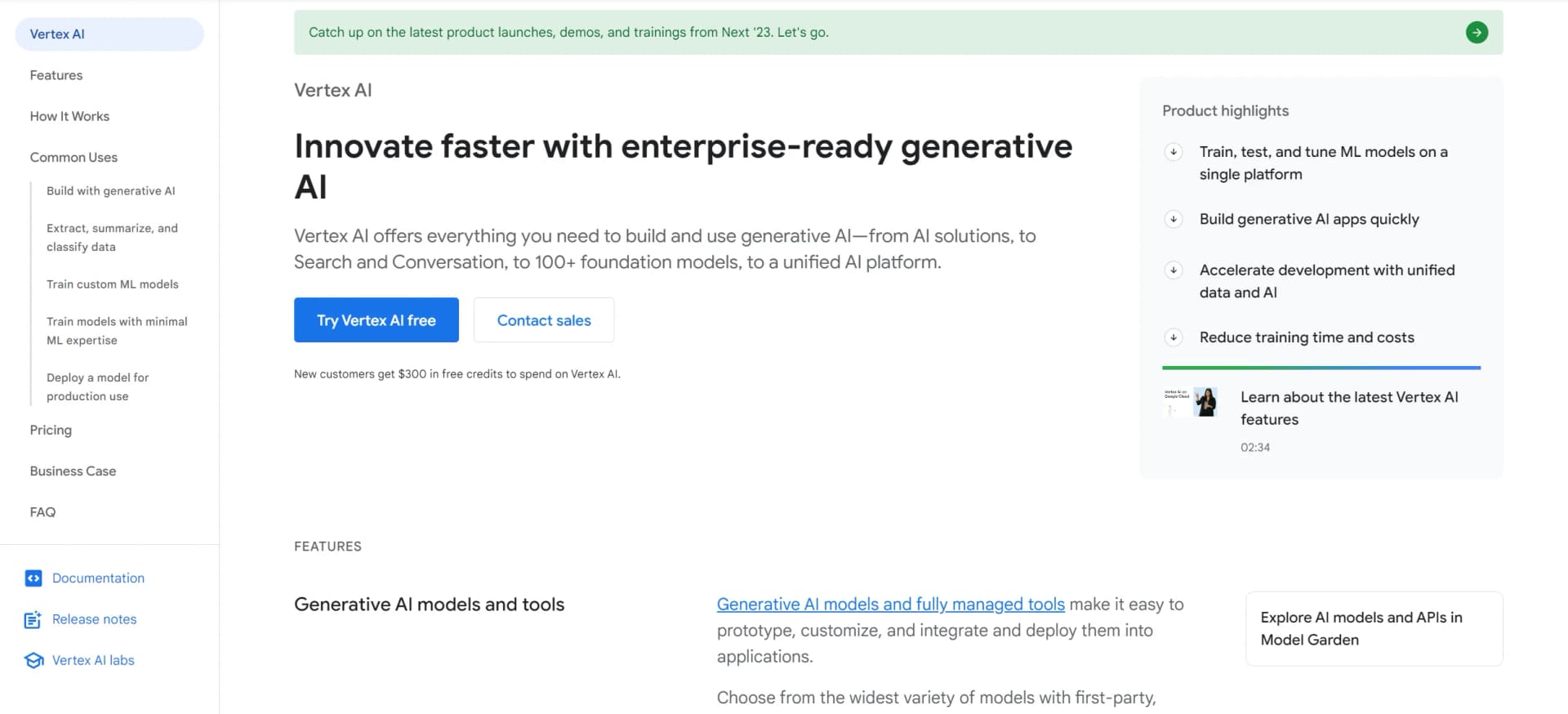
Streamline ML workflows with Google's advanced AI models and robust MLOps tools.
Key Takeaways
- What it is
- Streamline ML workflows with Google's advanced AI models and robust MLOps tools.
- Pricing
- $300 · Freemium
- Best for
- Unified ML Platform
- State-of-the-Art Models
- MLOps Tools
- Rating
- 4.5/5
What is Vertex AI?
Vertex AI stands as a beacon of innovation in the AI landscape, offering a unified platform for machine learning (ML) on Google Cloud. It consolidates the entire ML workflow—from data preparation to model deployment—empowering developers and data scientists to build, deploy, and scale AI with remarkable efficiency.
Vertex AI offers a unified platform streamlining the ML process and access to Google’s advanced models like Gemini. Its integration of generative AI into the workflow sets it apart, offering unparalleled capabilities.
Vertex AI is a powerhouse in ML platforms, offering unparalleled capabilities for users across industries. Its integration of generative AI models, scalability, and seamless integration with Google Cloud make it a top choice for innovators seeking to leverage AI. With a commitment to accessibility, scalability, and cost-efficiency, Vertex AI is revolutionizing the AI landscape.
Who is Using Vertex AI?
Tech Startups
Rapidly develop innovative products with embedded AI capabilities.
Large Enterprises
Scale AI solutions across departments with robust ML workflow management.
Research Institutions
Conduct groundbreaking research in ML and data science.
Healthcare Providers
Improve patient outcomes through predictive analytics and personalized medicine.
Uncommon Use Cases
Non-profits analyze large datasets for social good; educational tech companies integrate AI for adaptive learning.
Key Features
Rating Breakdown
Pricing Plans
Free Tier
$300
- In free credits available to new customers
Generative AI Pricing
Free
- Imagen model for image generation
- Text
- Chat
- Code generation priced based on input/output characters
Which Vertex AI plan should you pick?
Start with pay-as-you-go usage for prototyping, then request a custom quote when workloads require predictable enterprise scale.
Pay-as-you-go
Good for developers and teams who need usage-based access to Vertex AI models, tuning, pipelines, and deployment.
Vertex AI Use Cases
Build generative AI applications
Use Gemini models and APIs to create production AI applications and agents.
Outcome: Deploy AI-powered applications at scale.
Train and deploy custom models
Train models with AutoML or custom training, then register and deploy them.
Outcome: Serve predictions through managed endpoints.
Analyze documents and images
Provide documents or images to multimodal models for extraction, classification, summarization, or question answering.
Outcome: Generate structured or natural-language insights.
Create and manage ML workflows
Use Vertex AI Pipelines to orchestrate training, evaluation, deployment, and monitoring tasks.
Outcome: Automate repeatable machine-learning processes.
Tune foundation models
Adapt supported foundation models for specific tasks using tuning or fine-tuning workflows.
Outcome: Improve task-specific model performance.
Workflow Ideas with Vertex AI
Document analysis pipeline
- 1Connect supported documents from Cloud Storage or other data sources
- 2Import and process documents with RAG Engine
- 3Query Gemini for summaries, extraction, or question answering
Model training and deployment
- 1Prepare datasets and configure AutoML or custom training
- 2Train and evaluate the model
- 3Register and deploy the model to an endpoint
Prompt-to-application workflow
- 1Design and test prompts in Vertex AI Studio
- 2Share or manage prompts with project collaborators
- 3Use generated code and the Vertex AI API in an application
How Vertex AI fits into your stack
Google Cloud Services
Native integration with BigQuery and other Google Cloud services.
Open Source Frameworks
Supports various open-source ML frameworks.
MLOps Ecosystem
Offers MLOps tools for efficient model lifecycle management.
API Access
Provides APIs for custom integrations.
Pros
- +Accelerated Development: Speeds up ML model creation and deployment with pre-built and managed services.
- +Scalability: Scales to meet project needs with Google’s robust infrastructure.
- +Cost-Effectiveness: Offers various pricing options, including a free tier, for accessibility.
- +Comprehensive Integration: Seamlessly integrates with Google Cloud services and third-party applications.
Cons
- −Complexity for Beginners: Advanced features and models may overwhelm those new to ML.
- −Vendor Lock-In Potential: Reliance on Google's ecosystem could lead to dependency.
- −Resource Intensity: Some operations may require substantial computational power, leading to higher costs.
Limitations & when to consider alternatives
Known limitations
- Usage is quota- and capacity-dependent. Vertex AI applies project and regional quotas; requests can fail when quotas or shared capacity are exhausted.
- Costs vary by service and resource. Billing can include model usage, compute, storage, management fees, pipelines, and other Google Cloud resources.
- Some features have regional restrictions. Model availability, tuning, hardware, and quotas vary by supported Google Cloud region.
- Preview features may change. Preview or Pre-GA features can have limited support and may change incompatibly.
Look elsewhere when
- You need a native mobile app.
- You need a dedicated desktop installer.
- You need a simple fixed-price plan.
How to Use Vertex AI
- 1
Google Cloud offers extensive documentation and tutorials, guiding users from basics to advanced features of Vertex AI.
Who is Vertex AI For?
Machine-learning engineers
Vertex AI provides training, deployment, model registry, monitoring, and MLOps capabilities.
Data scientists
Vertex AI supports notebooks, AutoML, experiments, datasets, evaluation, and custom model training.
Application developers
Developers can build generative AI applications with Gemini APIs, SDKs, agents, and model endpoints.
Enterprise AI teams
Google Cloud provides IAM, security controls, data residency, monitoring, and scalable deployment.
Frequently Asked Questions
What is Vertex AI?
Vertex AI is a machine-learning platform for training, deploying, and using AI models and applications.
How can developers access Vertex AI?
Developers can use the Vertex AI API through REST, client SDKs, Google Cloud CLI, or the Google Cloud console.
Can Vertex AI process images?
Yes. Gemini models can accept image inputs and generate answers about their contents.
Can Vertex AI customize models?
Yes. Vertex AI supports model tuning, custom training, and deployment of custom-trained models.
Does Vertex AI support files and documents?
Yes. Supported document inputs include PDF, HTML, JSON, Markdown, text, and Google Workspace documents.
Community reviews
Be the first to share your experience.
Sign in to leave a review for Vertex AI.
Vertex AI Alternatives
Looking for alternatives to Vertex AI? Here are similar tools in the same category:
Learn to Master Vertex AI
With Skill Leap courses
Get in-depth training on Vertex AI and 50+ other AI tools with our expert-led video courses.
Start 7-Day Free Trial