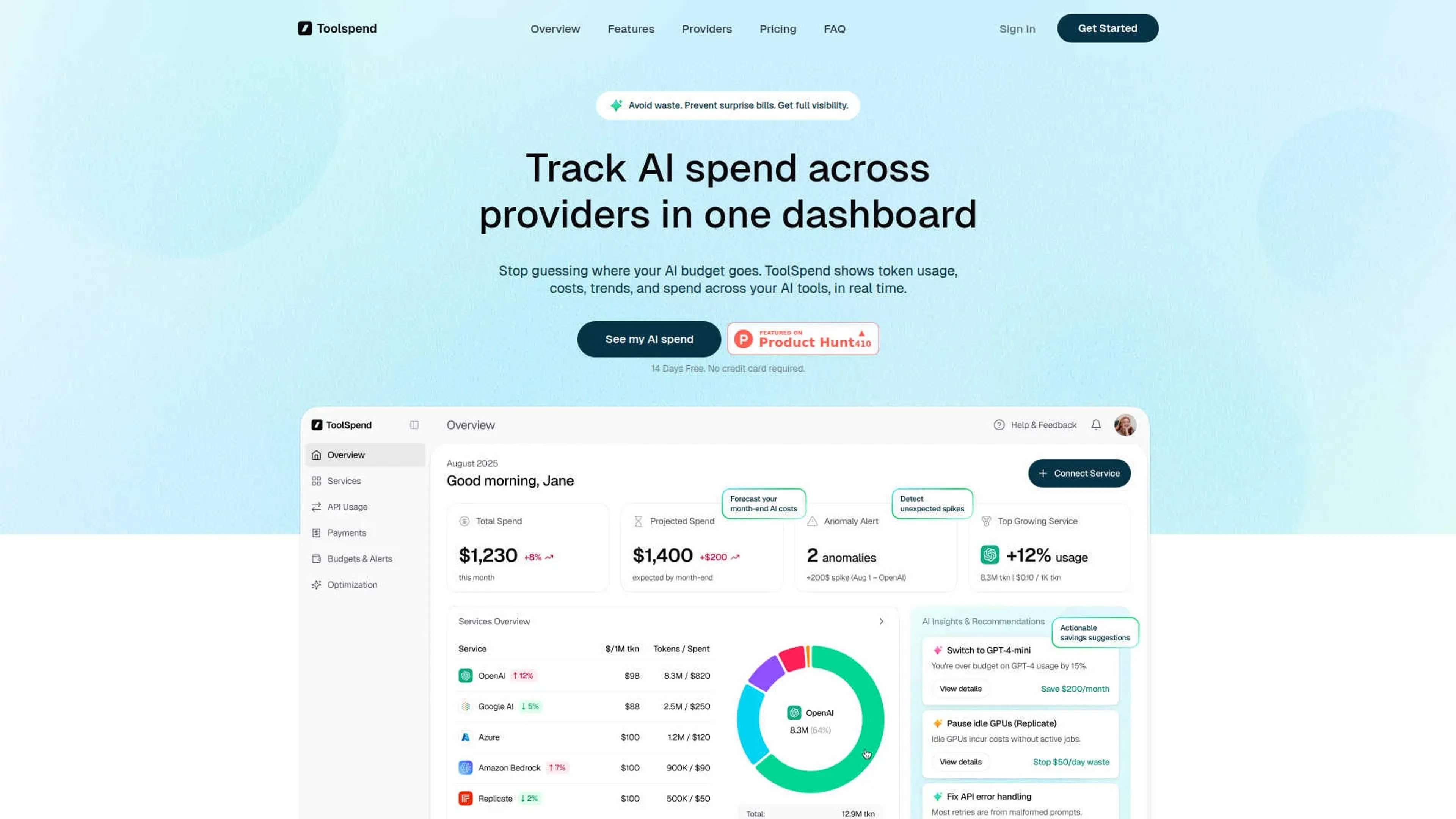
ToolSpend focuses on one core question: where is AI and SaaS money actually going. It connects AI providers and SaaS tools with banking or card data to reveal true spend, map it to teams and projects, and highlight waste. Using AI-driven analytics, it tracks token usage, subscription costs, and spend anomalies across providers like OpenAI, Google AI, Azure, and Amazon Bedrock. Finance, engineering, and product teams get a shared dashboard that replaces scattered spreadsheets and guesswork, so budgets for LLMs and SaaS stay under control instead of spiraling quietly in the background.
Key Features:
Unified AI and SaaS Spend Dashboard: Aggregates costs, usage, and subscriptions across multiple AI providers and general SaaS tools into a single view, down to model, project, or API key.
Real-Time Cost Tracking and Forecasting: Updates spend continuously and projects month‑end bills based on current usage, helping teams avoid surprise invoices from high‑volume LLM workloads.
Usage, Seat, and Duplicate Detection: Surfaces underutilized licenses, “ghost” seats, and overlapping tools across teams so organizations can consolidate vendors and trim bloat.
Anomaly and Spike Alerts: Uses analytics to spot retry storms, broken prompts, runaway jobs, or unusual spend patterns and alerts teams early enough to intervene.
AI Cost-Saving Recommendations: Suggests cheaper model alternatives, flags inefficient usage, and can point to idle compute (such as unused GPUs) that should be paused.
Security-First Architecture: Operates with read‑only connections to providers and financial data, with encryption and SOC 2 Type II practices aimed at “bank-level” reassurance.
Pros
Clear AI and SaaS Visibility: Gives finance, engineering, and leadership a shared, granular picture of where AI and SaaS money goes.
Practical Cost Reduction: Identifying idle seats, redundant tools, and wasteful usage can quickly reclaim meaningful budget.
Early-Warning System: Real‑time alerts and forecasts reduce the odds of bill shock from rapid LLM adoption.
Good Fit for Multi-Provider Teams: Particularly helpful for organizations juggling several AI vendors, models, and internal teams.
Security Posture: Read‑only access and strong security practices suit risk‑sensitive companies that still want detailed analytics.
Cons
Young Product: Recently launched, so some edges and missing “nice to have” refinements are likely as the team ships updates.
Integration Coverage Still Growing: While major AI providers are supported, smaller or niche tools may not yet plug in automatically.
Overkill for Light Users: Individuals or very small teams with only one or two AI tools may not get full value from the depth of analytics.
Who is Using ToolSpend?
Finance and FP&A Teams: Using it as a command center for AI and SaaS spending, improving forecasting and controlling software creep.
Engineering and Platform Teams: Tracking model usage, token burn, and anomalies across services to keep infrastructure‑adjacent costs in check.
AI Product and Data Science Teams: Monitoring experimental and production LLM workloads to spot waste and justify model choices.
Procurement and Operations Leaders: Coordinating renewals, spotting duplicate vendors, and preparing negotiations with data instead of rough estimates.
Uncommon Use Cases: Adopted by AI consultancies to track client‑specific tool costs; used by startup founders to consolidate personal, side‑project, and company AI subscriptions in one place.
Pricing:
Free Trial: A 14‑day free trial with access to core features and limits on connected services and tracked tokens.
Pro Plan: $14.99 per month; includes connection to up to 10 services, full history and trends, projected month-end spend, anomaly alerts (spike detection), AI insights and savings tips, export-ready reporting view.
Disclaimer: Please note that pricing information may not be up to date. For the most accurate and current pricing details, refer to the official ToolSpend website.
What Makes ToolSpend Unique?
ToolSpend does not just list tools and invoices; it correlates real provider usage data with actual financial transactions. That bridge between engineering metrics and finance records is where it shines. Teams can see, for example, which specific LLM model or API key is driving a card charge and whether a cheaper alternative would have done the job. The focus on both AI services and general SaaS, plus security practices suitable for serious spend, makes it feel like a purpose‑built AI spend cockpit rather than a generic expense tracker with some AI buzzwords sprinkled on top.
How We Rated It:
Accuracy and Reliability: 4.6/5
Ease of Use: 4.2/5
Functionality and Features: 4.4/5
Performance and Speed: 4.5/5
Customization and Flexibility: 4.0/5
Data Privacy and Security: 4.7/5
Support and Resources: 4.0/5
Cost-Efficiency: 4.5/5
Integration Capabilities: 4.2/5
Overall Score: 4.3/5
ToolSpend For Smarter Control Of AI And SaaS Budgets:
ToolSpend delivers a focused answer to the messy reality of AI and SaaS sprawl: one place to see truth in spending, powered by usage‑aware analytics rather than static spreadsheets. For teams already deep into multi‑provider LLMs and a growing stack of SaaS tools, it offers tangible, money‑saving clarity, from catching idle seats and duplicate apps to flagging runaway jobs before they bite. The product is still young, so some sophistication and integrations will likely grow over time, but the core idea is strong and immediately useful. For any organization where “AI costs are getting a bit out of hand” is an honest admission, ToolSpend belongs on the shortlist.