
TasteGPT
Ask food questions, get evidence-backed launch decisions.
Key Takeaways
- What it is
- Ask food questions, get evidence-backed launch decisions.
- Best for
- Food‑specific conversational engine
- Live, multi‑source data backbone
- Statistical confidence and audience cuts
- Rating
- 4.4/5
What is TasteGPT?
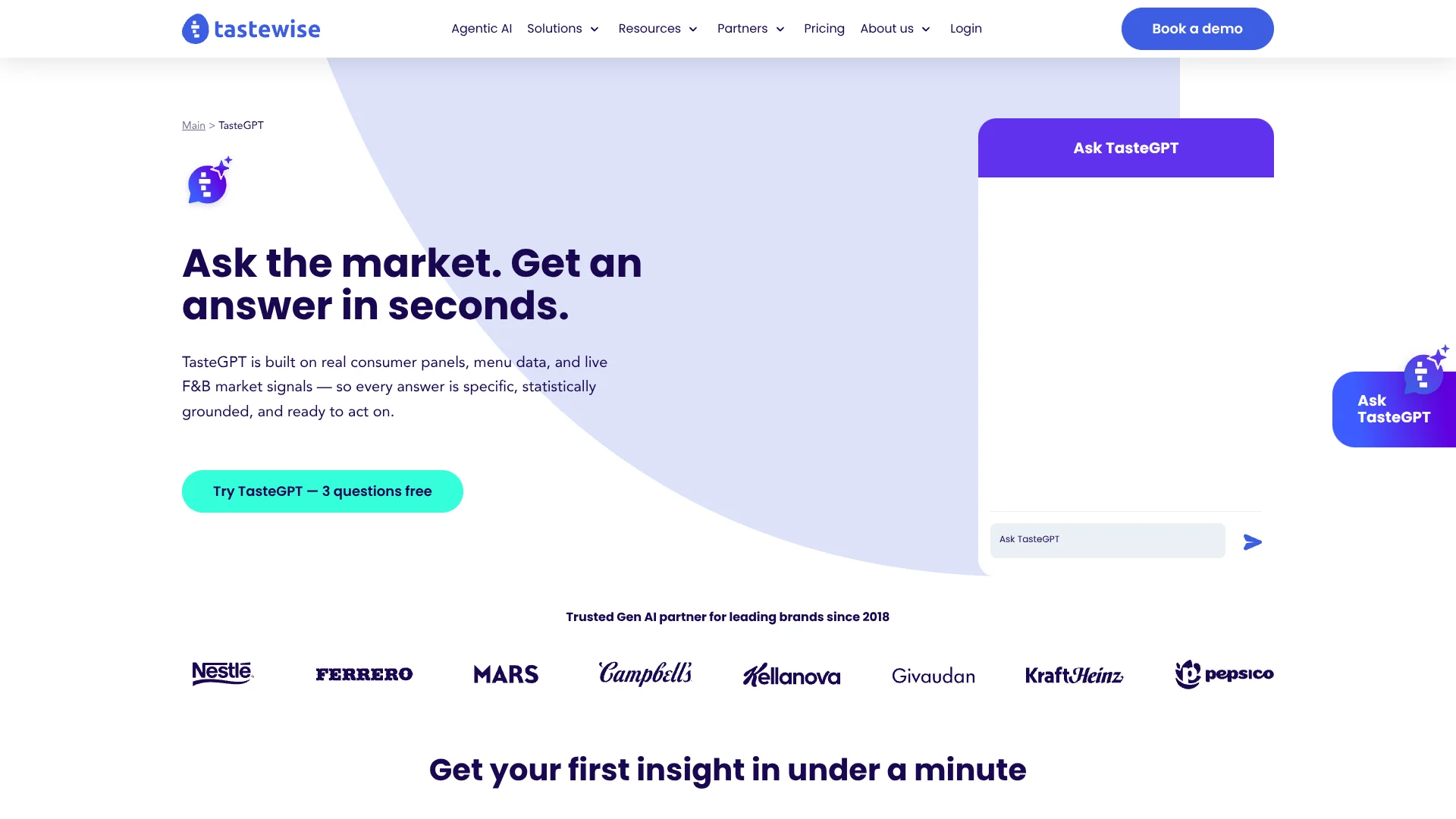
TasteGPT is Tastewise’s conversational food and beverage intelligence assistant. It lets teams ask natural language questions about categories, consumers, menus, and retail performance, then responds with statistically grounded answers built on consumer panels, menu trackers, and real purchase signals. Instead of static dashboards, it focuses on decision-ready insight that explains which trends matter, for which audiences, in which channels, and how to act on them across innovation, marketing, and sales.
TasteGPT stands out by being built only on food and beverage intelligence rather than a generic internet corpus. Its combination of live consumer panels, menu and retail trackers, and a food‑trained generative layer means it answers “What should we launch next?” with specific products, audiences, and claims, not vague trend labels. The emphasis on statistical validation and transparent evidence makes it unusually suitable for high‑stakes decisions like retailer pitches and global innovation bets.
TasteGPT gives food and beverage teams a focused way to turn messy, fast‑moving market signals into clear moves: which concepts to back, how to talk about them, and where to take them first. For organizations that already treat data as a competitive edge, it removes much of the grind between a hunch and a defendable decision. For those still relying on slow, historic research, it offers a practical path into AI‑driven innovation without forcing marketers and product developers to become data scientists.
Who is Using TasteGPT?
Global CPG and beverage brands
Using it to spot emerging flavors, test concepts, and build retailer sell‑in stories.
Ingredient and flavor houses
Quantifying demand for ingredients, occasions, and benefit territories to guide customers’ pipelines.
Retailers and shopper teams
Shaping category roles, shelf strategy, and promotion themes with demand evidence.
Foodservice operators and restaurant groups
Informing menu innovation, LTOs, and competitive benchmarking.
Uncommon Use Cases
Adopted by creative agencies for data‑backed campaign territories; used by boutique challenger brands to punch above their weight in buyer meetings.
Key Features
Rating Breakdown
Pricing Plans
Free TasteGPT trial
- A limited experience where users can ask up to a small number of questions with real market data
- No credit card required
Which TasteGPT plan should you pick?
Start with the limited no-card TasteGPT access to test fit, then upgrade to Enterprise when you need broader modules, markets, team access, permissions, integrations, and enablement.
Enterprise
Good for large CPG organizations, global teams, and multi-brand portfolios that need multi-market coverage, permissions, integrations, and shared evidence workflows.
TasteGPT Use Cases
Validate a new product idea
Ask which flavors, claims, audiences, and occasions support a proposed launch.
Outcome: A more evidence-backed product direction.
Identify category whitespace
Explore unmet opportunities and demand signals within a food or beverage category.
Outcome: Prioritized whitespace opportunities.
Build a retailer sell-in narrative
Request the consumer evidence, audience context, and category framing behind a retail placement ask.
Outcome: A buyer-ready category story.
Support a foodservice menu pitch
Use audience, occasion, and demand data to justify a menu or operator recommendation.
Outcome: A proof-backed foodservice pitch.
Track emerging food trends
Ask about breakout ingredients, flavors, dishes, audiences, and channels using live market signals.
Outcome: Faster detection of relevant trends.
Workflow Ideas with TasteGPT
From trend question to innovation brief
- 1Ask TasteGPT which trends or ingredients are accelerating in a target category.
- 2Narrow the answer by audience, market, channel, or occasion.
- 3Use the resulting evidence to shape a product innovation brief.
From concept to retailer sell-in
- 1Ask whether a product concept has demand and whitespace support.
- 2Request the relevant audience, claims, occasions, and competitive context.
- 3Turn the evidence into a retailer-ready narrative.
From market signal to team workflow
- 1Connect Tastewise to Slack, Teams, Notion, or another supported workspace.
- 2Use API, webhooks, Zapier, Make, or n8n to route signals and outputs.
- 3Deliver trend alerts, briefs, or agent outputs into the team’s existing workflow.
How TasteGPT fits into your stack
Browser
TasteGPT is presented as Tastewise’s conversational web assistant: users ask plain-language food and beverage questions and receive evidence-backed answers.
Automation and APIs
Tastewise exposes REST APIs, webhooks, MCP, Zapier, Make, and n8n so agents and insights can feed repeatable workflows and internal systems.
Team chat and tickets
Tastewise can surface insights and alerts in Slack and Microsoft Teams, allowing teams to discuss and share outputs where they work.
Docs and writing
Integrations include Google Workspace, Notion, Microsoft PowerPoint, Google Sheets, and Excel for turning Tastewise evidence into briefs, decks, and analysis.
Pros
- +Time savings for insights: Replaces weeks of desk research and multiple tools with answers in seconds.
- +Accessible for non‑analysts: Brand, culinary, and sales teams can self‑serve insight without SQL, BI tools, or research briefs.
- +Highly domain‑specific: Food‑trained models reduce off‑topic responses and “hallucinated” trends common in generic chatbots.
- +Meeting‑ready output: Data, context, and narrative structure arrive in a format suited to pitches, decks, and concept validation.
Cons
- −Food‑only focus: Not useful for categories outside food and beverage.
- −Opaque public pricing: Serious users must talk to sales for full platform access.
- −Best for clear questions: Teams get more value once they learn to phrase focused, outcome‑oriented prompts.
Limitations & when to consider alternatives
Known limitations
- Public pricing is not itemized. Tastewise publishes custom-quote pricing rather than a public table of fixed plan prices.
- Free access is limited. The TasteGPT page offers three questions without a credit card, but does not describe unlimited free usage.
- Customer data is not used for model training. Tastewise states that customer-provided data is not used to train AI models.
- Outputs require human judgment. Tastewise describes its AI as decision support and warns that generative AI outputs may sometimes be inaccurate.
- Sensitive personal information should not be submitted. Tastewise instructs users not to input personal or sensitive information such as names, addresses, email addresses, or dates of birth.
Look elsewhere when
- You need fine-tuning on your own customer data.
- You need a native mobile or desktop application.
- You need a general-purpose coding assistant.
How to Use TasteGPT
- 1
Open TasteGPT
Use the TasteGPT online assistant and start with one of the three no-card questions included for evaluation.
- 2
Ask a focused F&B question
Describe the category, audience, market, channel, claim, trend, or whitespace question you need answered.
- 3
Review the evidence-backed response
Use the cited sources, audience context, channel context, and regional data to assess the recommendation.
- 4
Turn the answer into a decision
Apply the result to product innovation, trend analysis, retailer sell-in, foodservice pitching, marketing, or category planning.
- 5
Connect outputs to existing tools
For enterprise workflows, connect Tastewise with tools such as Slack, Teams, Notion, Salesforce, Power BI, ChatGPT, Claude, Zapier, Make, or n8n.
- 6
Upgrade for broader enterprise use
Request custom pricing when you need additional modules, markets, users, permissions, integrations, or brief volume.
Who is TasteGPT For?
R&D directors
They can use TasteGPT to generate food-and-beverage insights, validate ideas, and support innovation decisions.
Food scientists
They can use category, ingredient, flavor, and consumer-demand intelligence during product development.
Product innovation leads
They can pressure-test concepts, identify whitespace, and prioritize opportunities before development or internal pitching.
Marketing teams
They can use demand, audience, occasion, and claim intelligence to sharpen positioning and campaign direction.
Sales and commercial teams
They can build retailer-ready narratives and foodservice sell-in stories backed by consumer and market evidence.
Frequently Asked Questions
What is TasteGPT?
TasteGPT is Tastewise’s AI food-and-beverage assistant. It answers plain-language questions using consumer panels, foodservice menus, retail signals, home-cooking behavior, and live market data.
How is TasteGPT different from general AI assistants?
TasteGPT is specialized for food and beverage and uses category-specific consumer, menu, retail, and food-culture signals rather than generic open-web knowledge.
What kinds of questions can I ask?
You can ask about category whitespace, flavors gaining traction, launch claims, emerging demand, competitor positioning, occasions, and retailer or foodservice sell-in narratives.
Can TasteGPT support product innovation?
Yes. It can help identify what to launch, which flavors are gaining momentum, which claims may resonate, and which occasions to design for.
Can TasteGPT help with retail or foodservice sell-in?
Yes. It can provide category narratives, consumer evidence, audience context, occasion data, numbers, and proof for placement or menu-pitch discussions.
How much does Tastewise cost?
Tastewise publishes custom pricing rather than fixed public plans. Pricing scales with modules, market coverage, workflow, and brief volume.
Community reviews
Be the first to share your experience.
Sign in to leave a review for TasteGPT.
TasteGPT Alternatives
Looking for alternatives to TasteGPT? Here are similar tools in the same category:
Learn to Master TasteGPT
With Skill Leap courses
Get in-depth training on TasteGPT and 50+ other AI tools with our expert-led video courses.
Start 7-Day Free Trial