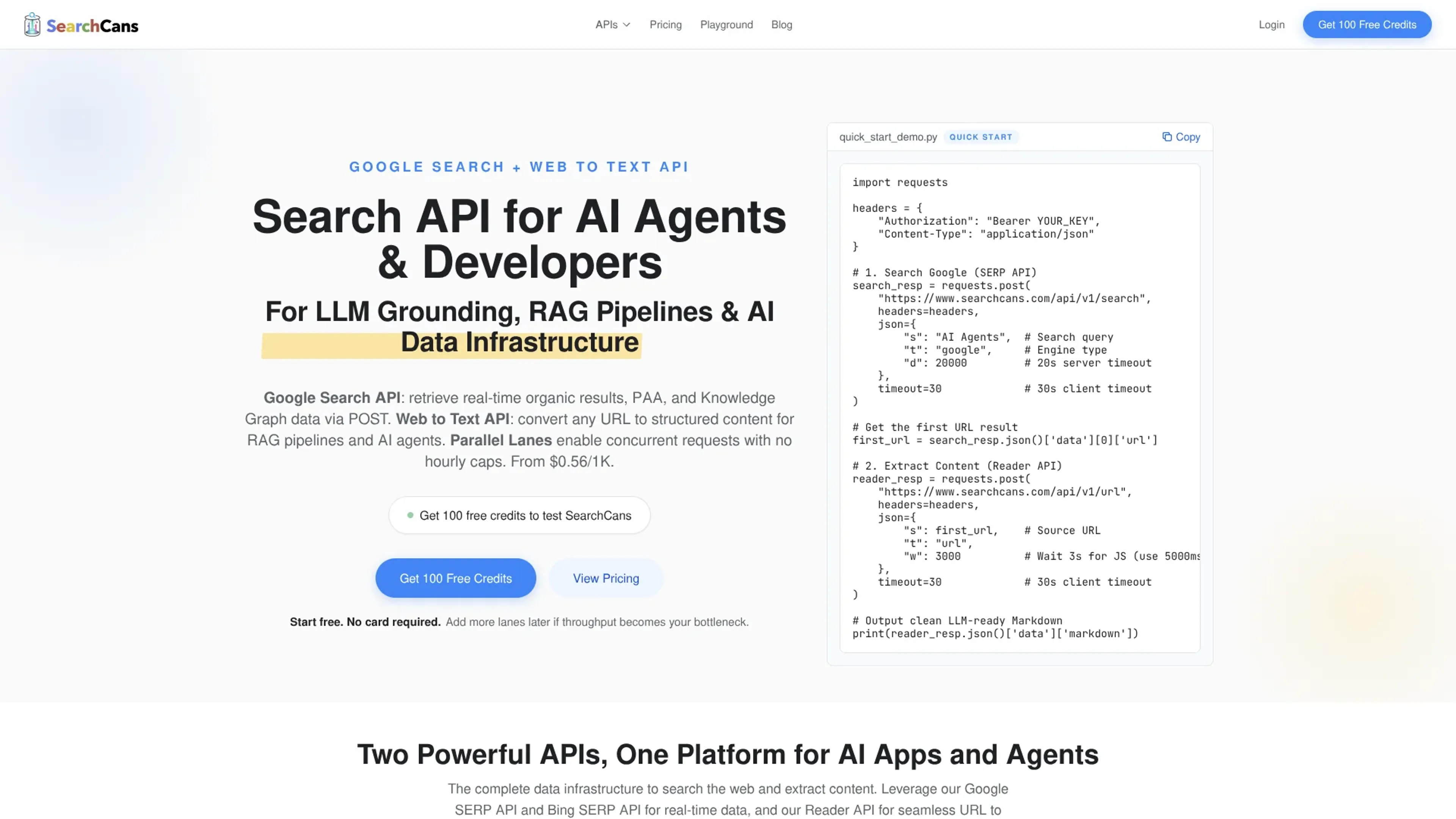
SearchCans is an API-first data layer for AI applications that need fresh web search results and clean page content. It combines Google and Bing SERP APIs with a Web to Text “Reader” API so agents, RAG pipelines, and LLM tools can search, fetch, and turn messy pages into structured, LLM‑ready text in a single workflow. Its architecture focuses on high throughput, real-time search data, and predictable pricing for developers building AI systems.
Key Features:
Multi‑Engine Search APIs: Unified POST endpoint for Google and Bing search, including organic results, People Also Ask, and Knowledge Graph fields tailored to AI grounding.
Reader API (Web to Text): Converts any URL into structured JSON and Markdown, stripping boilerplate so text can feed directly into RAG or summarization steps.
Parallel Lanes & Lane Stacking: Concurrency model with “lanes” for many requests in flight at once, plus stacking plans to raise throughput without changing integration code.
Developer‑Friendly Responses: Clean JSON schemas that work smoothly with tools like LangChain and LlamaIndex, plus straightforward Bearer token authentication and clear error codes.
Pros
AI‑Native Design: Search plus Reader combination fits agentic workflows and RAG pipelines without custom scraping infrastructure.
Cost‑Focused Pricing: Credits start at roughly $0.56 per 1,000 requests at higher tiers, appealing for heavy workloads.
High Concurrency: Parallel lanes and stacking give a clear path from hobby projects to production traffic.
Simple Integration: Single search and URL endpoints with example code make it quick to plug into existing LLM stacks.
Cons
Narrow Scope: Focuses on search and content extraction rather than end‑to‑end features like ranking, deduplication, or summarization.
Concept Overhead: The idea of lanes, stacking, and throughput estimates may feel abstract for smaller teams.
Ecosystem Still Growing: Some utility APIs, such as file extraction and YouTube search, are still labeled as coming soon.
Who is Using SearchCans?
AI Agent Platforms: Using SERP and Reader APIs to give agents reliable web tools without bespoke scrapers.
RAG Pipeline Builders: Feeding fresh search results and cleaned article text into vector databases.
Search‑Augmented SaaS Products: Powering “research” or “web insights” features inside productivity and analytics tools.
Data Engineering Teams: Replacing brittle scraping jobs with a managed search and extraction layer.
Uncommon Use Cases: Used by SEO research teams to programmatically pull PAA and Knowledge Graph hints; adopted by academic labs prototyping search‑grounded LLM experiments.
Pricing:
Standard: $18 per plan; includes 20,000 credits ($0.90 per 1K credits), 2 parallel search lanes, ~2,400 throughput per hour, real-time results, fast response time, email technical support, and credits valid for 6 months.
Starter: $99 per plan; includes 132,000 credits ($0.75 per 1K credits), 3 parallel search lanes, ~3,600 throughput per hour, real-time results, faster response priority, email technical support, lane stacking eligibility, and credits valid for 6 months.
Pro: $597 per plan; includes ~1,000,000 credits ($0.60 per 1K credits), 22 parallel search lanes, ~26,400 throughput per hour, real-time results, priority request routing, Tier-1 developer support, lane stacking eligibility, and credits valid for 6 months.
Ultimate: $1,680 per plan; includes 3,000,000 credits ($0.56 per 1K credits), 68 parallel search lanes, ~81,600 throughput per hour, dedicated cluster node, zero queue latency, dedicated account manager, lane stacking eligibility, and credits valid for 6 months.
Disclaimer: Please note that pricing information may not be up to date. For the most accurate and current pricing details, refer to the official SearchCans website.
What Makes SearchCans Unique?
SearchCans stands out by tightly pairing SERP APIs with a Reader API built for LLM consumption instead of traditional SEO dashboards. The lane model removes hourly rate limits and makes concurrency a first‑class control knob, which suits agents and batch jobs that spike traffic. That mix of AI‑centric outputs, clear throughput scaling, and prepaid credit packs makes it unusually friendly for experimentation that can later ramp into production.
How We Rated It:
Accuracy and Reliability: 4.5/5
Ease of Use: 4.3/5
Functionality and Features: 4.2/5
Performance and Speed: 4.6/5
Customization and Flexibility: 4.0/5
Data Privacy and Security: 4.2/5
Support and Resources: 4.0/5
Cost-Efficiency: 4.7/5
Integration Capabilities: 4.1/5
Overall Score: 4.3/5
High-Throughput SERP and Reader APIs for Modern AI Workflows
SearchCans offers a focused, developer‑centric approach to web search and content extraction for AI systems. Teams that need real‑time results, LLM‑ready text, and predictable scaling can treat it as a plug‑in infrastructure layer rather than building their own scrapers and parsers. With lane‑based concurrency, credit‑based pricing, and AI‑oriented response formats, it suits both early‑stage experiments and serious production agents that live and breathe web data.