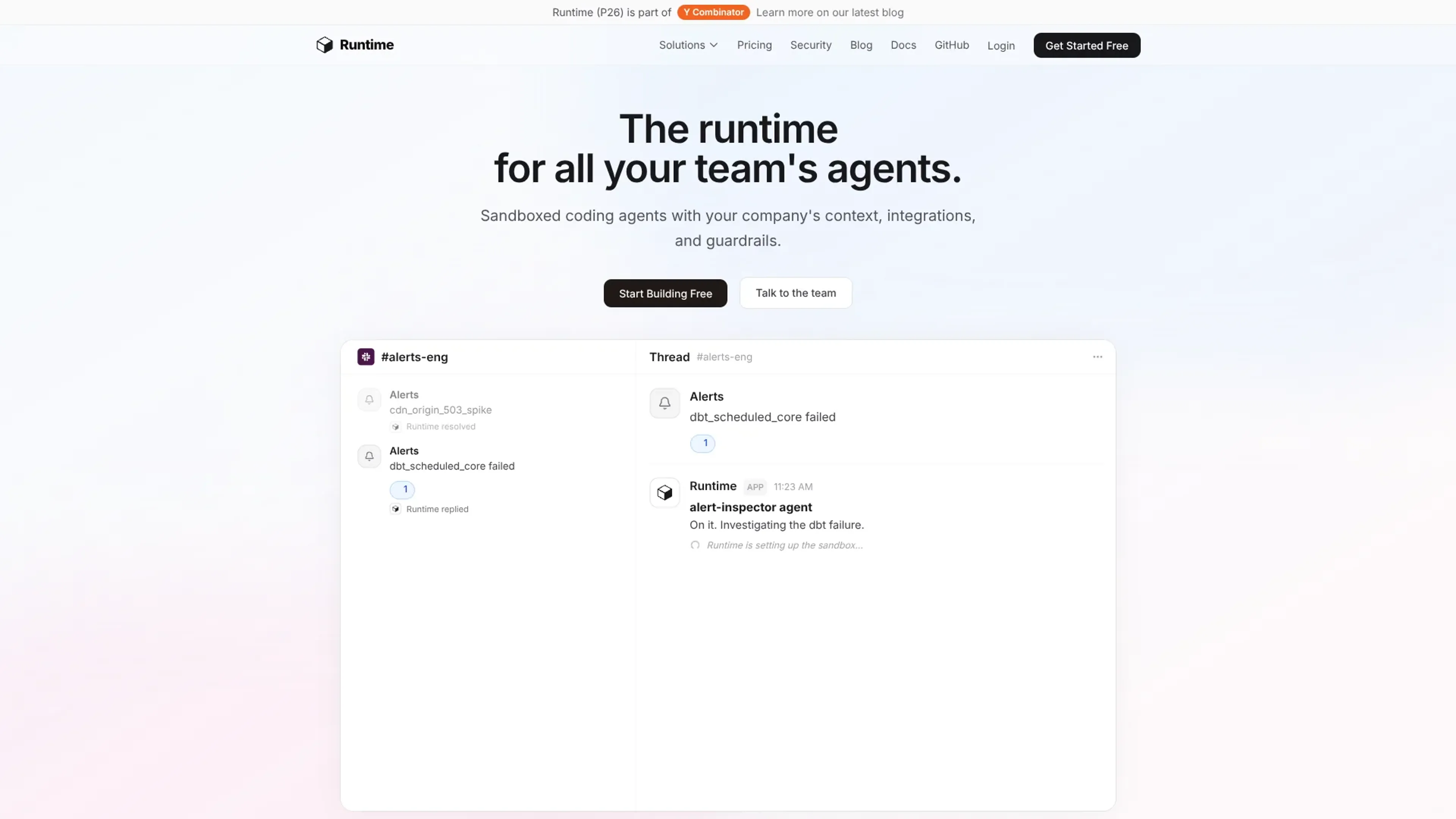
Runtime focuses on giving companies a shared runtime for coding agents so every team can run sandboxed, governed agents against real systems without building their own infrastructure. It plugs into existing coding agents such as Claude Code, Cursor, Copilot, Gemini CLI, Devin, and OpenCode, then layers on sandboxes, integrations, guardrails, and observability so agents can ship pull requests, tickets, and reports across the organization.
Key Features:
Multi‑agent coding runtime: Works with popular coding agents while Runtime supplies the environments, policies, and orchestration, so teams can swap models or tools without re‑plumbing everything.
Sandboxed compute with snapshots: Spins up pre‑warmed VMs that mirror monorepos and microservices, with custom CLIs, APIs, and secrets baked in, so each session starts quickly and stays isolated from production.
Background and interactive agents: Supports both interactive sessions and autonomous background agents that pick up tickets, issues, or Slack messages, write code, run tests, and return pull requests.
Mission Control & observability: Central dashboard to monitor every agent session, including tool calls, chain of thought, file diffs, costs, and approval status, plus spend limits and allowlists.
Deep SaaS and data integrations: Ships connectors for data warehouses, billing, HR, CRM, support, alerting, and engineering tools, and can call anything reachable via API, CLI, SDK, or MCP.
Self‑hostable and open source pieces: Can run fully inside a company’s cloud with its own models and storage, backed by open source components for the CLI, API worker, and templates.
Pros
Cross‑functional by design: Built so engineering, product, design, marketing, support, finance, and HR can all have tailored coding agents that work where they already live (Slack, Linear, GitHub, Jira).
Strong governance and safety: Sandboxes, approval gates, spend controls, and file rules help keep agents away from raw production data and risky side effects.
Infrastructure offload: Gives teams sandboxes, orchestration, cost tracking, and policies out of the box, saving months of internal platform work.
Model and tool flexibility: Lets companies bring their own model keys and tools instead of locking into a single agent vendor.
Collaboration friendly: Multiple teammates can step into the same session, watch live previews, and hand off work mid‑run.
Cons
Setup still requires engineering time: Modeling environments, wiring integrations, and defining guardrails need thoughtful platform ownership.
Best fit for teams, not solo developers: The value really appears at organizational scale, so very small teams may find it heavier than necessary.
Operational complexity: Once many agents run across functions, someone must actively manage policies, logs, and spend.
Who is Using Runtime?
Platform & DevOps Teams: Centralizing agent infra, sandboxes, and policies so other departments can adopt agents safely.
Engineering & Product Teams: Letting coding agents fix bugs, implement features, and turn PRDs into working prototypes.
Customer Support & Success: Running support triage agents that read tickets, query data sources, and draft responses.
Finance & Operations: Automating reconciliations, dashboards, and data pulls from billing and ERP systems.
Design & Marketing Teams: Iterating on live pages, campaign copy, and assets using sandboxed agents pointed at web properties.
Uncommon Use Cases: Used by internal audit and risk teams for continuous control checks; adopted by forward‑deployed engineering or professional services groups to deliver customer‑specific automations without one‑off scripts.
Pricing:
Free: $0 per month; includes 500 credits, 1 session, Claude Code, Codex and OpenCode, base sandbox, live preview and terminal, GitHub import and export, and community support.
Builder: $29 per month; includes 10 parallel sessions, all coding agents, standard sandbox, live preview and terminal, GitHub import and export, custom templates, BYOK, SDK/CLI/API access, and priority support.
Teams: Starting at $99 per seat per month; includes unlimited sessions, all coding agents, standard sandbox, real-time collaboration, shared templates and secrets, activity dashboard, role-based access, spend controls, BYOK, SDK/CLI/API access, and priority support.
Enterprise: Custom pricing; includes everything in Teams, self-hosted runtime, bring-your-own sandbox provider, environment templates, custom sandbox resources, dedicated infrastructure, compliance features, SSO/SAML/SCIM, and dedicated support engineer.
Disclaimer: Please note that pricing information may not be up to date. For the most accurate and current pricing details, refer to the official Runtime website.
What Makes Runtime Unique?
Runtime treats “agent runtime” as a first‑class product: it brings together sandboxes, orchestration, observability, guardrails, and integrations in one layer and lets organizations plug in whichever coding agents they prefer. Instead of each team experimenting with isolated bots, companies get governed, auditable agents that can touch real systems while still respecting policies and approvals. The combination of Slack‑native team agents, strong cost and policy controls, and the option to self‑host with open source components gives Runtime a very enterprise‑friendly flavor without losing developer ergonomics.
How We Rated It:
Accuracy and Reliability: 4.4/5
Ease of Use: 4.1/5
Functionality and Features: 4.7/5
Performance and Speed: 4.5/5
Customization and Flexibility: 4.6/5
Data Privacy and Security: 4.6/5
Support and Resources: 4.2/5
Cost-Efficiency: 4.0/5
Integration Capabilities: 4.7/5
Overall Score: 4.4/5
Runtime As A Practical Control Plane For Coding Agents
Runtime gives organizations that are serious about coding agents a practical way to roll them out across teams while keeping control of data, cost, and risk. For companies already experimenting with Claude Code, Cursor, Copilot, or similar tools, it turns scattered pilots into a governed, observable system that actually ships work across engineering, finance, support, and beyond.