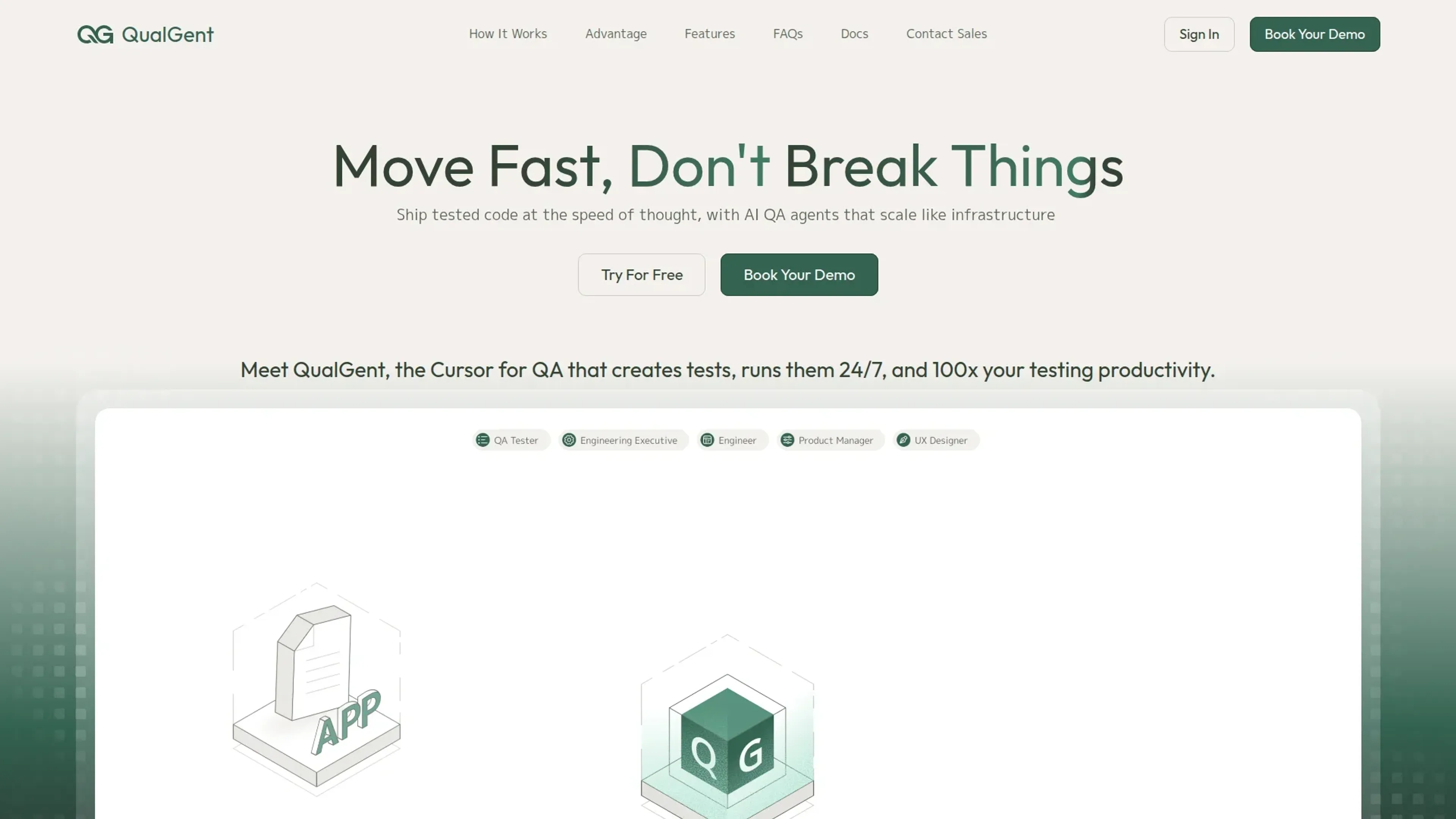
QualGent focuses on autonomous quality assurance for mobile apps, using AI agents that behave like real human testers. It creates tests from product context, runs them 24/7 on real iOS and Android devices, and helps engineering teams ship faster without scaling manual QA headcount. Backed by ex‑Google founders and built for mobile‑first teams, it turns natural language instructions, PRDs, and Figma designs into continuously running test suites.
Key Features:
AI test case creation from real product context: Ingests PRDs, user stories, repos, and Figma files to auto‑generate structured test plans and edge cases, including import from tools like TestRail, Qase, and Xray.
Autonomous, self‑healing AI testers: Vision‑based agents click, scroll, and swipe like a real user, adapt to UI changes, remember past failures, and even run with different personas such as new user or power user.
Massive parallel execution on devices: Scales from a single run to thousands of AI agents in parallel across emulators and real devices, with detailed videos, logs, and reports in minutes.
Deep mobile coverage: Handles push notifications, permissions, camera, GPS, backgrounding, Bluetooth, deep links, multi‑app flows, and backend/API validation across iOS, Android, and web views.
Localization‑friendly testing: Reuses one test suite across localized UIs in dozens of languages, including right‑to‑left layouts, without relying on fragile element IDs.
CI/CD and workflow integration: Hooks into CI/CD so tests can run on every commit, posting results into existing developer workflows and dashboards.
Pros
Huge coverage vs manual QA: 24/7 autonomous runs and parallelization mean many more user flows and devices get exercised than a typical manual team could manage.
Accessible test authoring: Natural language tests let product managers, designers, and non‑coding QA staff contribute cases directly.
Less maintenance pain: Self‑healing UI interactions reduce time spent updating scripts after every layout or component tweak.
Mobile‑first depth: Strong support for real devices, system integrations, and cross‑platform mobile stacks caters directly to modern app teams.
Fast onboarding: No‑card trial, guided setup, and familiar dashboards help teams reach first meaningful runs in hours, not weeks.
Cons
Relatively young product: As a newer YC‑backed entrant, community content, templates, and third‑party plugins are still growing.
Mobile bias: Web‑only organizations heavily invested in classic browser tools may not get as much immediate value.
Usage‑based economics: Teams with extremely high test‑run volumes could see spend climb and will need to actively manage quotas and schedules.
Who is Using QualGent?
Mobile product teams: Startups and scaleups shipping consumer or fintech apps that need fast iteration without exploding QA headcount.
Enterprise mobile groups: Larger companies with complex iOS and Android estates looking to cut regression cycles from days to minutes.
QA leaders and engineers: Specialists responsible for coverage, stability, and flaky‑test reduction in mobile pipelines.
Product managers and designers: Non‑engineering stakeholders who want to validate flows and UX changes via natural language test descriptions.
Uncommon Use Cases: Localization teams stress‑testing multilingual and right‑to‑left interfaces; design orgs validating prototype flows directly from Figma before full implementation.
Pricing:
Custom Pricing: Book a demo with the sales team to see all pricing options.
Disclaimer: Please note that pricing information may not be up to date. For the most accurate and current pricing details, refer to the official QualGent website.
What Makes QualGent Unique?
QualGent stands out by combining AI‑generated test design with autonomous execution on real mobile devices, rather than just scripting helpers. It behaves like a persistent AI QA workforce that learns an app’s behavior over time, explores unexpected paths, and adapts as the UI evolves. The focus on mobile system behaviors such as notifications, deep links, and device‑specific quirks sets it apart from more generic browser‑centric tools, while natural language authoring lowers the barrier for the rest of the product team to participate in quality.
How We Rated It:
Accuracy and Reliability: 4.5/5
Ease of Use: 4.2/5
Functionality and Features: 4.6/5
Performance and Speed: 4.7/5
Customization and Flexibility: 4.1/5
Data Privacy and Security: 4.0/5
Support and Resources: 4.2/5
Cost-Efficiency: 4.3/5
Integration Capabilities: 4.4/5
Overall Score: 4.3/5
High-Velocity Mobile QA For Modern Engineering Teams:
QualGent gives mobile teams an AI‑driven way to raise quality while shrinking QA cycles and manual toil. For organizations battling flaky scripts, device‑lab bottlenecks, and limited QA staffing, the appeal of an always‑on, self‑improving test agent is obvious. It is particularly attractive for mobile‑heavy product companies that care about global users, frequent releases, and rich device interactions. Teams that are comfortable experimenting with newer tooling and willing to tune their run quotas will find QualGent a powerful ally in keeping shipping velocity high without sacrificing trust in production builds.