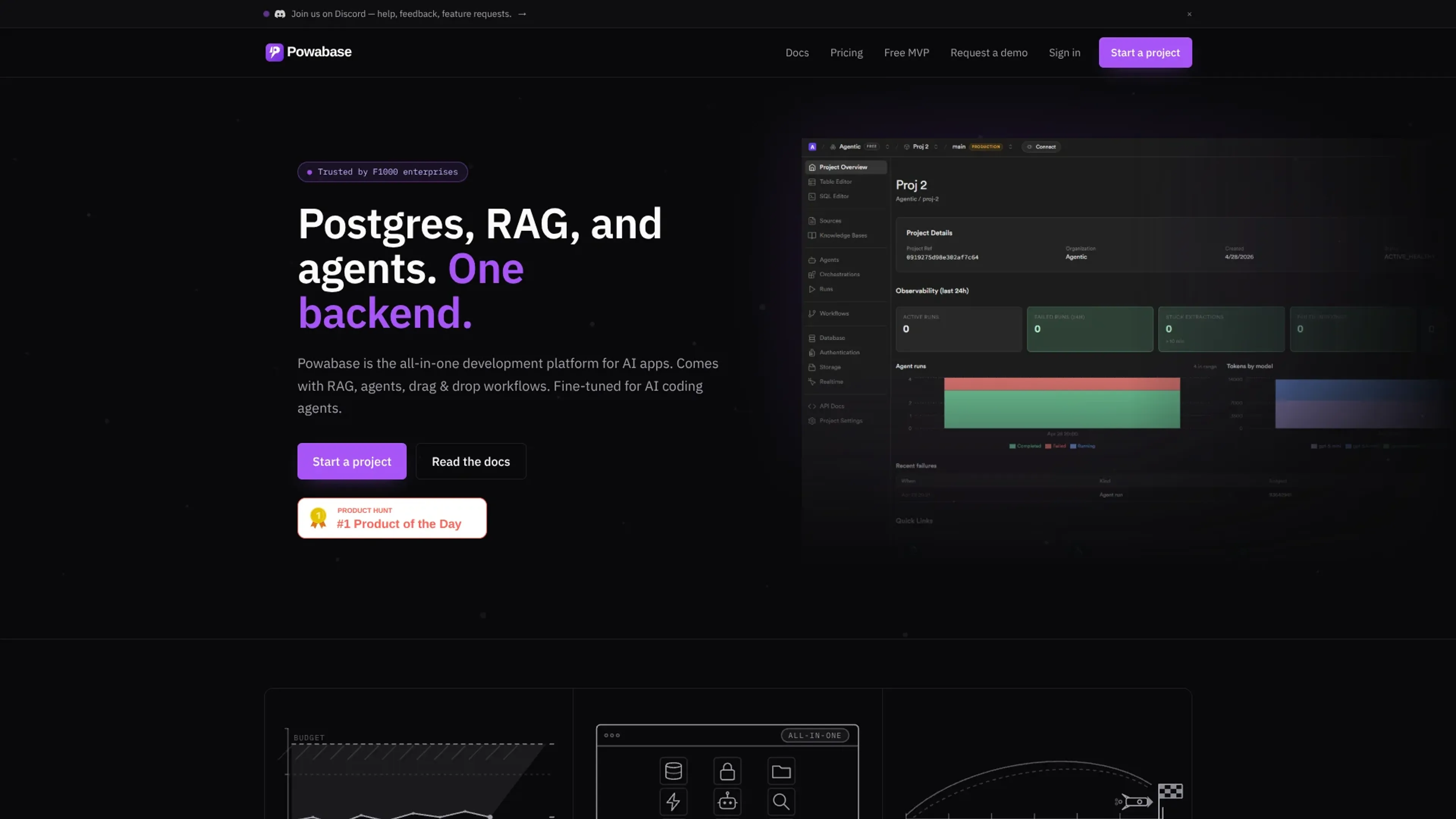
Powabase focuses on giving teams a single backend for AI applications, combining Postgres, retrieval augmented generation (RAG), agents, and visual workflows in one stack. It targets developers building AI products who want managed Postgres with vectors, high quality retrieval pipelines, and an agent runtime without stitching together half a dozen separate services or building infrastructure from scratch.
Key Features:
Unified Postgres + vector backend: Managed Postgres with row level security, pgvector for embeddings, built in auth, object storage, and realtime. Access comes via PostgREST for REST or GraphQL style queries, or through a direct database connection.
Production grade RAG pipeline: Handles PDFs, images, Office files, and URLs, then automatically extracts, chunks, embeds, and indexes content. Multiple indexing strategies and hybrid, vector, and BM25 search are combined with modern rerankers, with benchmarked OCR and retrieval accuracy.
Agent runtime with tools and sessions: Supports ReAct style agents across multiple LLMs, tools, and knowledge bases. Streaming over SSE exposes token deltas, retrieval events, tool calls, and citations, with session objects keeping multi turn state.
Visual and callable workflows: Drag and connect triggers, conditions, agents, HTTP calls, and code blocks, then deploy the graph as an HTTP endpoint that frontends or other systems can call.
Coding agent friendly surface: The platform speaks MCP, and the HTTP API plus docs are structured so coding assistants like Claude Code, Codex, and Cursor can drive project creation, from spinning up projects to wiring sources, knowledge bases, and agents.
Flexible deployment options: Run on Powabase Cloud, self host through Docker or Kubernetes with Helm or Compose, and keep LLM spend under local control with bring your own keys for major providers.
Pros
End to end AI backend in one place: Database, retrieval pipeline, agents, and workflows sit in a single product, which shortens MVP timelines for AI apps and automations.
Built for cost awareness: Claims of up to 70 percent token savings and 2 to 4 times lower build cost reflect how retrieval, agents, and workflows are tuned to avoid wasteful calls.
High quality retrieval stack: Multiple indexing modes, hybrid and vector search, and rerankers tuned on public benchmarks give serious accuracy for knowledge heavy assistants.
Strong observability for agents: Streaming SSE responses with detailed logs of retrieval and tool use make debugging prompts and flows more practical than with opaque hosted chat widgets.
Per project isolation: Each project runs on dedicated compute with its own Postgres, vector index, storage, and backups, which suits teams that care about noisy neighbors and data separation.
Cons
Early access status: The platform is still in early access, so pricing, limits, and some edges of the developer experience may evolve quickly.
Best suited for AI centric apps: Simple CRUD products that do not lean on RAG, agents, or workflows might find the platform heavier than necessary.
Self hosting complexity: Running the full stack in a private cloud or on premises introduces Kubernetes, networking, and security work that smaller teams may not want to own.
Who is Using Powabase?
AI product startups: Building chat style assistants, copilots, and agentic workflows that need Postgres, vectors, and orchestration in one stack.
Enterprise innovation and data teams: Prototyping and shipping internal assistants over docs, knowledge bases, and analytics data with stronger data residency controls.
Consultancies and agencies: Delivering custom AI automations and vertical assistants for multiple clients without rebuilding infrastructure each time.
Existing SaaS vendors: Adding RAG search, assistants, and workflow automation to established products backed by Postgres.
Uncommon Use Cases: Adopted by legal operations groups to run contract Q&A systems on internal documents, and by knowledge management teams using it as the backbone for searchable institutional archives with conversational access.
Pricing:
Free: $0 per month; includes all platform features, $10 in free credits on sign-up, an additional $25 in credits with a first purchase of $25 or more, Postgres + pgvector, Auth, Storage, Realtime, RAG pipeline with OCR, agents and workflows, retrieval and reranking tools, custom integrations, bring-your-own LLM keys, and pay-as-you-go billing with no monthly minimum.
Self Serve: $150 per month; includes $150 in monthly credits, up to 25% lower per-call costs than Free, 15% lower compute costs, reduced overage rates, and email support.
Scale: $600 per month; includes $600 in monthly credits, up to 50% lower per-call costs than Free, 20% lower compute costs, the lowest overage rates, and priority live support.
Enterprise: Custom pricing; includes managed cloud or private deployment options, free MVP build for select annual commitments, BYO cloud or data center support, regional data residency, air-gapped deployments, SOC 2 and ISO 27001 compliance, SSO, audit logs, RBAC, priority support with SLAs, and a dedicated solutions engineer.
Disclaimer: Please note that pricing information may not be up to date. For the most accurate and current pricing details, refer to the official Powabase website.
What Makes Powabase Unique?
Powabase stands out by treating Postgres, RAG, agents, and workflows as a single, opinionated backend for AI applications rather than a loose toolkit. The platform leans hard into agentic patterns with first class tools, multi agent orchestration, and detailed streaming telemetry. Its focus on coding agents, through MCP support and API designs that LLMs can understand, is unusual and makes it practical to have an AI assistant help build and maintain the backend itself. Combined with per project dedicated compute and flexible deployment, it sits neatly between classic BaaS products and bespoke enterprise AI stacks.
How We Rated It:
Accuracy and Reliability: 4.6/5
Ease of Use: 4.3/5
Functionality and Features: 4.8/5
Performance and Speed: 4.4/5
Customization and Flexibility: 4.7/5
Data Privacy and Security: 4.5/5
Support and Resources: 4.0/5
Cost-Efficiency: 4.6/5
Integration Capabilities: 4.2/5
Overall Score: 4.5/5
AI Backends Built For Agents And Humans Alike:
Powabase provides a tightly integrated, AI first backend that suits teams who care as much about retrieval quality and agent orchestration as they do about tables and indexes. For startups and enterprises that want to move from prototype to production without building a custom RAG and agent infrastructure layer, it offers a fast route to a serious stack, while still keeping options open for teams that need self hosting, strict data controls, or heavy use of coding assistants in their development workflow.