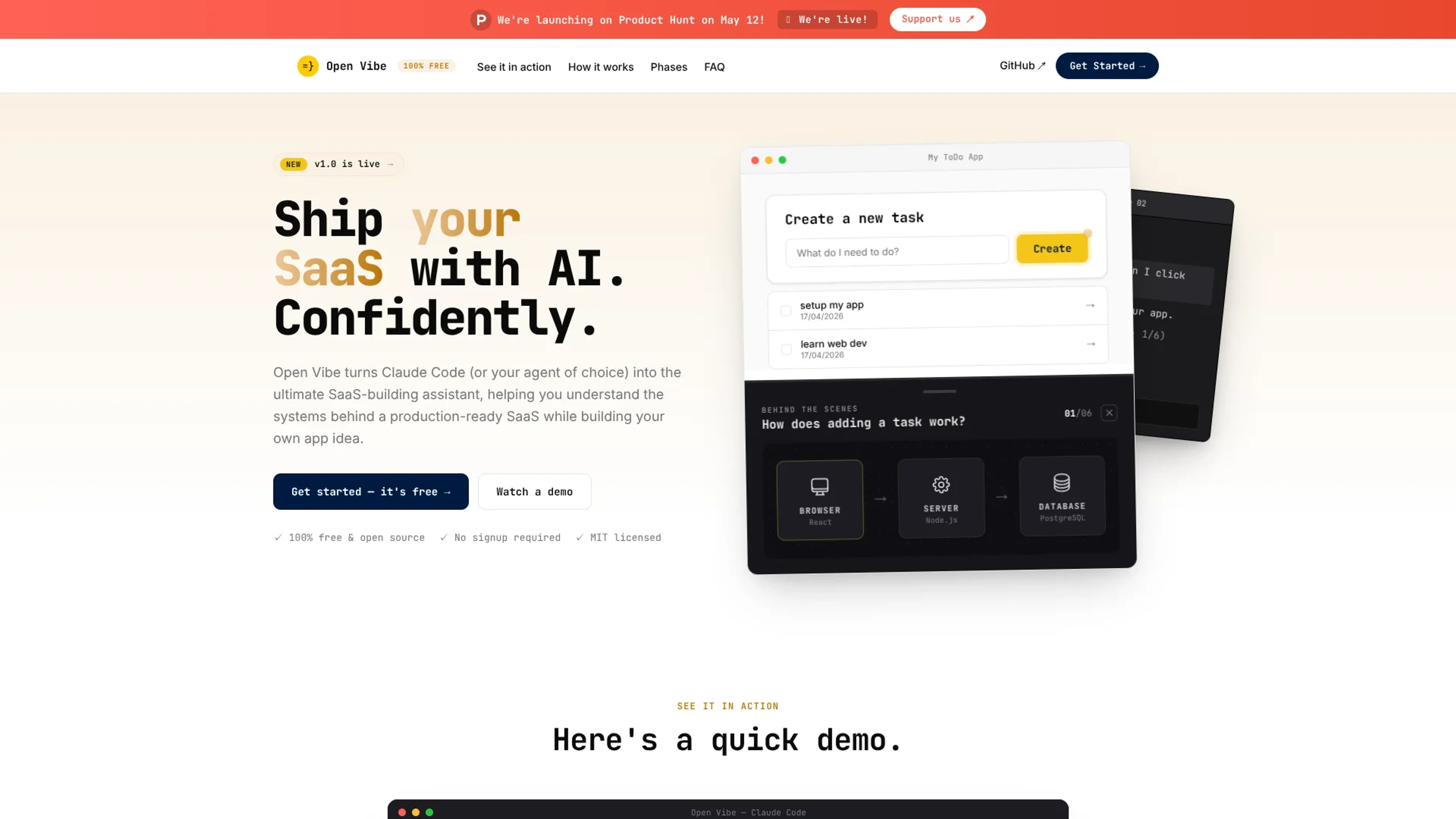
Open Vibe helps builders ship production-ready SaaS apps with an AI coding agent as a tutor. Instead of passive video courses or black-box “vibe coding,” it provides a structured curriculum, interactive diagrams, and a production SaaS template that run alongside agents like Claude Code or Cursor. Learners build real web apps on their own machine while the agent explains how each part of the stack works.
Key Features:
Agent-native curriculum: A single install prompt loads Markdown lessons, skills, and instructions directly into a compatible AI agent so it can guide SaaS development step by step.
Interactive “behind the scenes” diagrams: Live overlays show browser, server, and database flows for the user’s running app, with clickable nodes that trigger targeted explanations from the agent.
Open SaaS starter template: A production-grade template with auth, payments, admin, email, blog, and AI hooks, MIT-licensed and ready for customization and launch.
Phase-based course structure: Phases for web app basics and SaaS-building on Open SaaS, with clearly labeled available modules and upcoming content so users can pick a starting point that fits their level.
Pros
Free and MIT-licensed: No course fees, no platform lock-in, and full remix rights for individuals or classrooms.
System-oriented learning: Focuses on architecture, data flow, and SaaS patterns rather than only isolated code snippets.
Local-first workflow: Everything runs on the user’s machine, using their preferred agent and API key, which helps avoid surprise usage limits.
Real, deployable outcomes: Learners finish with an actual SaaS app they can deploy and charge for, not a throwaway tutorial project.
Cons
Requires an external AI tool: Users must bring a compatible agent subscription or key, which may add cost elsewhere.
Developer-style environment: Terminal use, local setup, and basic comfort with tooling can be a hurdle for non-technical learners.
Incomplete later modules: Some advanced modules are still marked as “coming soon,” so the path beyond the current content is evolving.
Who is Using Open Vibe?
Aspiring SaaS Founders: Using it to turn ideas into first subscription products while learning modern web app architecture.
Indie Hackers and Solo Developers: Accelerating the build of niche tools on top of the Open SaaS template.
Professional Software Engineers: Exploring structured AI-assisted workflows for full-stack development and deployment.
Coding Bootcamps and Educators: Treating it as an open curriculum to teach AI-assisted web development and SaaS fundamentals.
Uncommon Use Cases: Adopted by internal product teams for onboarding juniors into a common stack; used by community-led cohorts and study groups running guided “build a SaaS in X weeks” programs.
Pricing:
Free Tier: Open Vibe is currently free to use, with all course materials, diagrams, and the Open SaaS template available under the MIT license.
Paid Tiers: No official paid plans or upgrades are publicly listed at this time.
Disclaimer: Please note that pricing information may not be up to date. For the most accurate and current pricing details, refer to the official Open Vibe website.
What Makes Open Vibe Unique?
Open Vibe treats the AI agent as a co-instructor that follows a designed curriculum, not just a chat box that reacts to ad hoc prompts. By combining agent-native lessons, live architecture diagrams over a real running app, and a production-ready SaaS template, it helps learners understand how modern SaaS systems fit together while they actually ship something they can put in front of customers.
How We Rated It:
Accuracy and Reliability: 4.6/5
Ease of Use: 4.2/5
Functionality and Features: 4.4/5
Performance and Speed: 4.8/5
Customization and Flexibility: 4.7/5
Data Privacy and Security: 4.5/5
Support and Resources: 4.0/5
Cost-Efficiency: 5.0/5
Integration Capabilities: 4.3/5
Overall Score: 4.5/5
Open Vibe For AI SaaS Builders: Free, Local, And Surprisingly Practical
Open Vibe gives learners and builders a structured way to combine AI coding agents with a serious SaaS stack. Those comfortable with a terminal and curious about AI-assisted development get a guided path from “what happens when I click this button” to understanding real browser–server–database interactions, plus a template ready for payments and auth. For founders, indie hackers, and instructors who care about both shipping and understanding, it offers a rare mix of depth, practicality, and price that is hard to argue with.