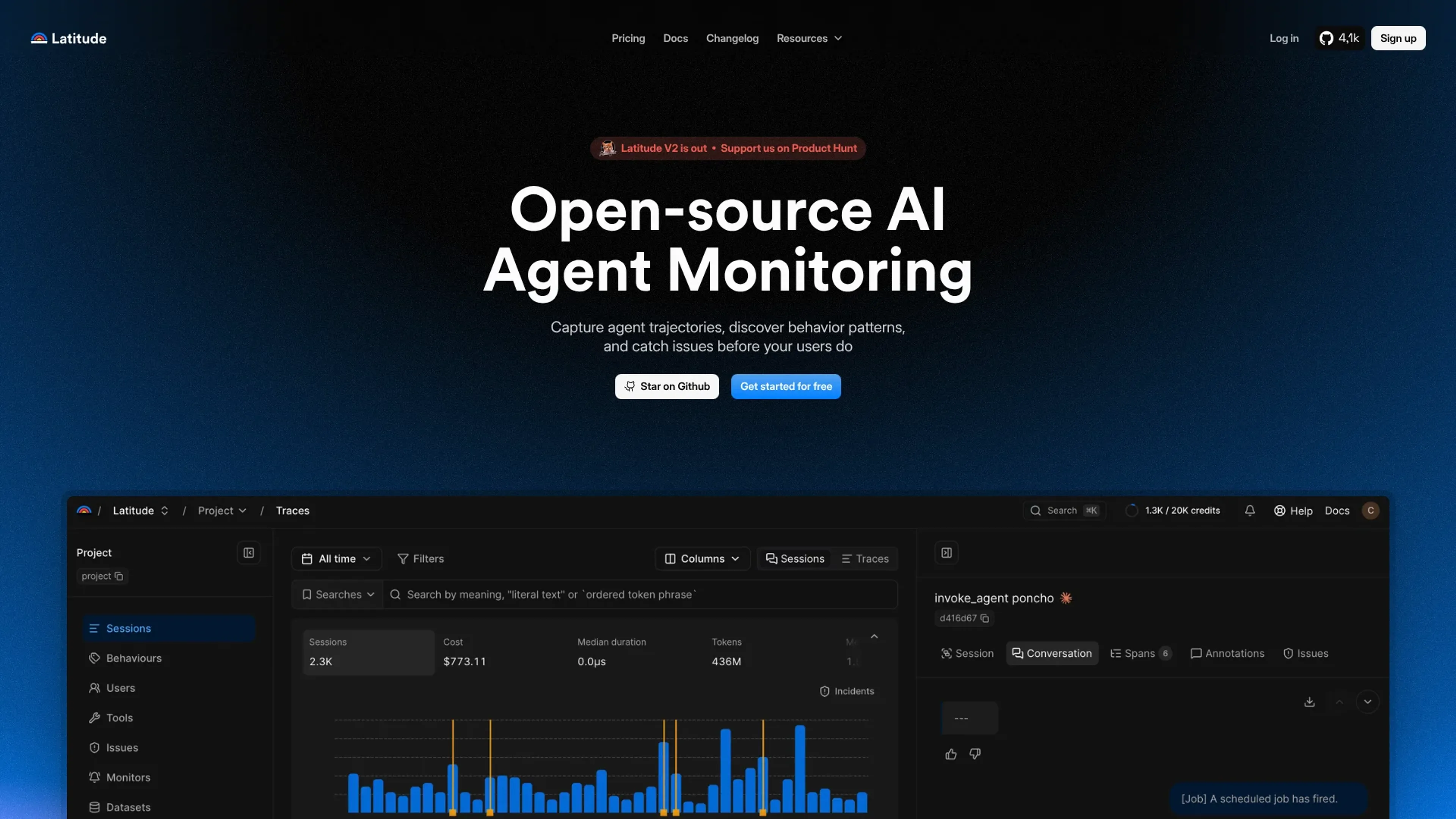
Latitude is an open-source agent observability platform for teams running AI and LLM-based agents in production. It captures rich, agent-native traces across sessions, tool calls, and reasoning steps, then turns live traffic and human judgment into scores, issues, and evals so teams can see what is breaking and why. It is aimed at engineering, product, and reliability teams that need a closed-loop system to monitor, evaluate, and continuously improve agents after they ship.
Key Features:
Agent-Native Observability: Records full multi-step traces with tool calls, reasoning turns, inputs, outputs, errors, and token usage so engineers can pinpoint exactly where an agent run failed.
Conversation Intelligence: Analyzes completed sessions to classify what the conversation was about and flag events like escalations, resolutions, abandonments, retries, trust breaks, and tool failures.
Session Search and Advanced Filters: Offers semantic search across 100% of traces, combined with exact text and metadata filters to quickly isolate specific cohorts and behaviors.
Automatic Issue Discovery and Failure Clustering: Groups similar failing traces into named issues with examples, trends, affected users, and lifecycle states, plus alerts over Slack, email, or webhooks.
Automated Evals and Golden Datasets: Converts discovered issues and human annotations into evaluations that run on every new trace, while automatically building versioned “golden” datasets from validated production traffic.
OpenTelemetry and MCP Integration: Accepts OpenTelemetry traces from existing pipelines and exposes an MCP server plus a coding-agent skill so developers and agents can manage projects, traces, issues, and datasets programmatically.
Pros
Open-source and MIT-licensed: Teams can self-host Latitude and inspect the code without vendor lock-in.
Built for agents, not generic APIs: Multi-step traces, reasoning visibility, and issue workflows match how modern AI agents actually behave.
Closed-loop reliability workflow: Observability, annotations, failure clustering, and eval generation are connected into a single improvement loop.
Strong security posture: SOC 2, encryption, SSO/SAML, GDPR tooling, data residency, and audit logs support enterprise security requirements.
Flexible deployment: Can run as managed cloud or be self-hosted for teams that want full data control.
Cons
Conceptual overhead: Traces, scores, issues, evals, and datasets form a rich model that can feel heavy for small or early experiments.
Infrastructure burden when self-hosted: Running the full open-source stack adds operational work compared to using only a hosted SaaS tool.
Most value for complex agents: Simple single-call LLM endpoints may not benefit as much from the deeper agent-centric tooling.
Who is Using Latitude?
CTOs and heads of engineering: Use Latitude to get production visibility into AI agents before scaling traffic and headcount.
ML and AI engineers: Instrument agents with OpenTelemetry, debug failures in traces, and iterate on tools and prompts using issue and eval feedback.
Product and reliability teams: Track conversation outcomes, escalations, and recurring failure modes to prioritize reliability work.
Data scientists and eval specialists: Turn human annotations and production examples into eval suites and regression tests.
Security and compliance teams: Rely on SOC 2, audit logs, and data residency features when approving observability for regulated workloads.
Uncommon Use Cases: Mining user research insights from conversation intelligence and search; letting coding agents use the MCP server to automatically triage issues and manage observability configuration.
Pricing:
Starter: Free; includes 20,000 credits per month, 30-day data retention, unlimited seats, and general Slack support.
Pro: $99 per month; includes 100,000 credits per month, 90-day data retention, unlimited seats, SOC 2 and ISO 27001 reports, priority support, and extra credits at $20 per 10,000 credits.
Enterprise: Custom pricing; includes custom credit volume, custom data retention, custom cloud deployment, RBAC, team training, SAML SSO, SOC 2 and ISO 27001 reports, SLA, and dedicated support.
Disclaimer: Please note that pricing information may not be up to date. For the most accurate and current pricing details, refer to the official Latitude website.
What Makes Latitude Unique?
Latitude stands out by combining an agent-first observability model with an opinionated reliability loop, all in an MIT-licensed OpenTelemetry-native stack. It does more than log calls: it turns production traces and human annotations into clustered issues, eval scripts, and golden datasets that run continuously on real traffic. Few tools offer that depth of agent-native insight plus both managed cloud and self-host options anchored in the same open-source core.
How We Rated It:
Accuracy and Reliability: 4.3/5
Ease of Use: 4.1/5
Functionality and Features: 4.6/5
Performance and Speed: 4.2/5
Customization and Flexibility: 4.0/5
Data Privacy and Security: 4.7/5
Support and Resources: 3.8/5
Cost-Efficiency: 4.4/5
Integration Capabilities: 4.1/5
Overall Score: 4.2/5
Latitude As An Agent-Native Reliability Loop For Production AI:
Latitude gives teams building serious AI agents a practical way to see what their agents are doing, understand where they fail, and turn that insight into evals and datasets that guard against regressions. It asks for some upfront thinking about concepts and deployment, especially for self-hosted setups, but repays that with deep visibility and control. Teams scaling multi-step agents in production will get the most value, particularly if they want open-source flexibility with enterprise-grade controls.