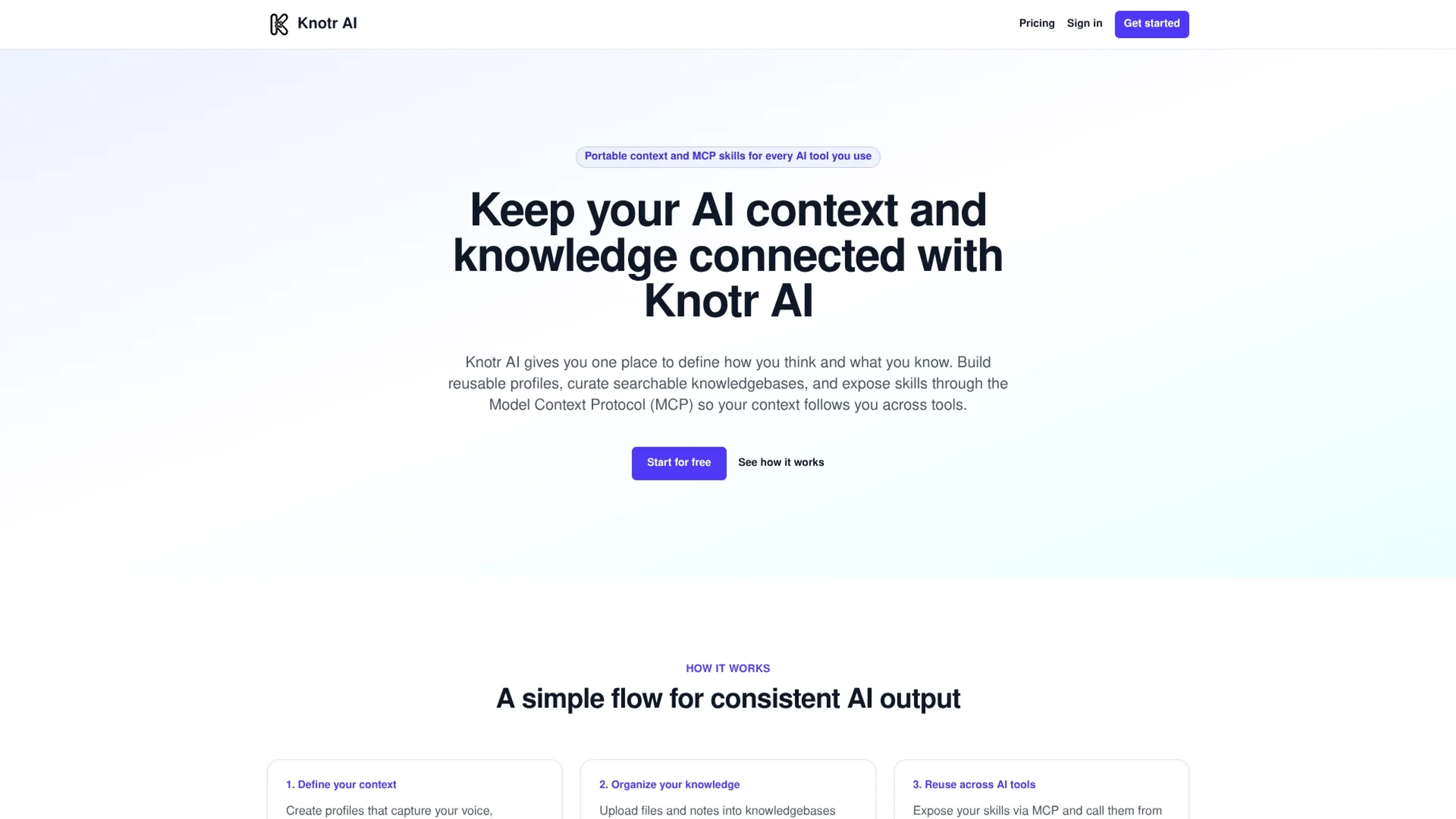
Knotr AI focuses on one specific problem: keeping AI context and knowledge consistent across every AI tool a person or team uses. It acts as a central context layer where users define profiles, store documents in searchable knowledgebases, and package repeatable workflows as skills that can be called through the Model Context Protocol (MCP). Instead of rebuilding prompts and instructions per app, users configure them once and reuse them with compatible clients like Claude and Cursor.
Key Features:
Profiles and Personas: Create multiple profiles that capture tone of voice, style, and constraints for different roles or projects so AI output matches the intended persona each time.
Semantic Knowledgebases: Upload notes and documents into organized knowledgebases that can be searched semantically when skills run, giving AI access to richer context without manual copy paste.
Reusable MCP Skills: Package prompts, parameters, and workflows as reusable skills that can be exposed over MCP and called from any compatible AI client, so the same capabilities are available across tools.
Team Workspaces and Changelogs: Share skills and knowledgebases in a team workspace with built in changelogs that show who changed what and when, without needing Git repositories or pull requests for prompt updates.
Built in AI Assistant for Skill Design: Refine skills directly in the browser with an assistant that helps adjust prompts before sharing them with the team or exposing them to external tools.
Pros
Consistent AI behavior across tools: One source of truth for profiles, rules, and knowledge reduces surprise differences between ChatGPT, Claude, Cursor, and others.
Less repetitive setup work: Users no longer need to re-upload the same documents or rewrite instructions for each new AI app they test.
Team collaboration without Git overhead: Non-technical team members can propose and refine skills without touching branches or repos, which is refreshing for prompt work.
Granular control over exposure: Context and skills can stay private, be shared within a workspace, or be exposed selectively through MCP, which suits teams with stricter access patterns.
Cons
Best value with MCP compatible tools: Users who mostly work in AI apps without MCP support will not get the full portability story yet.
Another control panel in the stack: Teams already juggling multiple dev tools and dashboards may feel some initial friction adding a separate context hub.
Document limits on lower tiers: Heavy document users may outgrow the Free or Pro document caps fairly quickly and need to move up a tier.
Who is Using Knotr AI?
AI Engineers and Prompt Engineers: Standardizing prompts, profiles, and skills across internal tools and IDEs.
Software Teams Using Cursor or Claude Code: Keeping rules, project instructions, and MCP skills consistent across developer machines. (knotr.ai)
Consultancies and Agencies: Packaging repeatable client workflows as skills that can be reused project after project.
Knowledge Heavy Solo Professionals: Lawyers, researchers, or analysts keeping personal knowledgebases and instructions aligned across multiple AI assistants.
Uncommon Use Cases: Internal enablement teams building a “house style” of AI usage for non-technical staff; educators running prompt-engineering labs where students call the same shared skills from different AI tools.
Pricing:
Free: $0 per month. Includes 1 Profile, 10 Skills, and 50 Documents.
Pro: $24 per month, or $20 per month billed annually. Includes 5 Profiles, 75 Skills, and 500 Documents.
Max: $49 per month, or $40 per month billed annually. Includes Unlimited Profiles, Unlimited Skills, and 5,000 Documents.
Team: $25 per user per month (3-user minimum). Includes Unlimited Profiles and Skills, 1,000 Documents per user, shared and private knowledge and skills, and built-in changelogs.
Disclaimer: Please note that pricing information may not be up to date. For the most accurate and current pricing details, refer to the official Knotr AI website.
What Makes Knotr AI Unique?
Knotr AI takes MCP seriously as its native distribution channel, treating skills as first class objects that can travel between clients while staying tied to shared profiles and knowledgebases. Its Git free collaboration model is friendly to non developers while still keeping a proper history of changes. Rather than being yet another agent builder, it concentrates on the context and instruction layer that all agents and assistants rely on, which feels surprisingly powerful for teams that constantly bounce between multiple AI tools.
How We Rated It:
Accuracy and Reliability: 4.4/5
Ease of Use: 4.6/5
Functionality and Features: 4.5/5
Performance and Speed: 4.5/5
Customization and Flexibility: 4.4/5
Data Privacy and Security: 4.2/5
Support and Resources: 4.0/5
Cost-Efficiency: 4.6/5
Integration Capabilities: 4.3/5
Overall Score: 4.4/5
Knotr AI As A Single Source Of Truth For AI Context
Knotr AI offers a focused way for individuals and teams to define how they want AI to think, talk, and reference internal knowledge, then reuse that context consistently wherever MCP can reach. For builders juggling multiple assistants, IDEs, and agents, centralizing profiles, documents, and skills in one place reduces repetition and makes context updates propagate everywhere at once. The experience is especially appealing for small teams that want structured AI workflows without maintaining a dedicated prompts repository, making Knotr AI a convincing candidate for the “context backbone” of modern AI stacks.