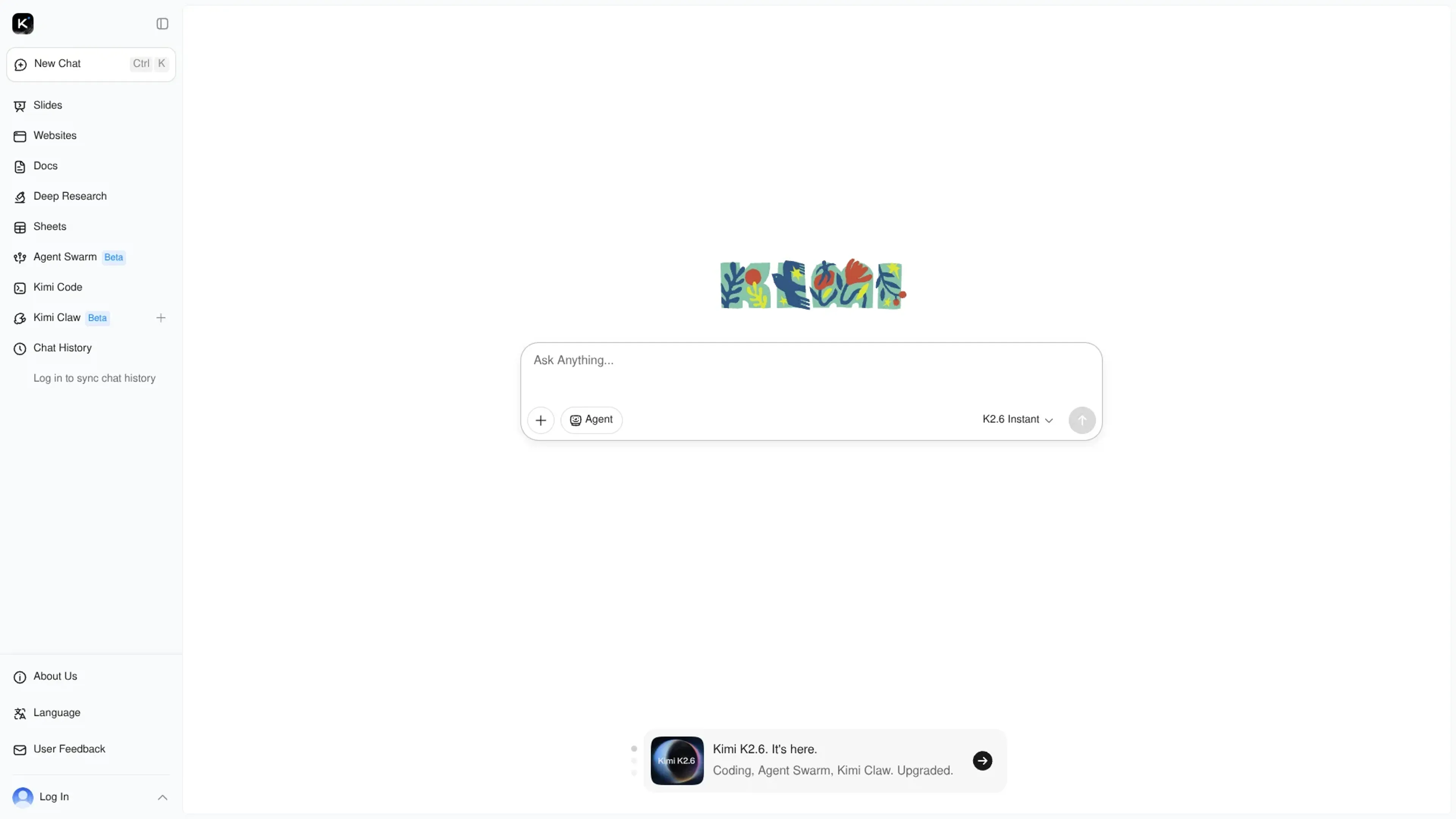
Kimi is a multimodal AI assistant and agent platform from Moonshot AI, aimed at coding, research, and workflow automation. The current K2.6 model is open-weight, supports 256K‑token context windows, and drives long-horizon, swarm-based agents plus productivity tools for documents, data, and web content.
Key Features:
Agent Swarm Orchestration: Coordinates multi-step workflows with large numbers of sub-agents and long execution horizons for monitoring, coding, and other operational tasks.
Code Agent: Kimi Code is a code-focused assistant for IDE and terminal use, supporting multi-file edits, refactors, and repository-scale reasoning.
Productivity Tool Suite: Built-in Docs, Sheets, Slides, website builder, and Kimi Claw agents support everyday content creation and automation without extra infrastructure.
Open-Weight Model & API: K2.6 is released as an open-weight model while also available via a token-priced API that uses cache-aware billing for repeated context.
Pros
Strong Coding Performance: Competitive results on coding and reasoning benchmarks suitable for real engineering tasks.
Serious Agent Capabilities: Swarm agents can monitor systems, iterate on code, and run complex workflows with many coordinated steps.
Rich Built-in Tools: Non-coders gain value from document, slide, and website builders plus Claw-style agents.
Flexible Consumption: Free entry tier, scalable membership plans, and pay-as-you-go API pricing suit different usage levels.
Cons
Billing Complaints: Some users report confusing cancellation flows and unexpected renewals or promo behavior.
Feature Overload: Advanced agent and coding options can be intimidating for casual or purely chat-focused users.
Regional Gaps: Experience and support still lean toward early Chinese and English markets, so localization can feel uneven elsewhere.
Who is Using Kimi?
Software Engineers & DevOps Teams: Automating refactors, debugging sessions, CI tasks, and log or incident monitoring via agents.
Data Scientists & ML Engineers: Generating analysis code and wiring agents into data pipelines and experiment workflows.
Product Managers & No-Code Builders: Prototyping AI-driven features, internal tools, and customer-facing agents using builder-style interfaces.
Researchers & Analysts: Running deep research, digesting long PDFs, and maintaining living knowledge hubs with long-context chat.
Uncommon Use Cases: Indie game studios automating build/QA pipelines; compliance teams tracking vendor policy changes with scheduled agents.
Pricing:
Adagio (Free): $0 per month for basic long-context chat, light agent use, and one concurrent task.
Moderato: $19 per month; more agent credits, agent multi-tasking, Kimi Code access, and Slides visual mode.
Allegretto: $39 per month; 2x agent credits, agent multi-tasking, 5x Kimi Code credits, Slides visual mode, and added research preview features.
Allegro: $99 per month; 5x agent credits, agent multi-tasking, 15x Kimi Code credits, Slides visual mode, and added research preview features.
Vivace: $199 per month; 10x agent credits, agent multi-tasking, 60x Kimi Code credits, Slides visual mode, and added research preview features.
Disclaimer: Please note that pricing information may not be up to date. For the most accurate and current pricing details, refer to the official Kimi website.
What Makes Kimi Unique?
Kimi’s mix of open-weight, long-context models with a polished, consumer-facing agent product is unusual: builders can self-host or use the API, while less technical teams still get powerful swarms, code agents, and content builders inside one coherent environment.
How We Rated It:
Accuracy and Reliability: 4.6/5
Ease of Use: 4.0/5
Functionality and Features: 4.8/5
Performance and Speed: 4.5/5
Customization and Flexibility: 4.4/5
Data Privacy and Security: 3.9/5
Support and Resources: 3.8/5
Cost-Efficiency: 4.3/5
Integration Capabilities: 4.2/5
Overall Score: 4.3/5
Kimi Turns Open Agentic Models Into Everyday Tools:
Kimi currently suits developers, technical teams, and knowledge workers who want more than simple chat. Those willing to invest in the stronger tiers gain unusually capable coding agents and automation, while still benefiting from an open-weight model they can experiment with or deploy in other environments.