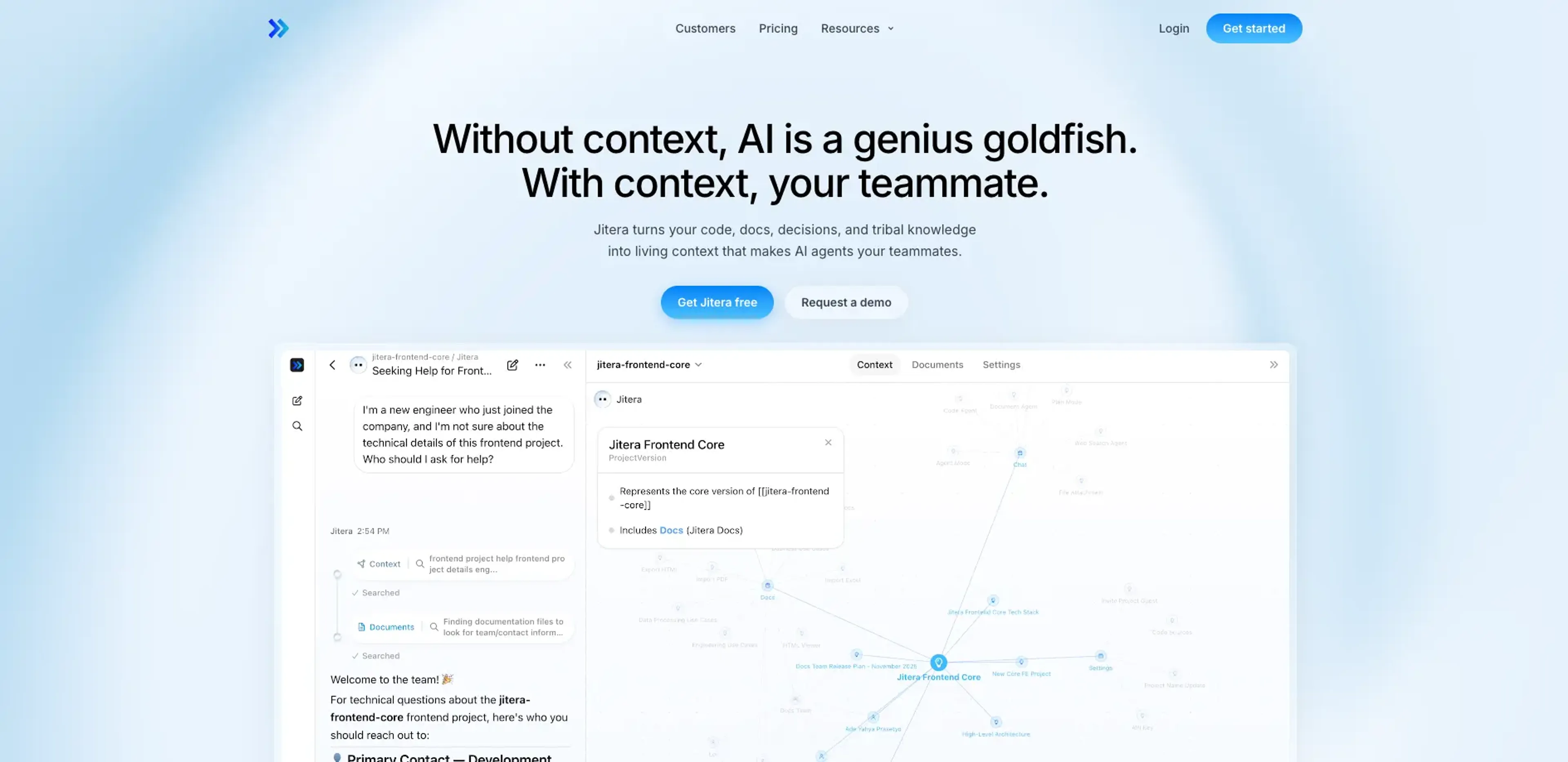
Jitera is an AI workspace where teams collaborate with AI agents that actually know how the organization works. It turns code, documents, decisions, and tribal knowledge into shared context, so agents and humans work from the same source of truth. Instead of every person running isolated chats, Jitera keeps conversations, automations, and documents together, so AI behaves more like a knowledgeable teammate than a one-off tool.
Key Features:
Shared context map: Visual graph of teams, projects, decisions, and resources that agents use to stay aligned with organizational structure.
Team-in-the-loop agents: Agents follow chat threads, co-edit docs, and ask humans for confirmation before acting, reducing bad guesses and surprises.
Multi-LLM custom agents: Support for leading models such as GPT, Claude, and Gemini, with per-agent instructions, tools, and skills.
Automations and integrations: Recurring workflows, multi-step pipelines, and connections to tools like GitHub, Notion, Linear, Jira, and Slack.
Pros
Shared memory across the company: Helps teams avoid duplicate prompts, conflicting drafts, and lost AI outputs in random chats.
Strong collaboration story: Real-time threads with humans and agents together make AI outputs visible and reviewable by the whole team.
Flexible agent design: Per-agent models, skills, and permissions help match different workflows, from coding to ops.
Credit-based scaling: Free tier for trials, then higher tiers with more credits per seat as usage grows.
Cons
Credit model adds complexity: Teams must keep an eye on credits and per-seat usage.
Relies on good knowledge setup: Poorly structured or outdated docs will limit agent quality.
Younger ecosystem: Fewer long-running case studies than some older collaboration products.
Who is Using Jitera?
Product and engineering teams: Using agents for specs, code-aware discussions, and keeping decisions linked to repos and tickets.
Customer support and success teams: Drafting replies, summarizing conversations, and consulting policies stored in the workspace.
Operations and project managers: Automating recurring check-ins, updates, and status documents across multiple tools.
Consultancies and agencies: Standardizing research, deliverables, and approvals across client projects.
Uncommon Use Cases: Adopted by compliance or risk teams to keep decision trails auditable; used by HR or enablement teams to answer employee questions from up-to-date internal knowledge.
Pricing:
Free: $0 per month. Includes AI chat, custom agents, context memory, limited AI models, agent automations, agent skills, real-time collaboration, app integration, 15 credits, up to 1 team, up to 3 members, and two-factor authentication.
Pro: $40 per seat per month. Includes everything in Free, plus unlimited frontier AI models, Jitera API / MCP server access, 1,000 credits per seat per month, up to 10 teams, and unlimited members.
Max: $100 per seat per month. Includes everything in Pro, plus Plan mode, 2,500 credits per seat per month, and unlimited teams.
Enterprise: Custom pricing. Includes everything in Max, plus dynamic document, audit log, AI model access control, single sign-on, IP restriction, organization usage analytics, self-host support, custom AI model residency, custom credits on demand, and dedicated support.
Disclaimer: Please note that pricing information may not be up to date. For the most accurate and current pricing details, refer to the official Jitera website.
What Makes Jitera Unique?
Jitera leans hard into shared context rather than isolated chats. Its context map and resource system turn organizational memory into a living graph that every agent can use, which is pretty cool for avoiding repeated work and inconsistent outputs. Human approval is built into agent behavior, so teams keep control while still gaining automation. Combined with multi-LLM support and agent-to-agent workflows, it targets serious team use rather than solo prompting.
How We Rated It:
Accuracy and Reliability: 4.4/5
Ease of Use: 4.2/5
Functionality and Features: 4.6/5
Performance and Speed: 4.4/5
Customization and Flexibility: 4.5/5
Data Privacy and Security: 4.2/5
Support and Resources: 4.0/5
Cost-Efficiency: 4.3/5
Integration Capabilities: 4.4/5
Overall Score: 4.3/5
Smart Team Collaboration With Context-First AI Agents:
Jitera gives organizations a shared AI workspace where context is treated as a first-class asset, not an afterthought. Teams that already experiment with AI but feel scattered gain a central place to chat with agents, keep documents aligned, and automate repeatable work. For groups serious about agents that respect organizational history, structure, and approvals rather than one-off prompts, it presents a thoughtful, future-facing option.