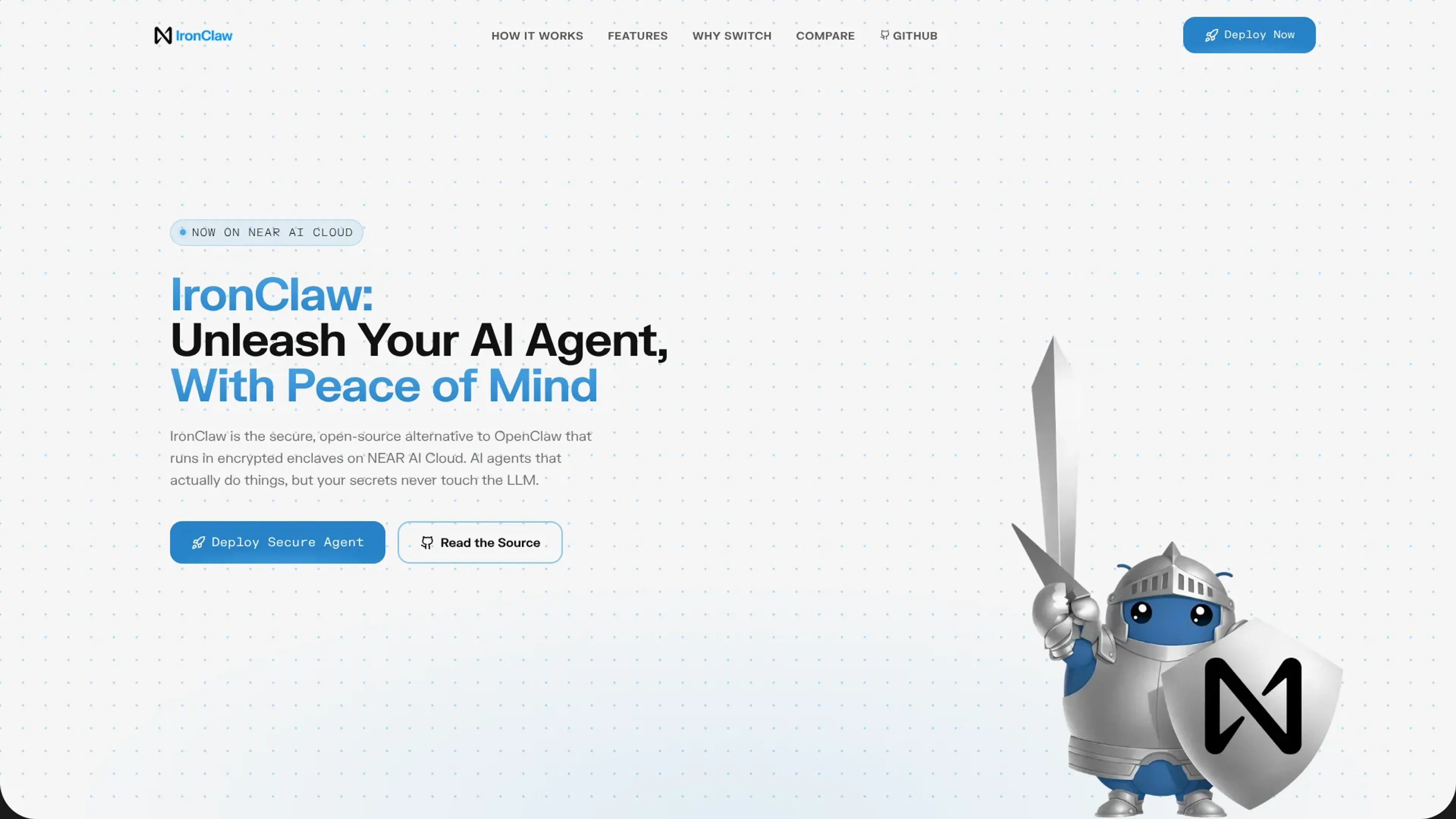
IronClaw focuses on running AI agents that can touch real systems without putting secrets at risk. Built on NEAR AI Cloud and Rust, it wraps OpenClaw-style personal agents in encrypted enclaves, WebAssembly sandboxes, and an encrypted credential vault. The headline idea is simple: agents can browse, code, and automate while API keys, tokens, and passwords never become LLM-visible text.
Key Features:
Encrypted credential vault: Stores API keys, tokens, and passwords encrypted at rest, injecting them only at the network boundary for explicitly allowlisted endpoints.
Trusted Execution Environment (TEE): Each IronClaw instance boots inside a hardware-backed encrypted enclave on NEAR AI Cloud, protecting data in memory from the host and provider.
WebAssembly tool sandboxing: Every tool runs in its own Wasm container with capability-based permissions, no filesystem access, strict resource limits, and constrained outbound networking.
Leak detection for secrets: Outbound traffic is scanned in real time, and anything that resembles credential exfiltration is blocked before it reaches the internet.
Rust-based runtime: The entire runtime is written in Rust, avoiding classes of memory bugs like buffer overflows and use-after-free, and skipping a garbage collector.
OpenClaw compatibility and simple deploy: Offers the same agent capabilities as OpenClaw with one-click deployment on NEAR AI Cloud or local runs, plus open-source code on GitHub.
Pros
High-assurance secret handling: Secrets never appear in prompts or tool outputs, which sharply reduces prompt-injection risk around credentials.
Defense-in-depth model: Combines vault, TEE, sandboxing, network allowlists, and leak detection instead of relying on LLM instructions like “please do not leak this.”
Developer friendly for serious agents: Lets developers keep familiar workflows such as browsing, research, coding, and automation while tightening security around sensitive APIs.
Open source and auditable: Source code availability invites external review, customization, and easier compliance conversations.
Scales from experiments to production: From a single agent to multiple high-usage agents with large monthly token allowances, all in the same security model.
Cons
Rust and Wasm centric stack: Teams heavily invested in TypeScript or Python may face extra overhead adapting tools to the Rust/Wasm model.
Cloud dependence for managed security: The easiest path runs on NEAR AI Cloud, which may not suit organizations locked into other providers.
Younger ecosystem: Compared with older agent platforms, there are fewer community skills and integrations, so early adopters may build more pieces themselves.
Who is Using IronClaw?
Security-conscious AI developers: Building agents that call production APIs, financial systems, or internal services where credential exposure is unacceptable.
Platform and DevOps teams: Providing company-wide AI assistants while keeping strict guardrails around infrastructure and internal tools.
Fintech and healthtech companies: Experimenting with agentic workflows on regulated or sensitive data while still respecting compliance and risk constraints.
Research labs and data teams: Running exploratory agents over proprietary datasets while reducing exposure to model providers and third parties.
Uncommon Use Cases: Used by red-team and security researchers to prototype exfil-resistant agent setups; adopted by solo founders who want “serious” security without standing up their own enclave stack.
Pricing:
Starter: $0 per month. Activate 1 agent instance in a secure TEE environment and pay per usage token using NEAR AI Inference.
Basic: $20 per month. Includes everything in Starter, plus credits for up to 2 agent instances and roughly 13 million tokens with usage pooling.
Pro+: $200 per month. Includes everything in Basic, supports up to 5 agent instances, around 130 million tokens, and priority support.
Self-hosted: Open-source code can be deployed on a team’s own infrastructure, with costs determined by underlying cloud and operations choices.
Disclaimer: Please note that pricing information may not be up to date. For the most accurate and current pricing details, refer to the official IronClaw website.
What Makes IronClaw Unique?
IronClaw separates “what the agent can do” from “what the agent can see” in a much stricter way than typical agent platforms. Credentials stay locked in a vault inside a TEE, tools are tightly sandboxed in Wasm, and outbound requests are gated by both allowlists and leak detection. That combination of hardware-backed isolation, Rust safety guarantees, and focused secret-handling for LLM agents gives teams a security story that feels closer to traditional production systems than experimental side projects.
How We Rated It:
Accuracy and Reliability: 4.6/5
Ease of Use: 4.0/5
Functionality and Features: 4.5/5
Performance and Speed: 4.3/5
Customization and Flexibility: 4.2/5
Data Privacy and Security: 4.9/5
Support and Resources: 4.1/5
Cost-Efficiency: 4.4/5
Integration Capabilities: 4.0/5
Overall Score: 4.3/5
Serious Security For AI Agents That Touch Real Systems:
IronClaw suits teams who like the idea of autonomous or semi-autonomous agents but are uneasy about handing an LLM the keys to production. By anchoring agents in TEEs, Rust, and Wasm sandboxes, then wrapping them with encrypted vaults, network allowlists, and leak detection, it turns “agents that actually do things” into something closer to an auditable service than a risky experiment. For anyone planning agents that talk to real APIs with real money or real data on the line, IronClaw earns a close look.