
Cyvl.ai
Revolutionize infrastructure management with AI-powered, precise mapping tools.
Key Takeaways
- What it is
- Revolutionize infrastructure management with AI-powered, precise mapping tools.
- Best for
- Automated Pavement Condition Assessments
- 360° Streetview Imagery
- LiDAR Scanning
- Rating
- 4.6/5
What is Cyvl.ai?
Cyvl.ai is a cutting-edge platform designed to revolutionize the management of transportation infrastructure through AI-powered mapping. By partnering with engineering firms and governments, Cyvl.ai provides tools to map, measure, and inspect the physical world with unprecedented efficiency and accuracy. This technology empowers users to make fast, data-driven decisions that are crucial for building and maintaining robust transportation networks.
Cyvl.ai stands out with its integration of AI with LiDAR technology and 360° imagery, offering a comprehensive view of the physical world that is unparalleled in the industry. Its ability to provide actionable insights with rapid turnaround times sets it apart from traditional methods.
Cyvl.ai excels in transforming the management of transportation infrastructure with its advanced AI-driven mapping solutions. It is an indispensable tool for engineers, urban planners, and government officials alike. Its robust features, including automated assessments and comprehensive imagery, offer significant advantages in terms of efficiency and accuracy, making Cyvl.ai a leader in its field
Who is Using Cyvl.ai?
Engineering Firms
Trusted by industry leaders for comprehensive infrastructure analysis.
Government Agencies
Employed by government bodies to oversee and upgrade transportation systems efficiently.
Urban Planners
Used by planners for detailed urban and regional development projects.
Environmental Consultants
Utilized for environmental impact assessments and sustainability studies.
Uncommon Use Cases
Adopted by academic institutions for research purposes; utilized by emergency management agencies for disaster response planning.
Key Features
Rating Breakdown
Pricing Plans
Enterprise Solutions
- Custom pricing based on the scope and scale of the project
Cyvl.ai Use Cases
Pavement and roads
Assess network-wide road condition and prioritize paving work using objective pavement scores.
Outcome: A defensible paving plan.
Sidewalks and ADA
Capture sidewalk and curb-ramp conditions to support ADA transition planning.
Outcome: A defensible ADA transition plan.
Signs, markings, and assets
Locate and measure signs, pavement markings, drainage, streetlights, and other right-of-way assets.
Outcome: A complete asset inventory.
Capital planning and budgets
Build multi-year plans, budget scenarios, treatment strategies, and council-ready reports.
Outcome: Evidence-backed capital decisions.
Work orders and operations
Use condition data to prioritize repairs, draft work orders, and support crew operations.
Outcome: A path from infrastructure condition to dispatched work.
Workflow Ideas with Cyvl.ai
Scan, prioritize, and repair
- 1Mount the CYVL sensor rig on an existing city vehicle.
- 2Drive normal routes to capture roads, sidewalks, and visible assets.
- 3Use ranked condition data to prioritize repairs and generate work orders.
Build a multi-year paving plan
- 1Choose the planning horizon, annual budget, strategy, and treatment library.
- 2Paint projects, adjust treatments and years, and compare scenarios on the live map.
- 3Promote the approved scenario to execution and track planned versus actual work.
Create a council-ready infrastructure report
- 1Ask CYVL a plain-language question about network conditions or priorities.
- 2Use the report wizard to select scope, format, sections, and detail.
- 3Export the Executive Snapshot as PNG, PDF, or PPTX.
How Cyvl.ai fits into your stack
ArcGIS Integration
Seamlessly exports data into ArcGIS for further analysis.
Civil 3D Compatibility
Works with Civil 3D to enhance civil engineering projects.
Cartegraph Integration
Syncs with Cartegraph for asset management and maintenance.
Cloud-Based Platform
Ensures easy access and collaboration via a cloud data processing platform.
Pros
- +Time Efficiency: Accelerates field surveys by up to 50 times compared to traditional methods.
- +Cost-Effective: Reduces the financial burden of extensive manual labor and speeds up the data collection process.
- +Scalability: From small projects to extensive mapping efforts, Cyvl.ai's sensors adapt to various scales seamlessly.
- +Data Accuracy: Enhances decision-making with high-precision data and detailed geospatial infrastructure reports.
Cons
- −Initial Setup Requirement: Requires initial installation of sensors and setup, which might be challenging for some users.
- −Hardware Dependency: Reliant on specific hardware for data collection, which might limit flexibility in some scenarios.
- −Learning Curve: New users may need some time to fully leverage the platform's capabilities.
Limitations & when to consider alternatives
Known limitations
- Network-specific pricing. CYVL does not publish standard plan prices; pricing requires a demo or scoped pilot quote based on network size.
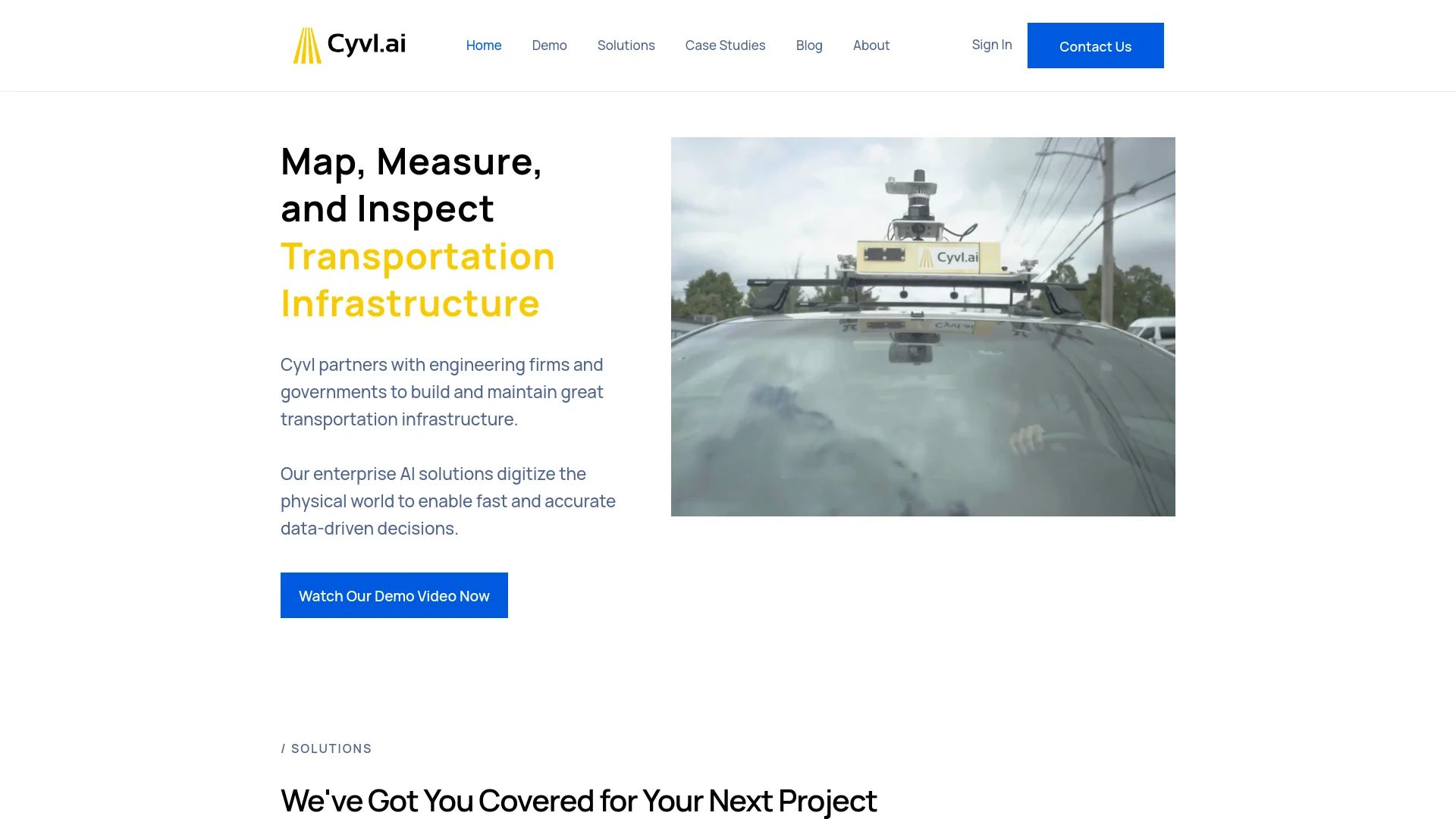
- Sensor deployment is required. The standard workflow requires mounting CYVL’s LiDAR, camera, and GPS sensor rig on an existing vehicle.
- MCP server is still in development. The platform page labels the MCP server as in development rather than shipped.
- Public demos are limited samples. Public city demos show downtown samples; a full-city capture requires a separate CYVL engagement.
Look elsewhere when
- You need a native mobile app for the municipal platform.
- You need a downloadable Windows, Mac, or Linux application.
- You need a browser extension.
How to Use Cyvl.ai
- 1
Explore the detailed user manuals and online resources provided on Cyvl.ai's website to get started and maximize the platform's potential.
Who is Cyvl.ai For?
Cities and towns
CYVL captures citywide roads, sidewalks, and assets in one pass for municipal infrastructure management.
Counties
Counties can account for infrastructure across hundreds of road miles and use the data for prioritization and accountability.
State DOTs
State transportation departments can use network-scale infrastructure data built to a consistent standard.
Public works teams
Public works staff can inspect conditions, prioritize repairs, create work orders, and plan budgets from one platform.
Frequently Asked Questions
Can CYVL be purchased without running a full RFP?
Yes. Eligible agencies can purchase CYVL through pre-competed cooperative and federal contract vehicles.
Do agencies need to purchase survey vehicles or hardware up front?
No. CYVL ships a self-install sensor rig that mounts on vehicles agencies already operate.
How is CYVL priced?
Pricing scales with network size rather than vehicle or crew count. Agencies request a demo or scoped pilot for a network-specific quote.
What can the AI Public Works Assistant produce?
It can answer infrastructure questions and generate reports, work orders, budgets, multi-year plans, and crew-routing recommendations.
Can municipalities upload their own data?
Yes. Municipalities can upload internal layers such as parcel information, income levels, and ZIP-code boundaries.
Who owns the collected infrastructure data?
The agency owns its infrastructure data, can export it, and CYVL states that it does not sell the data.
Community reviews
Be the first to share your experience.
Sign in to leave a review for Cyvl.ai.
Cyvl.ai Alternatives
Looking for alternatives to Cyvl.ai? Here are similar tools in the same category:
Learn to Master Cyvl.ai
With Skill Leap courses
Get in-depth training on Cyvl.ai and 50+ other AI tools with our expert-led video courses.
Start 7-Day Free Trial