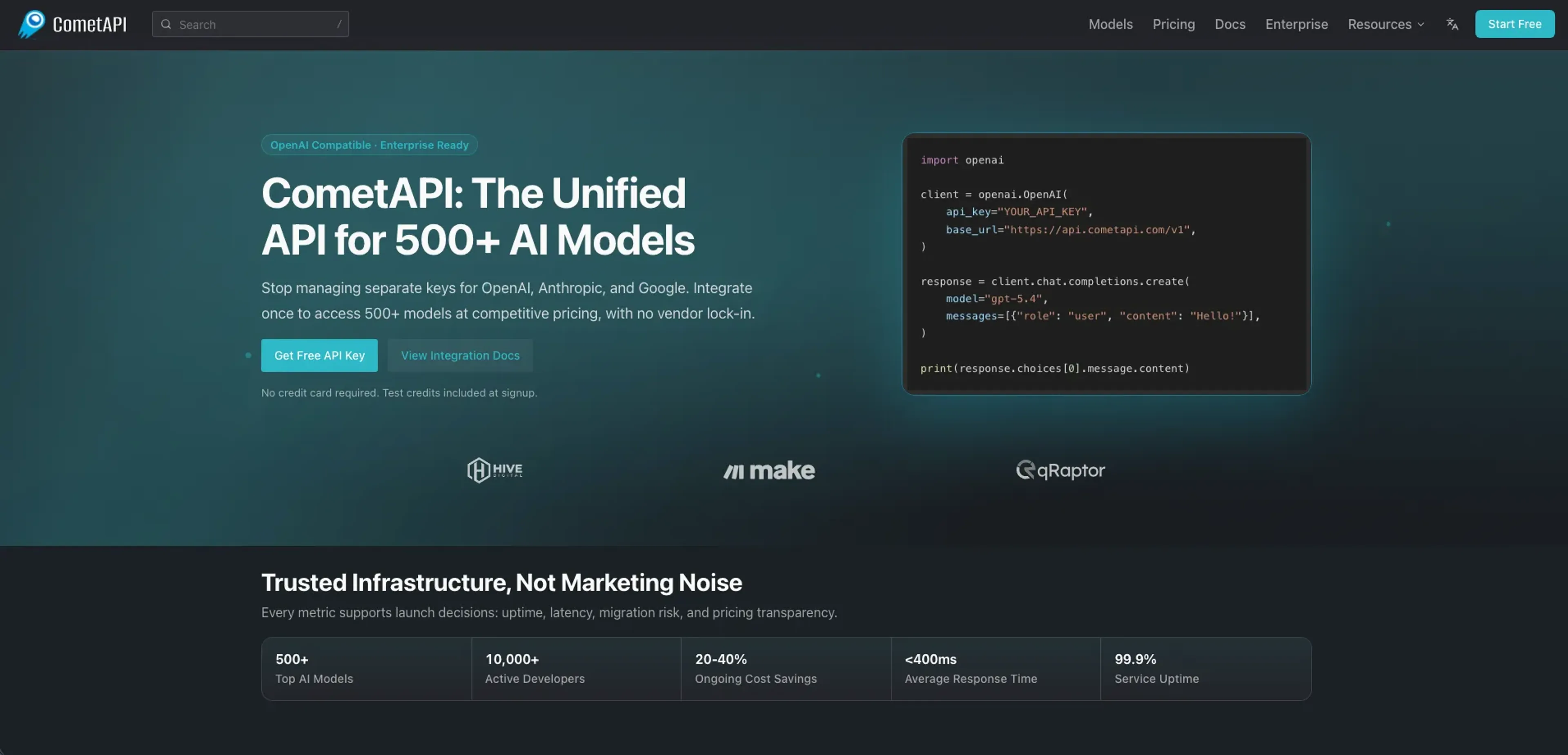
CometAPI is a unified AI API that lets developers call more than 500 text, image, audio, and video models from providers like OpenAI, Anthropic, Google, xAI, and others through a single OpenAI-compatible endpoint. It targets teams that already build on the OpenAI API pattern and want cheaper, multi-model access without rewriting application code or managing separate credentials, billing, and dashboards for every provider.
Key Features:
Unified OpenAI-Compatible API: Reuses existing OpenAI Chat Completions patterns and simply swaps the base_url and model name, so most client code stays unchanged.
500+ Model Catalog: Exposes hundreds of LLM, image, video, and audio models, including GPT‑5.6, Claude Opus 5, Gemini 3.x, Sora 2, Grok, and Nano Banana series.
Transparent Per‑Model Pricing: Shows side‑by‑side tables with unit price, official vendor price, and CometAPI’s discount for each model, starting at a minimum 20 percent off vendor rates.
Usage Analytics & Cost Controls: Offers a real‑time dashboard for spend, latency, and call volume, plus budget alerts and model comparisons for production monitoring.
Enterprise‑Grade Privacy: States that prompts and responses are not stored or logged, and that customer data is never used to train models, with encrypted transport and controllable request logging.
Tooling & Integrations: Includes playgrounds, SDK examples, and integrations with tools such as n8n, Zapier, Coze, Dify, and agent frameworks like CAMEL‑AI and Cline.
Pros
Low migration friction: OpenAI‑compatible endpoints let most existing codebases switch by changing only the base URL and model ID.
Consistent cost savings: Pricing is positioned 20–40 percent below official provider rates, with pay‑as‑you‑go credits and no subscription fee.
Production‑ready performance: Public claims of 99.9 percent uptime and sub‑400 ms average latency suit interactive apps and agents.
Good multi‑modal coverage: Text, image, video, and speech APIs sit behind the same auth model, which simplifies complex workflows.
Cons
Compliance still tied to providers: While CometAPI avoids logging prompts, upstream model vendors keep their own data policies that regulated teams must separately review.
Cloud‑only delivery: The marketing site and docs emphasize hosted API access, with no clear support for on‑premise or private‑cloud deployment.
Model choice remains manual: The platform surfaces pricing and metrics, but it does not advertise automatic routing based on latency or quality, so teams still need to test and pick models themselves.
Who is Using CometAPI?
SaaS and app developers: Add or swap AI features like chat, search, and media generation without tying the product to a single model vendor.
Enterprise platform teams: Centralize AI spend, enforce one API key pattern, and manage multi‑team budgets while keeping flexibility to change providers.
AI automation builders: Power n8n, Make, Zapier, and custom pipelines with different models for reasoning, images, and video in the same workflow.
Researchers and evaluators: Run side‑by‑side benchmarks of frontier models from multiple labs without juggling accounts or credentials.
Uncommon Use Cases: Content creators comparing how different models respond for educational demos; consultants building cost calculators that swap models behind a single client integration.
Pricing:
Free to Start: $0 upfront; no subscription, no minimum spend, free trial credits included with account signup
Pay-As-You-Go (Chat & Text): Usage-based billing; all models priced at least 20% below official provider rates, e.g. $0.60 per 1M tokens for Gemini 3.7 Flash, $1.60 per 1M tokens for Claude Sonnet 5, $8 per 1M tokens for Claude Fable 5
Pay-As-You-Go (Image): Per-image billing at 20% below official rates, e.g. $0.008 per image for FLUX 2 MAX, $0.06 per image for FLUX 2 PRO
Pay-As-You-Go (Video): Per-second billing at 20% below official rates, e.g. $0.064 per second for MiniMax H3, $0.136 per second for Flux 3
Pay-As-You-Go (Audio): Per-token billing at 20% below official rates, e.g. $2 per 1M tokens for GPT Audio 1.5, $12 per 1M tokens for TTS
Enterprise: Custom pricing; includes dedicated servers, custom SLAs, volume discounts, and unlimited rate limits
Disclaimer: Please note that pricing information may not be up to date. For the most accurate and current pricing details, refer to the official CometAPI website.
What Makes CometAPI Unique?
CometAPI distinguishes itself by combining an OpenAI‑compatible surface with an aggressively discounted, model‑by‑model catalog that spans hundreds of frontier and niche models, all visible with side‑by‑side vendor vs CometAPI pricing. Instead of just brokering access, it foregrounds measurable uptime, latency, and savings, which makes it unusually transparent among unified AI APIs focused on production use.
How We Rated It:
Accuracy and Reliability: 4.4/5
Ease of Use: 4.6/5
Functionality and Features: 4.2/5
Performance and Speed: 4.5/5
Customization and Flexibility: 3.9/5
Data Privacy and Security: 4.3/5
Support and Resources: 4.1/5
Cost-Efficiency: 4.8/5
Integration Capabilities: 4.4/5
Overall Score: 4.4/5
Unified Gateway For Cheaper AI Models:
CometAPI suits teams that already understand the OpenAI API pattern and now want multi‑vendor coverage, better cost control, and clearer observability without rebuilding their stack. It will not solve every compliance need or automate model selection, but as a single entry point into 500‑plus models at discounted rates, it offers strong practical value for SaaS products, internal tooling, and AI automation projects that expect to evolve their model mix over time.