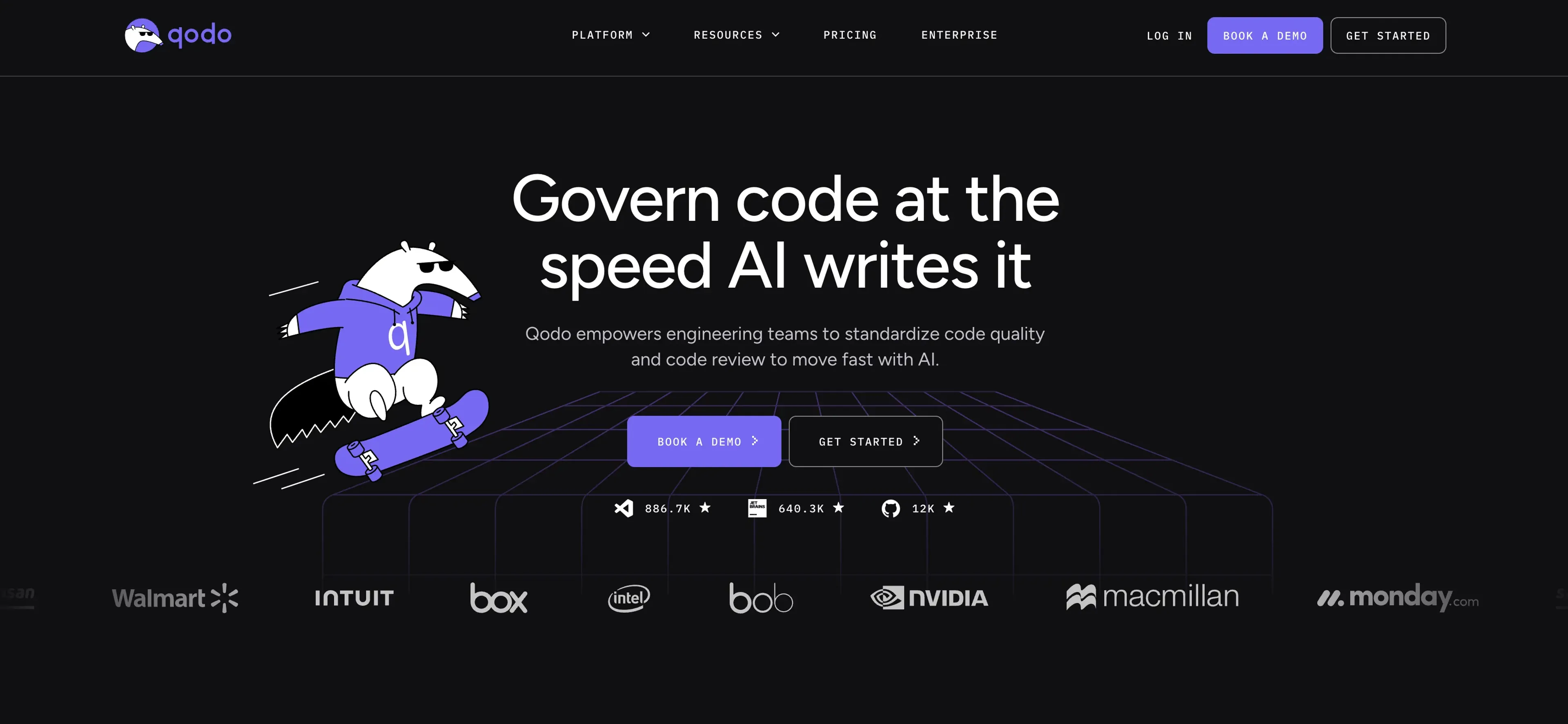
Qodo is an AI code review and governance platform for engineering teams dealing with complex, multi-repo codebases. It plugs into IDEs and Git providers to run context-aware reviews on every change, mine real coding standards from PR history, and map risk across services so teams can safely ship code generated by humans and AI agents at high speed.
Key Features:
Agentic PR Review: Specialized agents review each pull request with full codebase context to flag real bugs and violations.
IDE Local Review: Extensions for VS Code, JetBrains, and Visual Studio provide real-time findings and guided fixes while developers code.
Cross-Repo Context Engine: Maps relationships across repositories and Git providers so reviews catch breaking dependency changes before production.
Living Rules System: Rules Miner turns recurring PR comments and patterns into enforceable, measurable standards that adapt as code evolves.
Governance and Risk Portal: Dashboards show review findings, resolution rates, audit trails, and repo relationships for oversight across teams.
Pros
High-precision findings: Reduces noise compared with diff-only reviews and basic linters, keeping attention on real issues.
Consistent enforcement: Shared context engine and rules run in both IDEs and Git reviews for uniform standards.
Enterprise ready: Zero data retention, SOC 2 Type II, BYOK, and single-tenant or on-prem deployment suit strict security requirements.
Cons
Planning complexity: Credit-based metering can be harder to forecast than straightforward per-seat licensing.
Stack constraints: Focus on GitHub, GitLab, Bitbucket, Azure DevOps, Gerrit, and major languages excludes some tools and stacks.
Who is Using Qodo?
VPs of Engineering and CTOs: Track risk concentration, review throughput, and standards adoption across large engineering groups.
Staff and principal engineers: Use cross-repo context to catch breaking changes and subtle logic gaps before merge.
Platform and DevEx teams: Configure rules, skills, and integrations so AI-assisted development follows shared engineering standards.
Security and compliance leaders: Rely on audit trails and deployment controls to meet internal policies and regulator expectations.
Uncommon Use Cases: Open source maintainers automating PR triage; AI platform teams validating agent-generated code at scale.
Pricing:
Pro Team: Credit-based at $0.012 per credit, pooled across the workspace. No annual commitment, no rate limits, unlimited users. Packs renew monthly:
2,500 credits (~18 reviews per month): $30 per month
5,000 credits (~36 reviews per month): $60 per month
20,000 credits (~144 reviews per month): $240 per month
Overage billed at the same rate up to a configurable spending cap. Additional pack sizes available after signing in.
Trial: 14 days free, no credit card required, full access with unlimited credits.
Disclaimer: Please note that pricing information may not be up to date. For the most accurate and current pricing details, refer to the official Qodo website.
What Makes Qodo Unique?
Qodo stands out by combining cross-repo, full-codebase reasoning with a self-learning rules system that mines standards from real PR history and applies them consistently across IDE, Git, and agent workflows. Together with its AI Code Review Benchmark performance and governance portal, it behaves less like a narrow review plugin and more like a dedicated quality layer for AI-accelerated software delivery.
How We Rated It:
Accuracy and Reliability: 4.5/5
Ease of Use: 4.0/5
Functionality and Features: 4.7/5
Performance and Speed: 4.3/5
Customization and Flexibility: 4.2/5
Data Privacy and Security: 4.8/5
Support and Resources: 4.2/5
Cost-Efficiency: 4.0/5
Integration Capabilities: 4.6/5
Overall Score: 4.4/5
AI Governance For Code Reviews:
Qodo suits teams that already use AI-assisted development and need reliable, auditable code quality across many repositories. Its value is highest for organizations that care about standards, governance, and cross-repo impact, rather than just speeding up individual reviews. Smaller teams with simple stacks may not need its full breadth, but fast-growing and enterprise engineering groups get a focused safety and quality layer for both human and agent-written code.