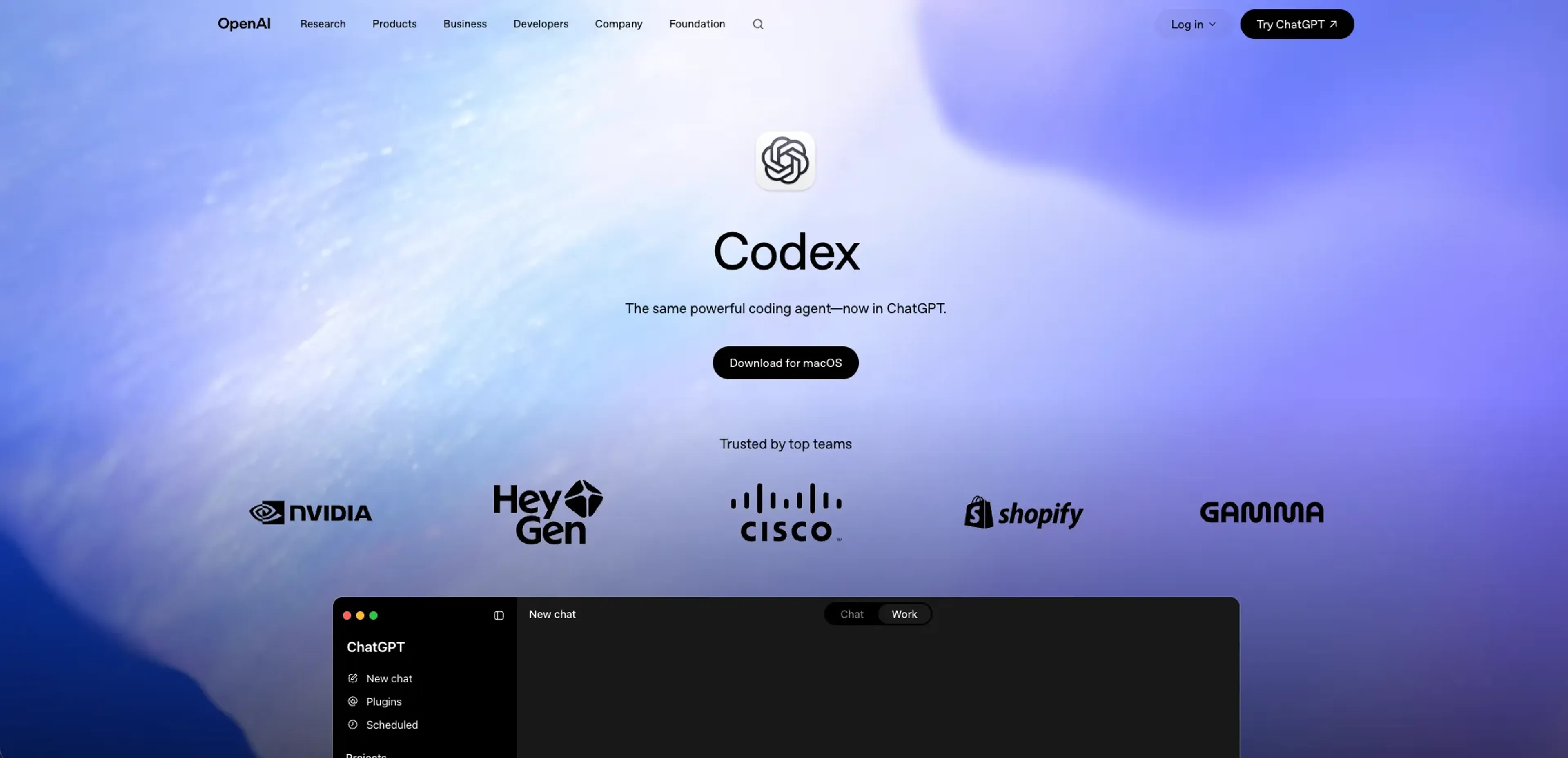
Codex is a coding agent inside ChatGPT that lets software teams hand real engineering work to AI. It can own pull requests, features, refactors, and migrations, powered by OpenAI frontier coding models. The same agent runs in ChatGPT, an IDE extension, and a command line interface across a team’s account.
Key Features:
End-to-end coding workflows: Handles feature work, complex refactors, migrations, reviews, and tests, not just code suggestions.
Multi-agent worktrees and cloud environments: Runs multiple agents in parallel across worktrees and cloud environments to tackle larger backlogs.
Skills for team standards: Lets teams define Skills that capture coding standards and workflows, applied consistently across tasks.
Always-on background automation: Schedules Codex for issue triage, alert monitoring, CI/CD chores, and other recurring maintenance work.
Unified agent everywhere you code: Provides the same agent in ChatGPT, the IDE extension, and the CLI under one account.
Pros
Broad engineering coverage: Supports feature development, refactors, migrations, tests, and reviews instead of only autocomplete.
Team-specific behavior: Skills give a structured way to teach Codex local standards beyond ad hoc prompts.
Real-world validation: Site quotes from teams at Harvey, Ramp, Duolingo, Cisco Meraki, and others report faster iteration and better bug catching.
Cons
Tied to the OpenAI stack: Codex is accessed through ChatGPT, its IDE extension, and CLI, not as a standalone tool.
Sparse public integration details: The homepage does not specify which IDEs, languages, or toolchains are first class.
No published pricing: The Codex page does not state which ChatGPT plans include it or any extra cost.
Who is Using Codex?
Engineering managers and tech leads: Use Codex to offload refactors, migrations, and PR reviews while focusing on system design.
Software engineers: Rely on Codex for pull requests, feature branches, and generating more thorough tests.
Platform and reliability engineers: Schedule Codex to triage issues, follow up on alerts, and assist with CI/CD pipelines.
Developer productivity or AI enablement teams: Configure Skills and rollout patterns so Codex aligns with coding standards and governance.
Uncommon Use Cases: Startup founders could use Codex to prototype and ship features without a large team; internal tools groups could run Codex overnight to modernize legacy systems.
Pricing:
Codex: The product page does not publish pricing or clarify which ChatGPT plans include access.
Disclaimer: Please note that pricing information may not be up to date. For the most accurate and current pricing details, refer to the official Codex website.
What Makes Codex Unique?
Codex treats coding help as a persistent agent that can plan, execute, and maintain engineering work, not just complete lines. Multi-agent worktrees, background runs, Skills, and one agent across chat, IDE, and CLI center it on real workflows instead of isolated code suggestions.
How We Rated It:
Accuracy and Reliability: 4.4/5
Ease of Use: 4.0/5
Functionality and Features: 4.6/5
Performance and Speed: 4.3/5
Customization and Flexibility: 4.1/5
Data Privacy and Security: 4.2/5
Support and Resources: 3.9/5
Cost-Efficiency: 3.7/5
Integration Capabilities: 4.0/5
Overall Score: 4.1/5
Agentic AI For Real Coding Work:
Codex gives teams a single AI coding agent that lives in ChatGPT, the IDE, and the terminal, and can own defined slices of delivery. It best fits organizations already on OpenAI that want agents handling multi step and background work, though the lack of clear public pricing may slow procurement-focused buyers.