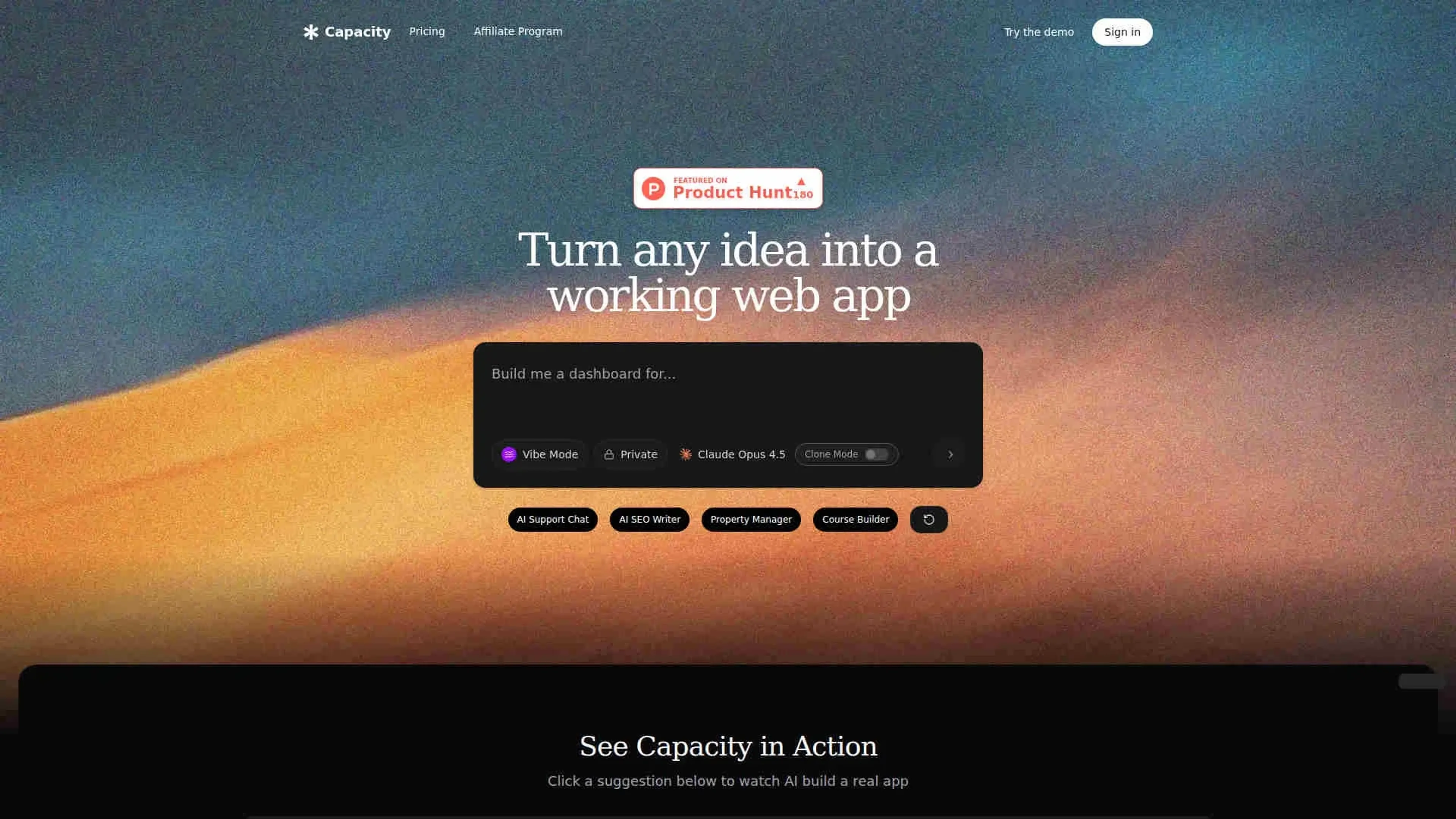
Capacity is a credit‑based AI development tool that turns plain‑language ideas into full‑stack web applications, positioning itself as an “AI cofounder” for founders, indie hackers, and product teams. It focuses on specification‑driven development through its Spec Coding workflow, where users define a project brief, UX, and design requirements before the AI generates production‑ready code. The platform produces modern web apps using technologies such as Next.js, React, TypeScript, Tailwind CSS, and Supabase, and supports both quick “vibe coding” experiments and more rigorous production builds.
Key Features:
Spec Coding methodology: Structured, specification‑first flow (brief, UX, design) so AI generates code that follows clearly defined requirements instead of guessing from vague prompts.
AI Cofounder workspace: An AI “cofounder” that helps brainstorm ideas, refine concepts, and translate them into scoped features and coding tasks, keeping product vision and implementation aligned.
True agentic coding: Project‑aware AI agents that understand the codebase, support multi‑file refactors with dependency tracking, and automatically fix many errors and bugs across files.
Full‑stack generation: Builds database‑backed apps with auth, storage, and real‑time updates on top of Supabase, along with frontend and backend code in a production‑ready stack.
Credit‑based workflow: Every interaction with the AI uses credits based on task complexity, which lets users scale usage from quick tests to large projects without changing tools.
Code export and hosting: Users can export the entire codebase, connect GitHub, and still rely on Capacity’s managed hosting when they do not want to run infrastructure themselves.
Pros
Production‑oriented flow: Spec Coding pushes users toward clear requirements and better architecture, which suits serious apps more than one‑off prototypes.
Fast MVP creation: Founders can go from idea to working MVP in minutes or hours instead of months, which is attractive for validation and experimentation.
Modern tech stack: Output uses widely adopted web technologies, making handoff to human developers or later customization much easier.
Non‑coders friendly: Many workflows are chat‑driven, so non‑technical founders can still get functional apps without writing code.
Flexible usage model: Credit billing with optional one‑time “mini packs” fits both light tinkerers and heavier, ongoing projects.
Cons
Learning curve for specs: Users who are used to pure prompting may need time to adjust to writing structured briefs and UX specs.
Credit complexity: New users must understand how credits map to tasks, which can initially feel opaque compared with simple per‑seat pricing.
Web‑app focus: Great for full‑stack web apps, but less relevant for native mobile or highly specialized back‑end workloads.
Who is Using Capacity?
Solo founders and indie hackers: Validating SaaS or marketplace ideas quickly without hiring developers.
Startup product teams: Spiking features, building internal tools, and iterating on product experiments.
Agencies and studios: Producing client MVPs, dashboards, and custom CRMs faster while still delivering exportable code.
Internal ops and IT teams: Spinning up internal portals, booking tools, or inventory systems on top of existing data.
Uncommon Use Cases: Educators using it to demonstrate full‑stack architecture with AI assistance; content creators building niche AI tools like SEO writers or AI support chat widgets as side products.
Pricing:
Starter: $25 per month; includes 100 credits, unlimited projects, full Agentic mode access, and email support.
Growth: $69 per month; includes 250 credits, full codebase export, custom domains, and a dedicated WhatsApp support channel.
Professional: $129 per month; includes 500 credits, all Growth features, premium support, and early access to new features.
Business: $299 per month; includes 1,000 credits, all Professional features, a dedicated success manager, and custom integrations.
Mini Pack: $9 one-time; includes 20 credits, one small project build and test, and full Agentic mode access.
Disclaimer: Please note that pricing information may not be up to date. For the most accurate and current pricing details, refer to the official Capacity website.
What Makes Capacity Unique?
Capacity’s key distinction is its Spec Coding approach, treating AI as a structured collaborator rather than a pure prompt engine. Specs become living documentation that stays aligned with the actual codebase, improving maintainability and reducing rework. Combined with agentic, project‑aware coding and exportable, production‑ready code, the tool sits closer to a junior engineering partner than a simple snippet generator.
How We Rated It:
Accuracy and Reliability: 4.3/5
Ease of Use: 4.0/5
Functionality and Features: 4.6/5
Performance and Speed: 4.5/5
Customization and Flexibility: 4.4/5
Data Privacy and Security: 4.1/5
Support and Resources: 4.2/5
Cost-Efficiency: 4.4/5
Integration Capabilities: 4.0/5
Overall Score: 4.3/5
AI Cofounder For Shipping Real Web Apps Fast:
For builders who care about owning real, maintainable code, Capacity offers a rare blend of high‑speed AI development and specification discipline. It suits founders and teams who want to move quickly without giving up architecture, documentation, or future developer control, and it shines when the goal is a production‑ready web app rather than a throwaway prototype.