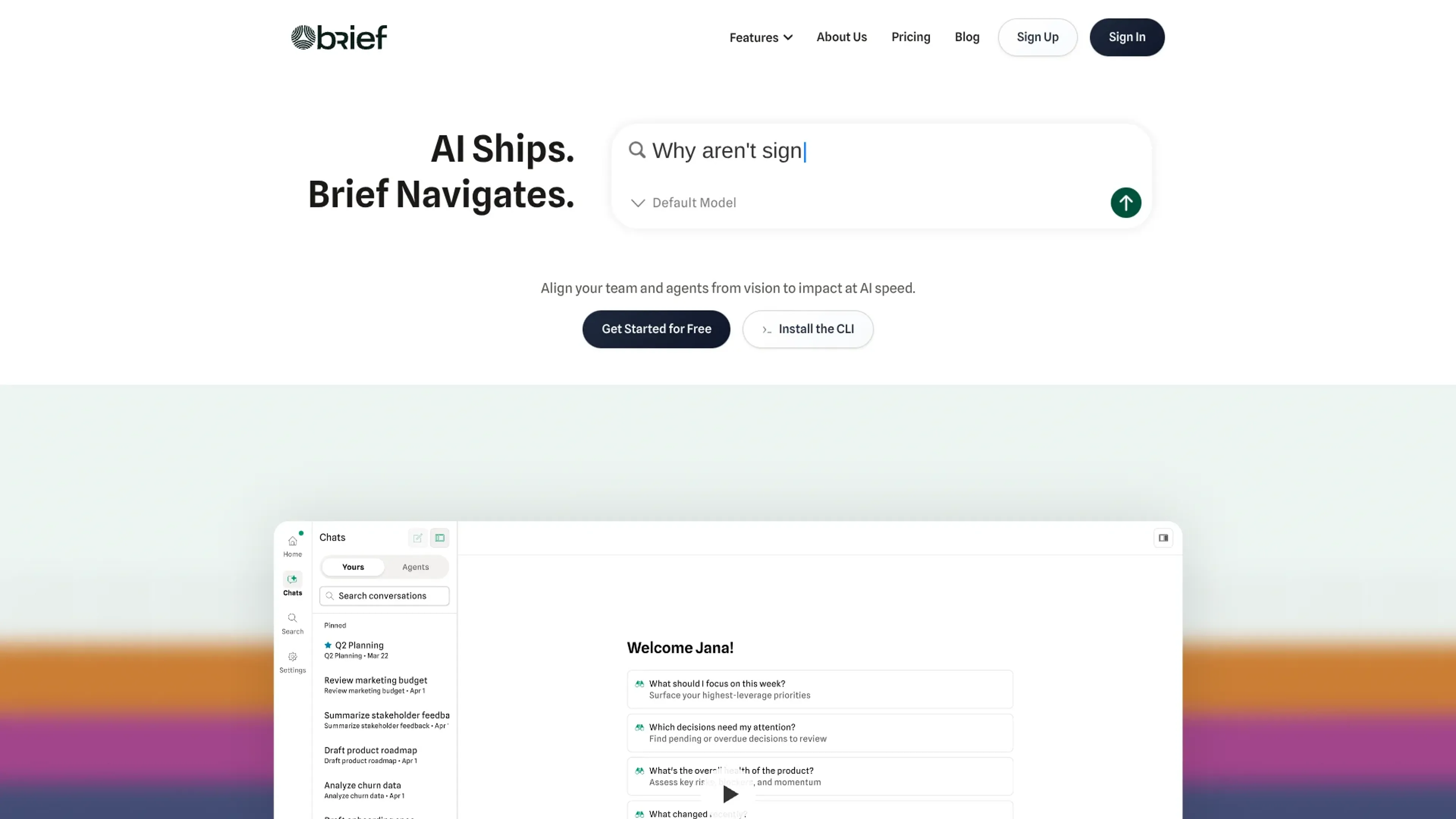
Brief is a product intelligence and context engine that keeps software teams and AI coding agents aligned with real product decisions. It connects to tools like task trackers, docs, calls, CRM, analytics, and code hosts, uses large language models to extract decisions and tradeoffs, then exposes that “product truth” through a web app, CLI, and MCP server. Teams adopt Brief to cut rework, improve decision compliance, and help AI agents ship code that actually matches strategy.
Key Features:
Product Graph Engine: Automatically builds a living graph of product decisions, constraints, and rationale across tools so teams can see not only what exists but why it exists.
AI-driven Decision Extraction: Uses AI to read tools such as Linear, Jira, Notion, Slack, GitHub and many others, pulling out decisions and mapping them into structured, searchable context.
MCP Server, CLI, and IDE Integrations: Exposes context to Cursor, Claude Code, Windsurf, and any MCP-compatible assistant, so AI coding agents can query Brief directly from the IDE.
Unified Product Search and Chat: Web app and chat interface that let humans and agents ask questions about product decisions, history, and customer signals instead of digging across scattered systems.
Pros
Strong alignment for AI agents: Dramatically improves how often agents follow existing decisions, which reduces rewrites and failed merge requests.
Minimal workflow disruption: Works on top of current tools, so teams do not need to move projects into a new tracker.
Deep integration coverage: Connectors across engineering, product, GTM, analytics, and storage tools make it attractive for organizations with complex stacks.
Clear AI value story: Ties usage to shipped work and “return on invested tokens,” which resonates with leaders watching AI spend.
Cons
Best suited to tool-heavy teams: Very small teams with simple workflows or few systems may not feel the same payoff from the Product Graph.
Early documentation footprint: Public docs are still being fleshed out, which can leave advanced users wanting more examples and patterns.
Who is Using Brief?
Product Managers and Heads of Product: Keeping feature decisions, tradeoffs, and customer insights accessible to both engineers and AI coding agents.
Engineering Leaders and CTOs: Giving agents and developers shared context so sprint work lines up with strategy instead of local guesses.
Developer Experience and Platform Teams: Standardizing how AI assistants access product context across multiple repos, services, and tools.
GTM and Revenue Teams: Connecting product decisions with CRM and call data to clarify what was promised, what shipped, and why.
Uncommon Use Cases: Used by AI agent startups to give their customer-specific agents guardrails and product truth; adopted by consulting firms that want persistent product context across many client engagements.
Pricing:
Free: $0 forever; includes 50 AI credits per month, shared workspace, pooled context, and MCP integration.
Pro: $49 per seat per month; includes 200 AI credits per month per seat, $0.10 per credit overage, per-user billing, and email support.
Teams: $89 per seat per month; includes a 5-seat minimum, 500 AI credits per month per seat pooled, $0.08 per credit overage, centralized billing, admin dashboard, and priority support.
Enterprise: Custom pricing; includes negotiated AI credits, SSO and security controls, dedicated customer success manager, SLA-backed support, and multi-workspace support.
Disclaimer: Please note that pricing information may not be up to date. For the most accurate and current pricing details, refer to the official Brief website.
What Makes Brief Unique?
Brief’s standout move is treating product knowledge as a first-class dataset for AI. Instead of just indexing code or documents, it builds a Product Graph that encodes the reasoning and constraints behind decisions, then feeds that directly into AI coding agents through MCP and a CLI.
How We Rated It:
Accuracy and Reliability: 4.2/5
Ease of Use: 4.3/5
Functionality and Features: 4.4/5
Performance and Speed: 4.3/5
Customization and Flexibility: 4.0/5
Data Privacy and Security: 4.2/5
Support and Resources: 3.8/5
Cost-Efficiency: 4.5/5
Integration Capabilities: 4.7/5
Overall Score: 4.3/5
Brief As A Navigator For AI-Driven Product Teams:
Brief offers a focused answer to a very modern problem: AI agents and engineers can move quickly, but without shared context they often move in the wrong direction. By turning messy cross-tool product history into a structured Product Graph that both people and agents can query, Brief helps teams ship work that reflects actual decisions, not tribal memory. For organizations leaning into AI coding agents or experimenting with MCP-based workflows, it represents a practical way to bring judgment, context, and alignment into the loop without asking everyone to change tools.