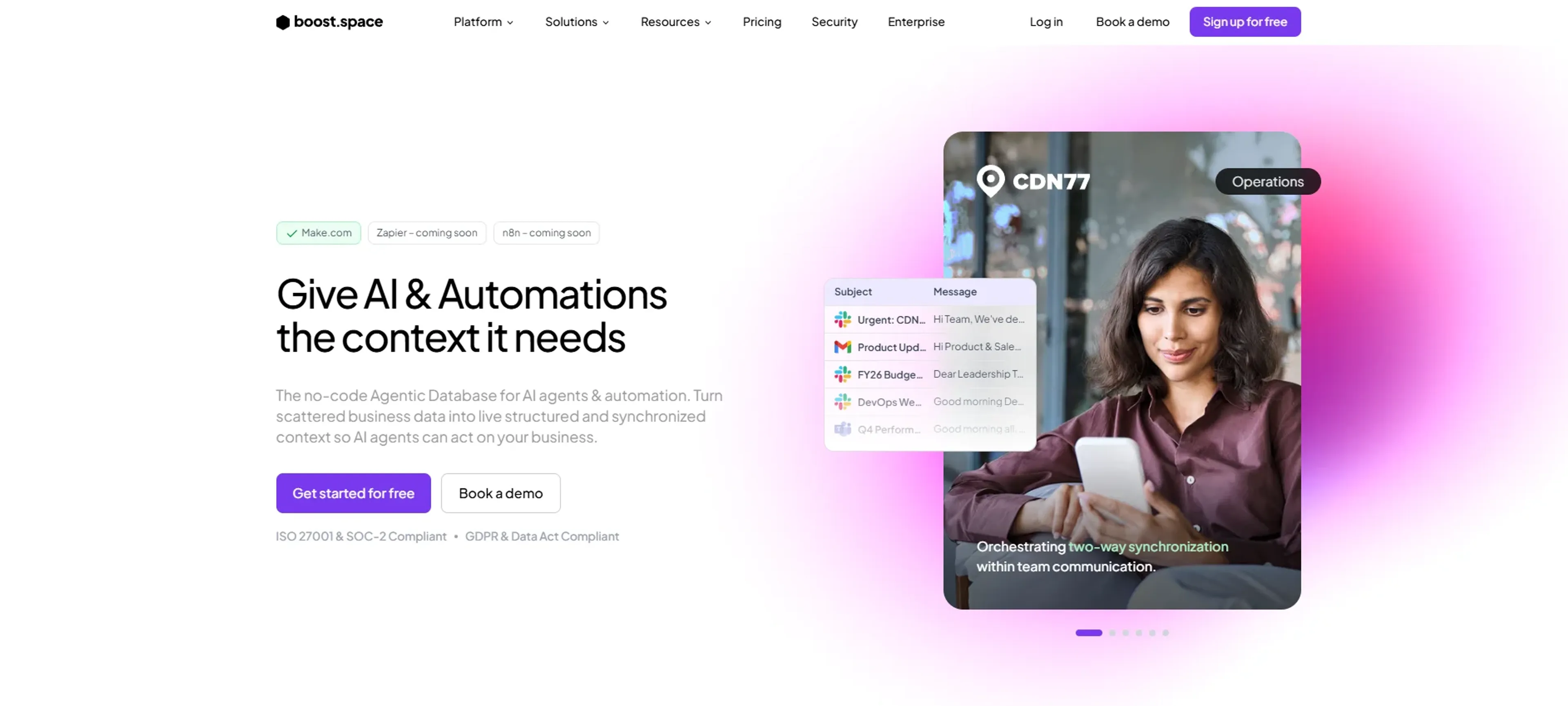
boost.space focuses on turning fragmented business data into a single, AI-ready context layer. It acts as a no-code agentic database that centralizes records from CRM, e-commerce, billing, support, and more, then keeps everything synchronized. On top of that standardized data, teams can run automations and AI agents, use built-in enrichment fields, and let large language models calculate answers and trigger workflows on live data rather than stale exports.
Key Features:
Agentic Database & Context Layer: Consolidates customer, product, and operational data into a live structured view for AI agents.
Data Layer & Two-way Sync: Connects to 2,600+ tools and automation platforms like Make, Zapier, and n8n to keep records aligned.
AI & Data Enrichment: Uses AI Fields to classify, normalize, translate, and enrich records at scale with structured metadata.
MCP-based AI Agents: Connects any LLM through Model Context Protocol so agents can query data, compute results, and trigger workflows.
Pros
AI-first architecture: Built around context for agents instead of one-off chatbot answers.
Integration breadth: Connectors for thousands of SaaS tools, plus tight collaboration with Make scenarios.
Scalable data handling: Designed for high record counts and bulk enrichment without constant CSV imports.
Enterprise posture: ISO 27001, SOC 2, GDPR and Data Act compliance reassure security-conscious buyers.
Cons
Setup complexity: Good outcomes depend on thoughtful data modeling and sync configuration.
Automation dependencies: Smaller plans still rely on external tools like Make for many workflow automations.
Ecosystem maturity: Zapier and n8n options are still marked as coming soon.
Who is Using boost.space?
E-commerce Businesses: Unifying catalog data, supplier feeds, and images, then enriching listings for marketplaces and storefronts.
Sales & RevOps Teams: Synchronizing CRM data and activities while powering AI-supported outreach and reporting.
Marketing Teams: Building first-party audiences and coordinated campaigns from centralized data across ad, email, and analytics tools.
Operations & Data Teams: Maintaining a single source of truth that underpins dashboards, internal tools, and automation.
Uncommon Use Cases: Used by AI consulting agencies for client data-readiness projects; adopted by SaaS product teams to feed in-app copilots.
Pricing:
Free: $0 per month; includes 500 records, 500 AI credits per month, unlimited users, Automation Engine with your Make account, and free trial access.
Pro: $25 per month (discounted from $49 per month with code TADEAS50); includes 20,000 records, 20,000 AI credits per month, unlimited users, Automation Engine with your Make account, and free trial access.
Business: $135 per month (discounted from $269 per month with code TADEAS50); includes 150,000 records, 150,000 AI credits per month, unlimited users, Automation Engine with your Make account (built-in option +$75 per month), and free trial access.
Enterprise: Custom pricing; includes custom records and AI credits, unlimited users, Automation Engine (custom built-in option), and demo booking access.
Disclaimer: Please note that pricing information may not be up to date. For the most accurate and current pricing details, refer to the official boost.space website.
What Makes boost.space Unique?
boost.space occupies a niche between classic integration tools and heavy data platforms by treating synchronized records as a real-time context layer for AI. Instead of just moving data, it enriches and standardizes it, then exposes that context through MCP so agents can safely read, compute, and act inside existing stacks.
How We Rated It:
Accuracy and Reliability: 4.4/5
Ease of Use: 3.8/5
Functionality and Features: 4.6/5
Performance and Speed: 4.4/5
Customization and Flexibility: 4.2/5
Data Privacy and Security: 4.7/5
Support and Resources: 4.2/5
Cost-Efficiency: 4.5/5
Integration Capabilities: 4.8/5
Overall Score: 4.4/5
Turning Scattered Data Into Agentic Context:
boost.space looks well suited to teams that want AI agents and automations working on accurate, always-synced business data. Its mix of two-way sync, enrichment, computed answers, and MCP connectivity turns sprawling tools into something closer to one coordinated system. For e-commerce, sales, and marketing groups chasing AI-readiness without rebuilding their stack from scratch, it is a strong contender.