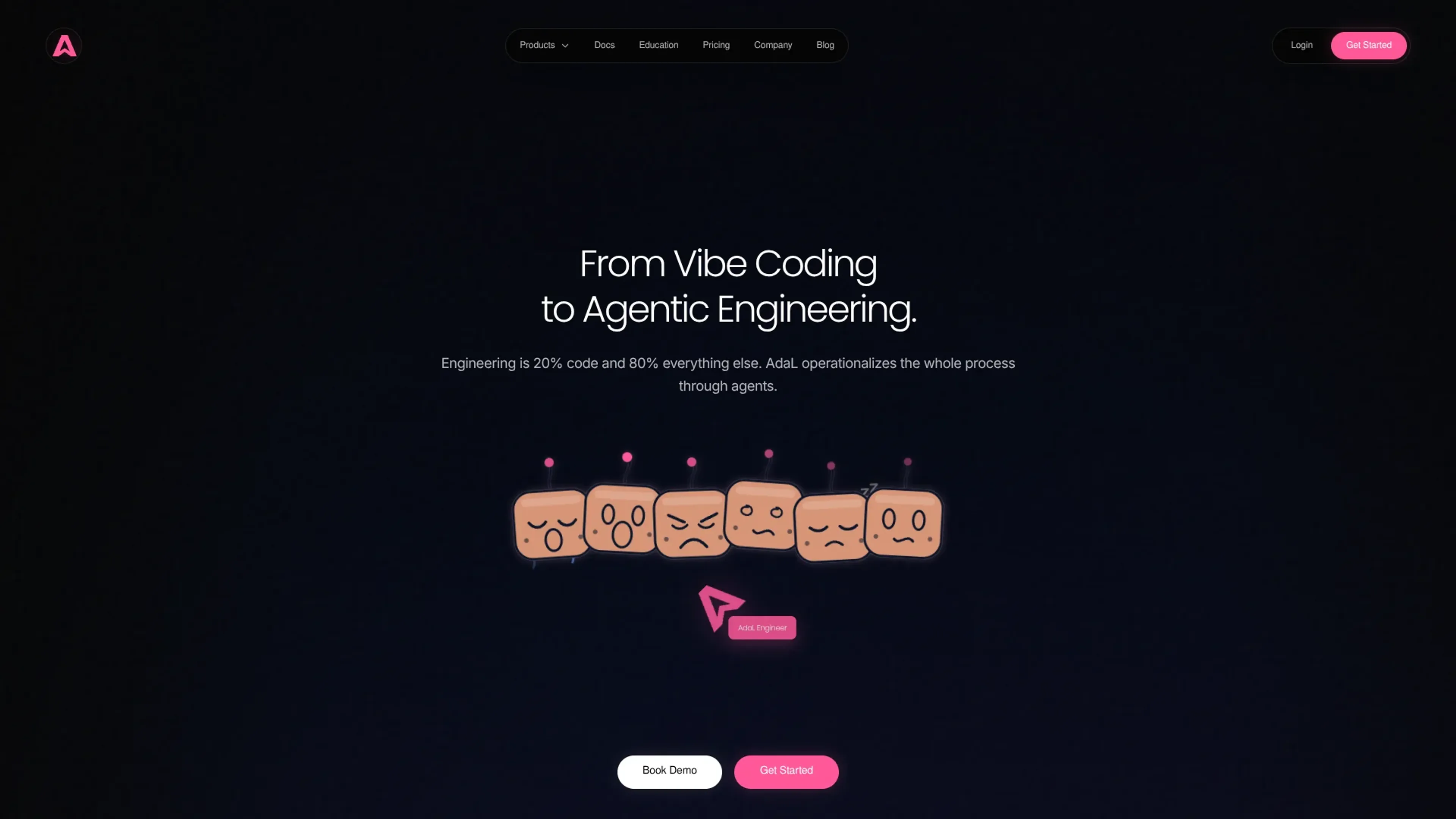
AdaL is an agentic engineering toolkit that helps software teams move from basic code generation to full workflow automation. It combines a transparent CLI, an Agentic IDE, and specialized worker agents for deep research, coding, browser automation, verification, and review so engineering teams can automate more than just the typing part of development.
Key Features:
Worker Agents For Engineering Tasks: Dedicated agents handle deep research, coding, browser use, verification, and review so multi step work can run autonomously with clear handoffs.
Agentic IDE: A browser and desktop IDE that shows clustered code changes, visual diffs, risk levels, and review cards, helping humans inspect and guide what the agents shipped.
CLI With YOLO Sessions: The AdaL CLI runs autonomous worker loops, exposes every step and tool call, and lets developers swap models or workers mid session rather than hiding work in a black box.
Multi Model Support: Worker agents can run on Claude, GPT, Gemini and several other frontier models under one subscription, with each task routed to a suitable model and toolchain.
SDK, Headless, And Meta Agent Options: Teams can run agents headless in CI or backends, compose domain specific workers via SDK, or use a meta agent to scaffold workflows and evals.
Long Term Memory And Shared Context: Engineer agents maintain context across sessions so humans and agents can keep working on the same codebase and tasks without constant re prompting.
Pros
End To End Engineering Focus: Goes well beyond autocomplete, covering research, planning, coding, browser checks, and review in one toolchain.
Transparency And Control: Every agent step, tool input, and output is visible, which helps teams trust and audit autonomous runs.
Strong Review Experience: Change clustering, risk tags, and review cards give leads a clear summary of what changed and where to pay attention.
Model Choice Without Tool Sprawl: One interface for multiple frontier models keeps experimentation easier and avoids juggling several separate CLIs.
Production Friendly Surfaces: Headless mode and SDK support make it easier to embed agents into CI pipelines or internal tools.
Cons
Engineering Centric: Non technical teams or casual users are unlikely to get full value from a CLI plus IDE agent stack.
Learning Curve: Understanding worker loops, clusters, and agent configurations takes time, especially for teams new to agentic workflows.
Usage Heavy Pricing: Power users on larger codebases may gravitate to the higher tiers, which can feel premium for early exploration.
Who is Using AdaL?
Software Engineering Teams: Product engineering groups using it to accelerate feature work, bug fixing, and refactors while keeping human review in the loop.
Startups And Small Dev Shops: Two to ten person teams looking to stretch limited engineering capacity with multi agent workflows instead of more hires.
Data And ML Engineers: Using worker agents for research, experiment wiring, and maintenance of data heavy pipelines.
DevOps And Platform Engineers: Automating CI tweaks, infrastructure scripts, and repetitive debugging while staying close to the resulting changes.
Independent Developers: Solo builders who want a serious coding agent that stays oriented in a single codebase over long sessions.
Uncommon Use Cases: Hackathon organizers using it to help participants prototype faster; education programs introducing students to practical agentic engineering setups.
Pricing:
Pro Standard: $20 per month; includes 7-day free trial, suited for short coding sprints in small codebases.
Max (5x Usage): $100 per month; includes increased usage for everyday work in larger codebases.
Max+ (20x Usage): $200 per month; includes highest usage limits with maximum access to all models for power users.
Disclaimer: Please note that pricing information may not be up to date. For the most accurate and current pricing details, refer to the official AdaL website.
What Makes AdaL Unique?
AdaL takes the idea of a coding agent and stretches it across the full engineering workflow, not just the editor. The combination of a transparent CLI, an Agentic IDE tuned for clustered reviews, and composable worker agents on top of multiple frontier models creates a serious engineering assistant rather than a novelty chatbot. The YOLO mode name might sound playful, but the underlying controls, auditability, and production surfaces are aimed at teams shipping real systems.
How We Rated It:
Accuracy and Reliability: 4.4/5
Ease of Use: 3.9/5
Functionality and Features: 4.6/5
Performance and Speed: 4.3/5
Customization and Flexibility: 4.5/5
Data Privacy and Security: 4.2/5
Support and Resources: 3.8/5
Cost-Efficiency: 4.0/5
Integration Capabilities: 4.1/5
Overall Score: 4.2/5
AdaL Brings Order To Agentic Engineering Workflows:
AdaL gives high performing engineering teams a focused way to turn large models into dependable worker agents that handle research, coding, browser checks, and review without becoming inscrutable. The tool is clearly built for serious developers who are comfortable in a terminal and who care about understanding what their agents did, not just whether a snippet compiled. For teams that already view AI as a collaborator in software delivery rather than a toy, AdaL is a strong contender to anchor their agentic engineering stack.