
XFactor
Revolutionize revenue with AI-driven market insights and strategic planning.
Key Takeaways
- What it is
- Revolutionize revenue with AI-driven market insights and strategic planning.
- Best for
- MIKEY AI
- Marketing Effectiveness
- Precision Planning
- Rating
- 4.4/5
What is XFactor?
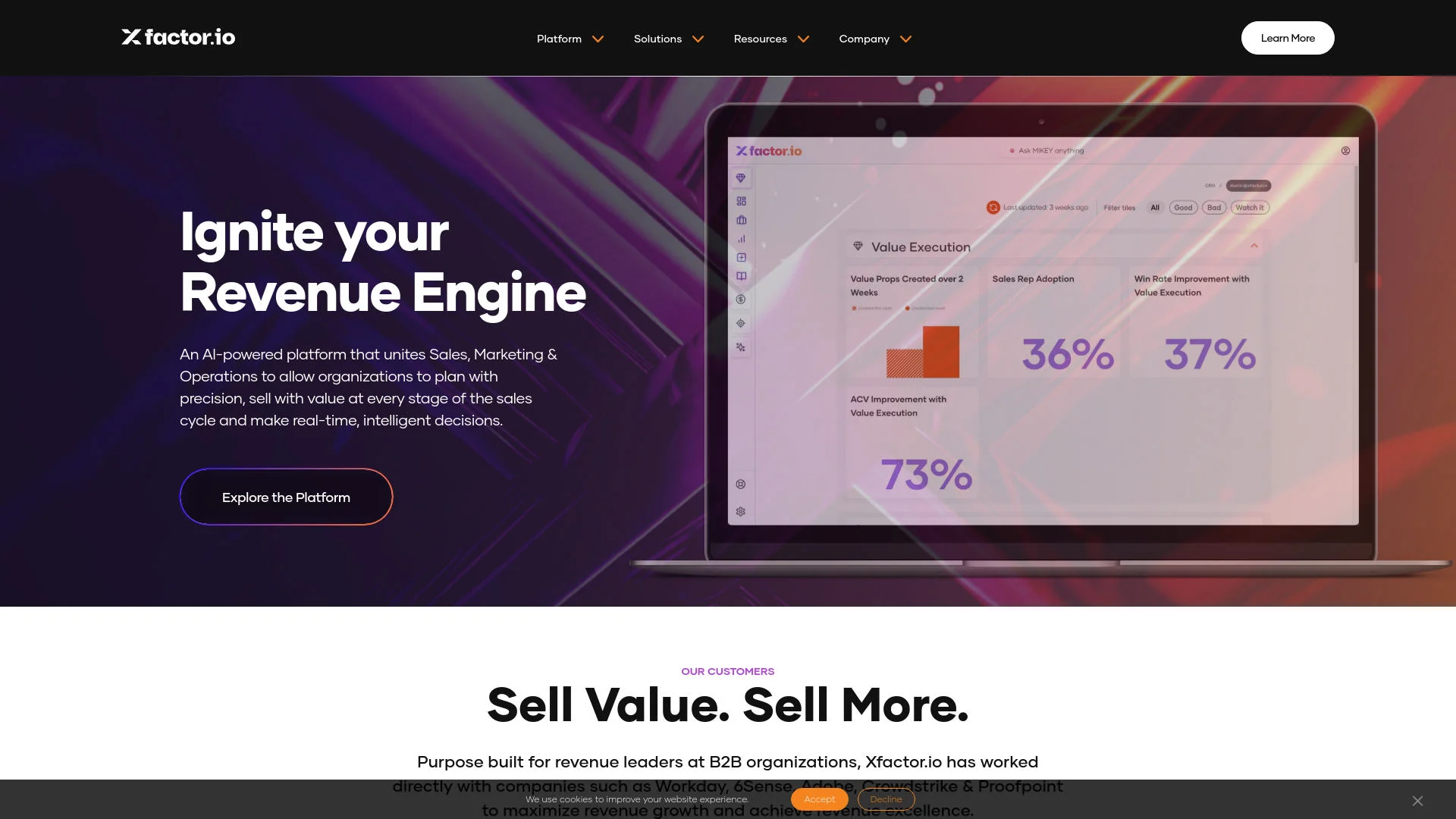
XFactor is an innovative go-to-market platform designed to streamline and enhance the efficiency of revenue generation for businesses. At its core, XFactor leverages a powerful AI assistant named Mikey, which combines elite human advisory insights with advanced generative AI models. This integration enables the tool to deliver precise business plans, market predictions, and scenario analyses. Primarily targeted at B2B organizations, XFactor is a game-changer for revenue leaders looking to optimize sales processes, align marketing and sales teams, and drive substantial growth through data-driven decisions.
XFactor stands out with its AI-driven approach to revenue optimization, particularly through its AI assistant, Mikey. This tool not only provides analytics but also actionable insights and recommendations, making it a critical asset for strategic planning. The integration of sales, marketing, and operations into a single platform allows for a unified approach to revenue generation, which is especially beneficial in today's fragmented market landscapes.
XFactor excels in driving revenue growth through its integrated, AI-powered platform. It's particularly valuable for revenue leaders at B2B organizations who are looking to streamline their go-to-market strategies and enhance operational efficiencies. With its unique MIKEY AI, XFactor not only provides insights but also actionable recommendations that are crucial for maintaining competitive advantage in fast-paced markets.
Who is Using XFactor?
Chief Revenue Officers
Utilizing the platform to drive sales and maximize rep productivity.
Enterprise Sellers
Leveraging value execution features to close more deals effectively.
Vice Presidents of Marketing
Employing the platform to ensure that marketing investments are directly contributing to revenue.
Digital Marketing Agencies
Using advanced analytics to track and improve campaign performances.
Uncommon Use Cases
Non-profit organizations use it to optimize their fundraising strategies; universities apply it for strategic alumni engagement and fundraising.
Key Features
Rating Breakdown
Pricing Plans
Custom Pricing
- XFactor offers tailored pricing based on the specific needs and scale of an organization
XFactor Use Cases
Pipeline and forecast intelligence
Monitor pipeline health, forecast confidence, stage distribution, and execution risk.
Outcome: Earlier visibility into revenue shortfalls and bottlenecks.
Revenue scenario simulation
Test pricing, headcount, territory, spend, and capacity decisions against modeled outcomes.
Outcome: Compare strategic paths before committing budget.
Root-cause analysis
Trace changes in win rate, conversion, sales cycle, retention, and revenue to contributing factors.
Outcome: Identify causes instead of relying on surface-level correlations.
Churn and retention analysis
Analyze customer interactions and deal velocity to identify at-risk accounts.
Outcome: Prioritize retention and expansion interventions.
Value selling and business cases
Generate buyer-ready business cases, ROI analysis, value propositions, and enablement content.
Outcome: Help sellers defend pricing and communicate economic impact.
Workflow Ideas with XFactor
Pressure-test a revenue plan
- 1Connect CRM and GTM data
- 2Model headcount, pricing, territory, or spend scenarios
- 3Compare projected outcomes and select an action plan
Investigate a pipeline decline
- 1Ask OpenInsights about conversion, stage, and pipeline changes
- 2Review causal drivers and prioritized risks
- 3Execute recommended corrective actions
Create a value-selling business case
- 1Provide customer and opportunity context
- 2Generate ROI-backed value content
- 3Share the buyer-ready business case with stakeholders
How XFactor fits into your stack
CRM Integration
Seamlessly connects with popular CRM systems to enhance data utilization and accessibility.
Analytics Tools Compatibility
Integrates with major analytics platforms to enhance data analysis capabilities.
API Access
Offers robust API support for custom integrations, facilitating a more tailored usage experience.
Cloud-Based
Ensures easy deployment and scalability through its cloud-based infrastructure.
Pros
- +Enhanced Decision Making: Real-time insights and analytics help in making informed decisions quickly.
- +Increased Revenue: Focused on maximizing deal sizes and improving win rates through strategic insights and value execution.
- +Seamless Integration: Aligns sales, marketing, and operations for unified decision-making and strategy implementation.
- +Customer-Centric Approaches: Keeps customer value at the forefront, enhancing satisfaction and retention.
Cons
- −Complex Features: New users may require time to fully grasp and utilize all available tools effectively.
- −Higher Cost for Smaller Businesses: The extensive features and benefits may come at a price point that is less accessible for smaller enterprises.
- −Dependency on Data Quality: The effectiveness of insights and predictions heavily relies on the quality and completeness of input data.
Limitations & when to consider alternatives
Known limitations
- Active CRM required for the free simulation. The free simulation program requires participating organizations to have an active CRM instance.
- Minimum sales-team size. The free simulation program requires at least three quota-carrying sales representatives.
- Enterprise-style purchasing. The subscription agreement states that fees are defined in an applicable Order or Statement of Work and billed annually unless otherwise specified.
Look elsewhere when
- You need a public developer API.
- You need a native mobile application.
- You need a browser extension or desktop installer.
- You need image analysis or document-upload workflows.
How to Use XFactor
- 1
Discover a range of tutorials on XFactor’s official website, covering everything from basic setup to advanced features usage.
Who is XFactor For?
Revenue leaders
They use Xfactor to improve forecast confidence, identify revenue drivers, and pressure-test growth decisions.
RevOps teams
They use Xfactor for pipeline visibility, revenue planning, operational monitoring, and scenario analysis.
Sales leaders
They use Xfactor to improve win rates, deal velocity, pricing discipline, and sales execution.
Marketing teams
They use Xfactor to connect marketing activity with pipeline and revenue forecasts.
Customer success teams
They use Xfactor to identify churn risks, retention issues, and expansion opportunities.
Frequently Asked Questions
What is Xfactor?
Xfactor is an AI-native revenue operations platform that connects GTM signals, identifies causal drivers, and simulates business decisions.
What data does Xfactor use?
Xfactor connects CRM, pipeline, usage, customer success, finance, support, and other GTM data sources.
What does Xfactor OpenInsights do?
OpenInsights analyzes CRM and other data, surfaces prioritized insights, answers questions, and generates charts and graphs for export.
What does Xfactor Simulation do?
Simulation models decisions such as headcount, territories, spend, and pricing before implementation.
How does the free simulation work?
Xfactor offers a no-charge working session that connects GTM data, runs a simulation, and produces an action plan.
Who qualifies for the free simulation?
Organizations must have an active CRM and at least three quota-carrying sales representatives.
Community reviews
Be the first to share your experience.
Sign in to leave a review for XFactor.
XFactor Alternatives
Looking for alternatives to XFactor? Here are similar tools in the same category:
Learn to Master XFactor
With Skill Leap courses
Get in-depth training on XFactor and 50+ other AI tools with our expert-led video courses.
Start 7-Day Free Trial