Wisedocs
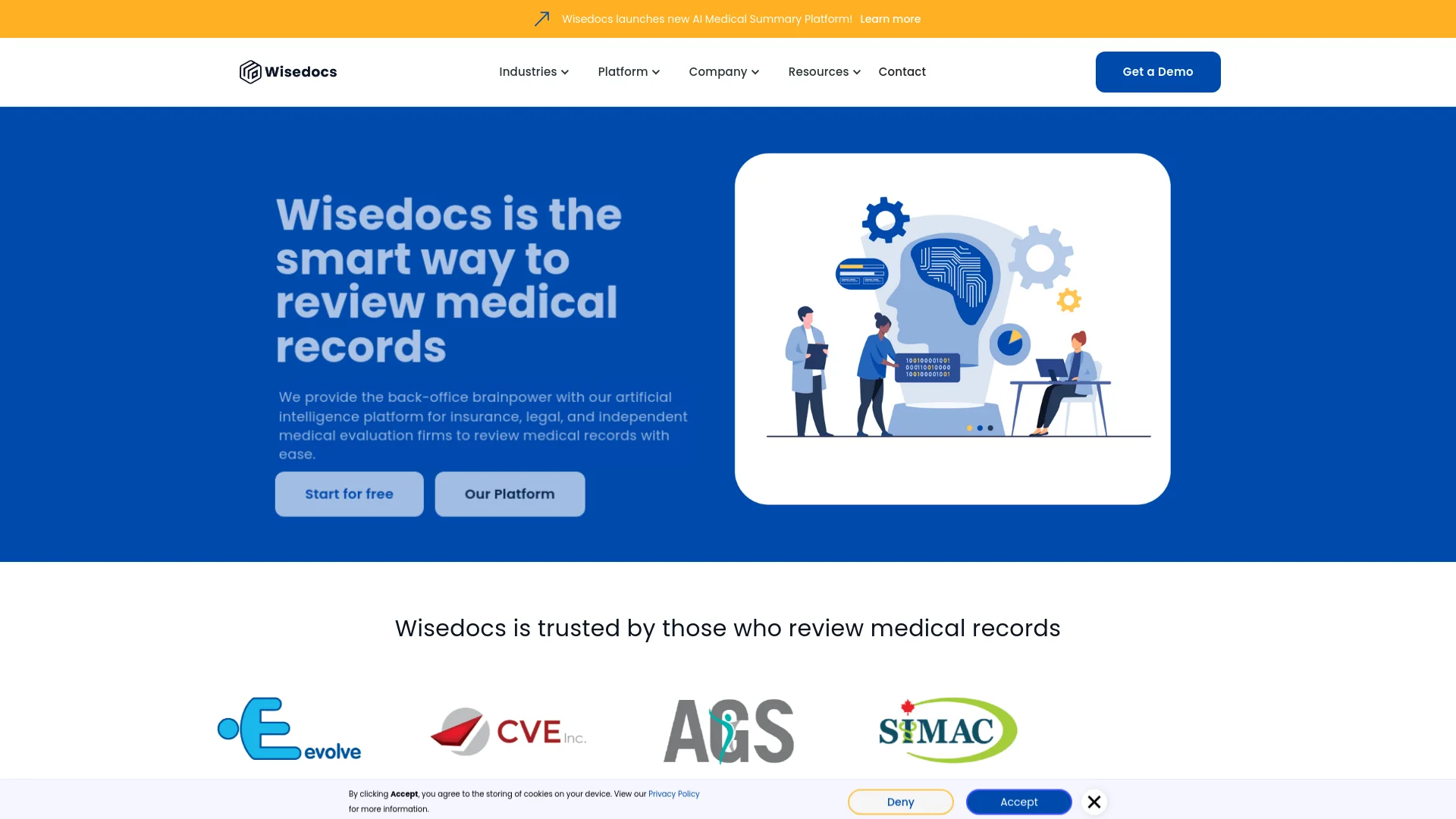
AI-driven platform streamlines medical document analysis.
Key Takeaways
- What it is
- AI-driven platform streamlines medical document analysis.
- Best for
- Medical Chronologies
- Intelligent OCR
- Deduplication
- Rating
- 4.7/5
What is Wisedocs?
Wisedocs is a robust AI-driven platform designed to revolutionize medical record reviews, primarily serving the insurance and legal sectors. By leveraging artificial intelligence, Wisedocs simplifies and accelerates the handling of medical claims, featuring medical chronologies, intelligent OCR, and automatic deduplication. It is an indispensable tool for firms looking to optimize their document processing workflows.
Wisedocs stands out with its sophisticated AI-driven features that automate the medical record review process and provide deep insights and analytics. Its seamless integration into existing workflows and focus on improving accuracy and efficiency make it uniquely positioned to transform how firms handle medical documentation.
Wisedocs excels in providing a sophisticated, AI-powered solution for managing medical records, making it an essential tool for insurance companies, legal firms, and healthcare providers. Its innovative features, particularly in improving the speed and accuracy of medical record processing, offer an unmatched advantage in the industry.
Who is Using Wisedocs?
Insurance Companies
Utilize Wisedocs to process claims more quickly and with greater accuracy.
Legal Firms
Employ Wisedocs for thorough and expedient medical record reviews in preparation for cases.
Independent Medical Evaluators
Leverage the platform to assess and review medical documents efficiently.
Healthcare Administrators
Use Wisedocs to manage patient records and streamline administrative tasks.
Uncommon Use Cases
Academic researchers analyzing medical data trends; HR departments managing employee health records.
Key Features
Rating Breakdown
Pricing Plans
Free Trial
- Start with Wisedocs for free and explore its features without initial investment
Subscription Plans
- Detailed pricing is available upon request
- Tailored to the size and needs of the organization
Wisedocs Use Cases
Workers’ compensation claim review
Review treatment histories, claim records, and recovery timelines with structured summaries and insights.
Outcome: Faster, more defensible workers’ compensation decisions.
Medical record chronology
Upload large medical record packets and convert them into searchable, timeline-based chronologies.
Outcome: Quicker identification of treatment gaps, missing procedures, and inconsistencies.
Claims litigation preparation
Extract critical medical facts and organize records for legal and claims-defense workflows.
Outcome: Stronger case preparation with less manual review.
Custom claim reporting
Configure templates, extract verified medical insights, and generate DOCX or PDF reports.
Outcome: Consistent, referenceable reports ready to share.
AI claims-document Q&A
Ask natural-language questions about uploaded claim files and receive answers linked to source documents.
Outcome: Fast, traceable access to relevant claim information.
Workflow Ideas with Wisedocs
Create a structured medical chronology
- 1Upload PDFs, faxes, JPEGs, Word documents, or TIFs
- 2Let Wisedocs sort, deduplicate, and organize records chronologically
- 3Review the searchable timeline and linked source documents
Generate a custom claim report
- 1Upload medical, legal, or insurance documents
- 2Select or configure a report template
- 3Review the human-verified report and export or share it
Automate an API-based claims workflow
- 1Create a case through the Wisedocs API
- 2Upload claim documents and request processing
- 3Retrieve summaries, insights, or reports programmatically
How Wisedocs fits into your stack
Workflow Integration
Easily integrates with existing medical claims processing systems.
API Access
Allows for custom integrations with other software through its API.
Data Security
Adheres to stringent security protocols to ensure data integrity and compliance.
Cloud-Based
Offers a flexible, cloud-based platform, ensuring accessibility and scalability.
Pros
- +Efficiency Gains: Reduces the time required to process medical records by up to 70%, according to user testimonials.
- +Accuracy and Insight: Enhances the accuracy of medical record reviews and provides key clinical insights in real-time, supporting better decision-making.
- +User-Friendly Interface: Offers a clean, intuitive interface that simplifies onboarding and daily operations.
- +Cost-Effective: Automates several aspects of the medical record review process, helping firms save on operational costs and resource allocation.
Cons
- −Learning Curve: New users may require time to fully grasp all functionalities and integrate the platform into existing systems.
- −Niche Focus: Primarily tailored for the legal and insurance industries, which might not be as beneficial for sectors outside these fields.
- −Dependency on Digital Formats: Relies on the availability of digital records, which could be a limitation in environments still handling large volumes of paper-based documents.
Limitations & when to consider alternatives
Known limitations
- No public self-serve pricing. The public website directs prospective customers to schedule a demo rather than showing plan prices.
- Human review remains part of the process. Wisedocs uses expert human oversight and does not position the platform as a fully autonomous replacement for review.
- Wisedocs does not make claims decisions. Final claim determinations remain with the customer; Wisedocs provides structured documentation and decision support.
- Enterprise-oriented deployment. The documented deployment options are cloud, dedicated private cloud, or the customer’s cloud environment.
Look elsewhere when
- You need a downloadable desktop application.
- You need transparent public plan pricing.
- You need autonomous claims decisions without human review.
How to Use Wisedocs
- 1
Explore a range of tutorials and resources on the Wisedocs website, including detailed case studies and blog posts that provide insights into maximizing the platform's capabilities.
Who is Wisedocs For?
Insurance carriers
Carriers use Wisedocs to structure, analyze, and verify medical, legal, and insurance documents for faster claims decisions.
TPAs and case managers
TPAs and case managers use Wisedocs to organize high-volume claim files, reduce back-and-forth, and keep claims moving.
Legal and claims defense teams
Legal teams use structured medical summaries, citation-backed insights, and searchable records to prepare defensible cases.
Medical evaluators
Medical evaluators use Wisedocs to turn complex medical files into organized insights while focusing on expert assessment.
Government and public-sector agencies
Government organizations use Wisedocs for compliant medical-record ingestion, structuring, summarization, and claims handling.
Frequently Asked Questions
What does Wisedocs do?
Wisedocs uses artificial intelligence to read, sort, and summarize complex medical records and claims documents with human oversight.
What types of claims does Wisedocs support?
Wisedocs supports workers’ compensation, auto and casualty, disability, liability, healthcare, legal defense, government, and IME/QME claims.
What types of documents does Wisedocs support?
Supported materials include clinical notes, diagnostic imaging, IME/QME reports, emergency records, treatment notes, lab results, insurance forms, legal forms, employment documents, and financial documents.
How accurate are Wisedocs summaries?
Wisedocs combines AI processing with expert human validation to produce clinically reliable, defensible summaries.
How does Wisedocs integrate with existing workflows?
Wisedocs uses secure APIs to upload records, process summaries, and retrieve reports; custom reports also support SFTP integrations.
Is patient data secure?
Wisedocs cites HIPAA, PIPEDA, and SOC 2 Type II compliance, along with enterprise-grade encryption and audit trails.
Community reviews
Be the first to share your experience.
Sign in to leave a review for Wisedocs.
Wisedocs Alternatives
Looking for alternatives to Wisedocs? Here are similar tools in the same category: