
Trigger.dev
Revolutionize background job management with seamless, scalable automation.
Key Takeaways
- What it is
- Revolutionize background job management with seamless, scalable automation.
- Pricing
- Freemium
- Best for
- Open Source
- No Timeouts
- Automatic Retrying
- Rating
- 4.7/5
What is Trigger.dev?
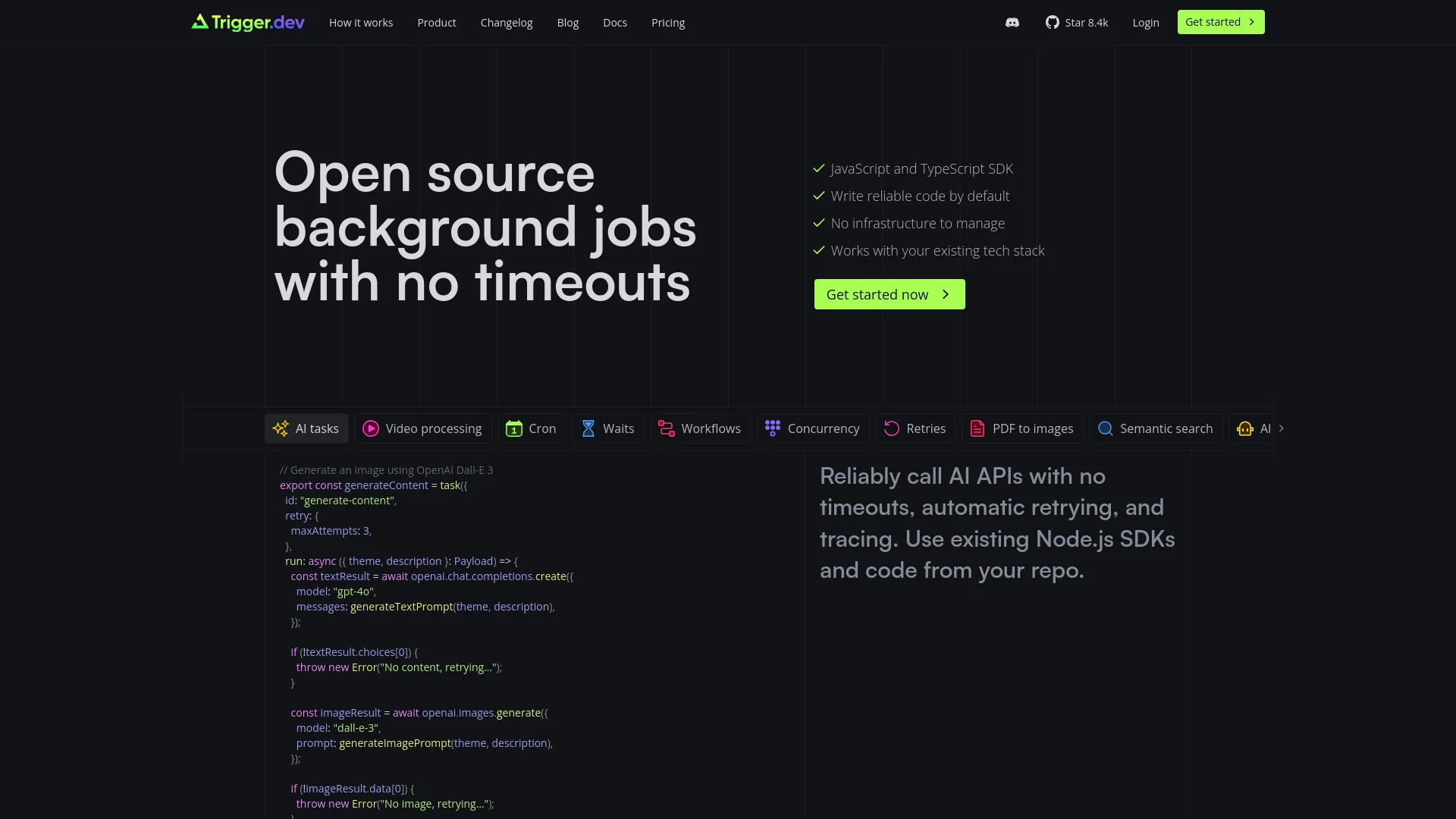
Trigger.dev revolutionizes the way developers manage background jobs and automation workflows. This open-source platform eliminates timeouts and simplifies the creation of reliable, scalable background tasks. Designed for developers and technical teams, Trigger.dev integrates seamlessly with existing tech stacks, offering a robust solution for managing everything from AI tasks to complex workflows without the need for extensive infrastructure management.
Trigger.dev stands out with its ability to handle long-running background jobs without timeouts, a game-changer for developers dealing with complex workflows. Its open-source nature and robust retry mechanisms make it an unparalleled tool in the background job management space.
Trigger.dev excels in providing a reliable and developer-friendly platform for managing background jobs and automation workflows. Its unique features, such as no timeouts and automatic retrying, make it an essential tool for developers and technical teams. Whether you're handling AI tasks or complex workflows, Trigger.dev offers unmatched advantages with its robust, scalable, and cost-effective solutions.
Who is Using Trigger.dev?
E-commerce Businesses
Utilizing the tool for automating inventory management and order processing.
Digital Marketing Agencies
Employing the tool for automating campaign workflows and data processing.
Software Developers
Leveraging the tool to manage CI/CD pipelines and background tasks.
AI and Machine Learning Teams
Using the tool to handle complex AI workflows and data processing.
Uncommon Use Cases
Utilized by educational institutions for teaching automation concepts; adopted by healthcare providers for automating appointment scheduling and reminders.
Key Features
Rating Breakdown
Pricing Plans
Free Tier
Free
- Experience Trigger.dev with a free trial
Pro Tier
Which Trigger.dev plan should you pick?
Start with Free for experimentation and small workloads; upgrade to Hobby or Pro for more capacity, retention, and team scale, or Enterprise for SSO and advanced controls.
Free
Good for individuals and small projects that need $0 access, $5 in monthly credits, unlimited tasks, and up to five team members.
Hobby
Good for growing projects that need $10 in monthly credits, higher concurrency, longer retention, and more schedules.
Pro
Good for production teams needing higher concurrency, more team members, longer retention, more alert destinations, and dedicated Slack support.
Enterprise
Good for organizations requiring custom pricing, SSO, RBAC, directory sync, compliance reports, priority support, and uptime commitments.
Trigger.dev Use Cases
Data processing and ETL
Build complex pipelines that process large datasets in durable background tasks.
Outcome: Large data workflows run without serverless execution timeouts.
Media processing
Batch-process videos, images, audio, and documents using build extensions and external libraries.
Outcome: Resource-intensive media jobs run reliably in the cloud.
AI media generation
Generate images, videos, audio, and documents through AI models orchestrated by Trigger.dev tasks.
Outcome: AI generation workflows gain retries, queues, monitoring, and scaling.
Durable AI agents
Build multi-step agents with tool calling, streaming, human approval, retries, and persistent run state.
Outcome: Agents survive refreshes, redeploys, crashes, and long waits.
Webhook-driven automation
Receive events from services such as Stripe, Supabase, and Hookdeck, then trigger background tasks.
Outcome: External events launch reliable, observable workflows.
Workflow Ideas with Trigger.dev
Process and import a CSV
- 1Upload a CSV file from the frontend
- 2Trigger a background validation task
- 3Stream processing progress back to the frontend
Process a video from Supabase
- 1Receive a Supabase database webhook
- 2Extract audio with FFmpeg
- 3Transcribe the audio and update the database record
Run an approval-based AI agent
- 1Start an AI agent task with tools
- 2Pause execution for human approval
- 3Resume the task and stream the result to the frontend
How Trigger.dev fits into your stack
Node.js and TypeScript SDK
Seamlessly integrates with Node.js and TypeScript projects.
Slack Integration
Get alerts and notifications directly in Slack.
API Access
Developers can harness the API for custom integrations.
Self-Hosting
Offers the flexibility to self-host, enhancing control and customization.
Pros
- +Time Efficiency: Eliminates the need for extensive setup and management of background jobs.
- +Cost-Effective: Only pay for what you use, making it a scalable solution for growing needs.
- +Developer-Friendly: Exceptional support and a thriving community enhance the developer experience.
- +Reliable: Automatic retrying and no timeouts ensure tasks are completed reliably.
Cons
- −Initial Learning Curve: Requires some time to get familiar with advanced features.
- −Limited Integrations: While it integrates well with many tools, the range is still expanding.
Limitations & when to consider alternatives
Known limitations
- Cloud runs have a 14-day maximum TTL. Trigger.dev Cloud clamps runs to a maximum time-to-live of 14 days; self-hosted deployments can configure their own limit.
- Offline development is unsupported. The local development server currently requires an internet connection.
- Cloud API rate limits apply. Plans are limited to 1,500 API requests per minute unless a higher paid-plan limit is approved.
- Batch triggering has a maximum size. A batch trigger can include up to 1,000 tasks on current SDK versions.
- Large task payloads require external storage. For larger payloads, Trigger.dev recommends uploading the data to your own storage and passing a URL.
Look elsewhere when
- You want a visual, no-code workflow canvas with many built-in integrations.
- You need a native desktop application.
- You need native iOS or Android access to manage the product.
How to Use Trigger.dev
- 1
Explore the comprehensive tutorial series on the Trigger.dev website, covering everything from basic setup to advanced features.
Who is Trigger.dev For?
TypeScript developers
Trigger.dev lets developers write background jobs and AI workflows as normal TypeScript code.
AI application builders
The platform supplies durable execution, queues, retries, streaming, and observability for AI agents.
Teams shipping production workloads
Teams get managed infrastructure, elastic scaling, environments, monitoring, alerts, and deployment versioning.
Data and media processing teams
Trigger.dev supports long-running ETL, document, audio, video, and image-processing workflows.
Enterprise engineering teams
Enterprise plans add SSO, RBAC, directory sync, compliance reports, priority support, and uptime commitments.
Frequently Asked Questions
What is Trigger.dev?
Trigger.dev is an open-source background-jobs framework for reliable workflows and long-running AI tasks written in TypeScript.
Can I use Trigger.dev for AI agents?
Yes. Trigger.dev provides infrastructure for durable AI agents with retries, queues, streaming, human-in-the-loop workflows, and observability.
Can I self-host Trigger.dev?
Yes. Trigger.dev Cloud is available, and the platform can also be self-hosted on your own infrastructure.
How long can a task run?
Tasks have no execution timeout, although Trigger.dev Cloud runs have a maximum 14-day TTL.
Can I run Trigger.dev locally?
Yes, but local development currently requires an internet connection because offline development is not supported.
How does Trigger.dev charge for usage?
Cloud usage is based on compute seconds and run invocations, with included credits depending on the plan.
Community reviews
Be the first to share your experience.
Sign in to leave a review for Trigger.dev.
Trigger.dev Alternatives
Looking for alternatives to Trigger.dev? Here are similar tools in the same category:
Learn to Master Trigger.dev
With Skill Leap courses
Get in-depth training on Trigger.dev and 50+ other AI tools with our expert-led video courses.
Start 7-Day Free Trial