
TextQL
Simplifies complex data operations with natural language querying.
Key Takeaways
- What it is
- Simplifies complex data operations with natural language querying.
- Best for
- Natural Language Processing
- Integrated Business Intelligence
- Advanced Metadata Management
- Rating
- 4.2/5
What is TextQL?
In the rapidly evolving world of data analytics, TextQL stands as a revolutionary tool designed to transform how enterprises interact with their data. At its core, TextQL serves as a virtual data analyst, integrating advanced AI capabilities to simplify complex data operations. This tool is particularly engineered for businesses and professionals who need to harness the power of data without the traditional complexities of data science.
TextQL stands out for its ability to democratize data analytics through its natural language processing interface. This unique feature allows individuals without technical expertise to perform complex data analyses, making it a game-changer for data-driven decision-making across various sectors.
TextQL excels in providing powerful, user-friendly data analytics capabilities, making it an essential tool for businesses seeking to enhance their data-driven strategies. Its ability to integrate seamlessly with existing platforms and offer natural language querying sets it apart in the field of enterprise data analytics.
Who is Using TextQL?
Data Teams
Utilizing TextQL for streamlined data querying and management.
Marketing Teams
Leveraging AI to gain insights into market trends and consumer behavior.
Finance Teams
Employing advanced analytics for financial forecasting and risk management.
Healthcare Providers
Using TextQL to manage large volumes of medical data efficiently.
Uncommon Use Cases
Non-profits utilizing TextQL to measure impact and optimize outreach strategies; educational institutions using it for research data analysis.
Key Features
Rating Breakdown
Pricing Plans
Enterprise Custom Pricing
- TextQL offers customized pricing based on the specific needs and scale of the enterprise
Which TextQL plan should you pick?
Start with Analyst for prototyping and individual analysis; upgrade to Team for broader collaboration, or Enterprise for SSO, dedicated infrastructure, compliance, and custom fine-tuning.
Analyst
Good for analysts and ICs who need a $0 plan with three seats, connectors, shared compute, and ad hoc analysis.
Team
Good for companies that need unlimited seats, team collaboration, additional credits, and email support.
Enterprise
Good for organizations needing SSO, SCIM, dedicated or private deployments, compliance support, custom fine-tuning, and priority support.
TextQL Use Cases
Recurring executive reporting
Create a scheduled playbook that analyzes revenue or business performance and delivers the report to executives.
Outcome: Automated recurring reports without manual analyst preparation.
Sales performance monitoring
Combine CRM and warehouse data to analyze pipeline, revenue, conversion, or account performance.
Outcome: Faster sales insights using live connected data.
Marketing campaign analysis
Analyze campaign performance and enrich internal results with external market or competitor information.
Outcome: Broader campaign context and more informed decisions.
Inventory and anomaly monitoring
Schedule checks for inventory levels, service-level metrics, or unusual changes in operational data.
Outcome: Alerts and monitoring delivered proactively.
Batch customer or product analysis
Upload or connect a table and run the same playbook analysis across selected rows using template variables.
Outcome: Repeatable reports generated at scale with version tracking.
Workflow Ideas with TextQL
Daily sales health report
- 1Connect Salesforce or another CRM and the warehouse
- 2Create a playbook analyzing daily pipeline, bookings, and conversion metrics
- 3Deliver the report to the sales-team Slack channel each morning
Weekly customer health reporting
- 1Upload or connect a customer table
- 2Create a template-backed playbook using customer-specific variables
- 3Run the analysis for selected customers and export the generated reports
Inventory anomaly monitoring
- 1Connect inventory and operational data sources
- 2Schedule an agent or playbook to check inventory and detect anomalies
- 3Send an alert to Slack or email when stock or performance thresholds are breached
How TextQL fits into your stack
Slack and Microsoft Teams
TextQL works where your team lives, integrating directly into communication platforms for seamless collaboration.
Business Intelligence Platforms
Connects with major BI platforms to centralize analytics and reporting.
Secure and Compliant Deployments
Configurable to meet industry-specific data protection standards.
Custom AI Model Tuning
Offers bespoke AI solutions tailored to specific organizational needs.
Pros
- +Enhanced Data Accessibility: Makes data analytics accessible to a broader range of professionals through natural language processing.
- +Time Efficiency: Reduces the time spent on searching and analyzing data across multiple platforms.
- +Cost-Effective: Minimizes the need for multiple analytics tools by integrating various functionalities into one platform.
- +Customizable AI Models: Tailors AI models to meet specific team needs, improving data analysis relevance and accuracy.
Cons
- −Complex Initial Setup: May require a detailed initial setup to integrate fully with existing systems.
- −Dependency on Data Quality: The effectiveness of analytics is heavily dependent on the quality of the underlying data.
- −Limited Language Support: Currently, the natural language processing capabilities might be limited to specific languages, potentially excluding non-English speakers.
Limitations & when to consider alternatives
Known limitations
- Long threads can become difficult to load. TextQL documents that long threads may fail to load, especially when they contain large file previews or exceed the context window.
- Direct browser-to-API calls are restricted. The API does not support direct calls from arbitrary browser origins; TextQL recommends routing API requests through a backend.
- Snowflake roles require separate connectors. TextQL documents that dynamic USE ROLE switching is not supported within one connection.
- dbt Cloud semantic-layer API integration is under development. The FAQ states that the dbt Cloud semantic-layer API integration is currently under active development.
Look elsewhere when
- You need a native mobile application.
- You need a browser extension.
- You need image-understanding or vision analysis.
How to Use TextQL
- 1
Explore the extensive range of tutorials available on the TextQL website, covering everything from basic setup to advanced data analysis techniques.
Who is TextQL For?
Analysts and individual contributors
The Analyst plan is intended for analysts and ICs connecting databases and exploring ad hoc analysis use cases.
Sales teams
Sales teams can ask natural-language questions across CRM, warehouse, and other connected business data.
Finance teams
Finance teams can use TextQL for close processes, real-time reporting, financial analysis, and audit-traceable answers.
Marketing teams
Marketing teams can analyze campaign performance, customer data, and external market context.
Operations teams
Operations teams can monitor KPIs, inventory, performance, and other operational metrics through conversational analysis and automation.
Frequently Asked Questions
What is TextQL?
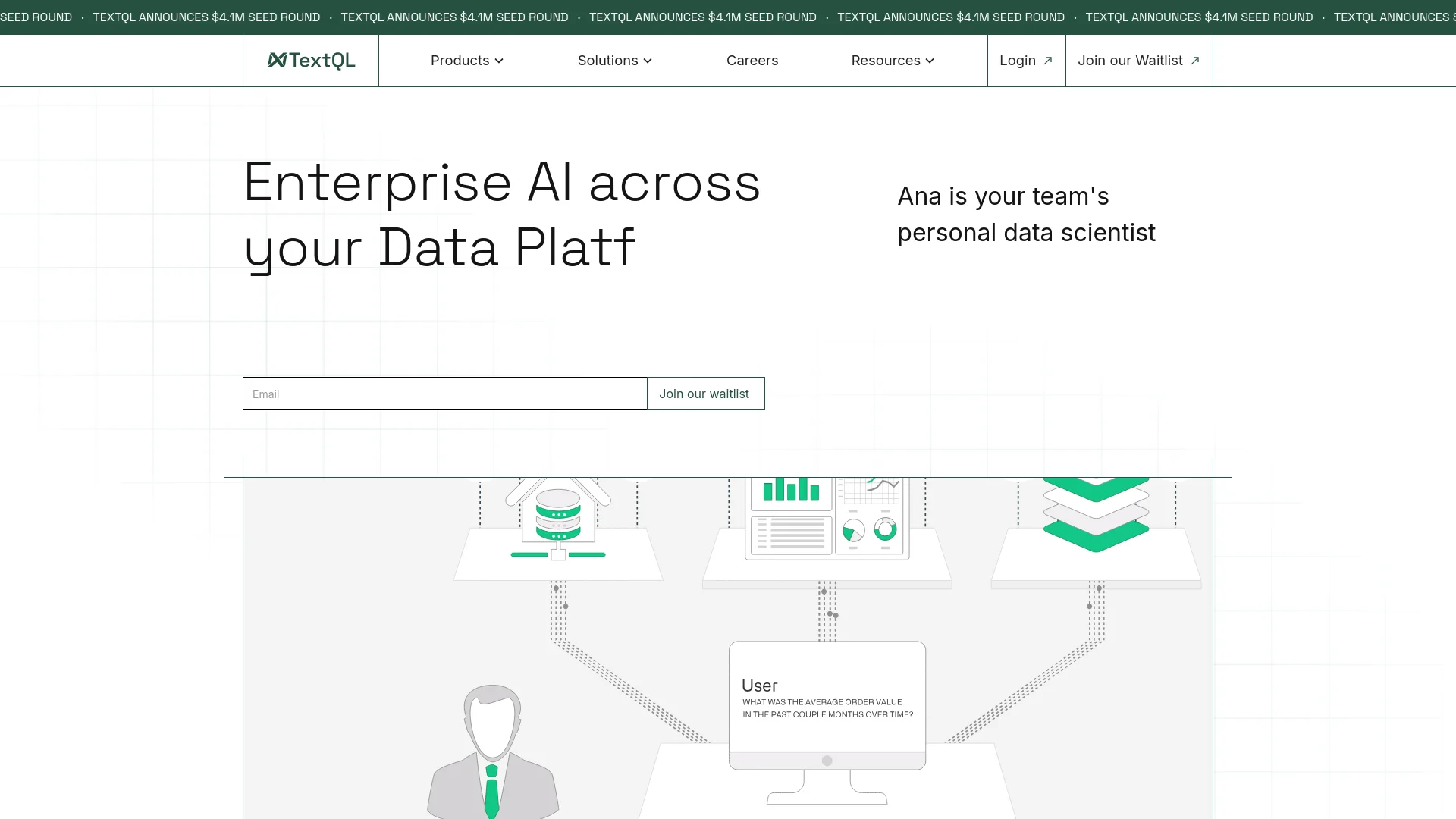
TextQL is an AI data scientist that connects to data warehouses and systems of record, answers questions in natural language, and produces analyses, charts, reports, dashboards, and files.
What data sources can TextQL connect to?
TextQL supports SQL connectors for warehouses, databases, and BI tools, plus API connectors for SaaS tools such as Salesforce, HubSpot, Slack, GitHub, Jira, and Stripe.
Can TextQL automate recurring analysis?
Yes. Playbooks and agents can run scheduled analyses and deliver findings to destinations such as Slack, email, Feed, or direct messages.
What outputs can TextQL produce?
Ana can produce conversational answers, SQL results, charts, visualizations, dashboards, scheduled reports, CSVs, PDFs, and PPTs.
Does TextQL support enterprise authentication?
TextQL supports SSO through OIDC, including Okta, Microsoft Entra ID, Ping Identity, and other OIDC-compliant providers.
How does TextQL protect data?
TextQL documents TLS 1.2 or higher in transit, AES-256 encryption at rest, isolated execution sandboxes, role-based access controls, and warehouse-enforced permissions.
Community reviews
Be the first to share your experience.
Sign in to leave a review for TextQL.
TextQL Alternatives
Looking for alternatives to TextQL? Here are similar tools in the same category:
Learn to Master TextQL
With Skill Leap courses
Get in-depth training on TextQL and 50+ other AI tools with our expert-led video courses.
Start 7-Day Free Trial