
TensorLeap
Enhance, debug, and explain deep learning models efficiently.
Key Takeaways
- What it is
- Enhance, debug, and explain deep learning models efficiently.
- Best for
- Root Cause Detection
- Data Optimization
- Deep Unit Testing
- Rating
- 4.6/5
What is TensorLeap?
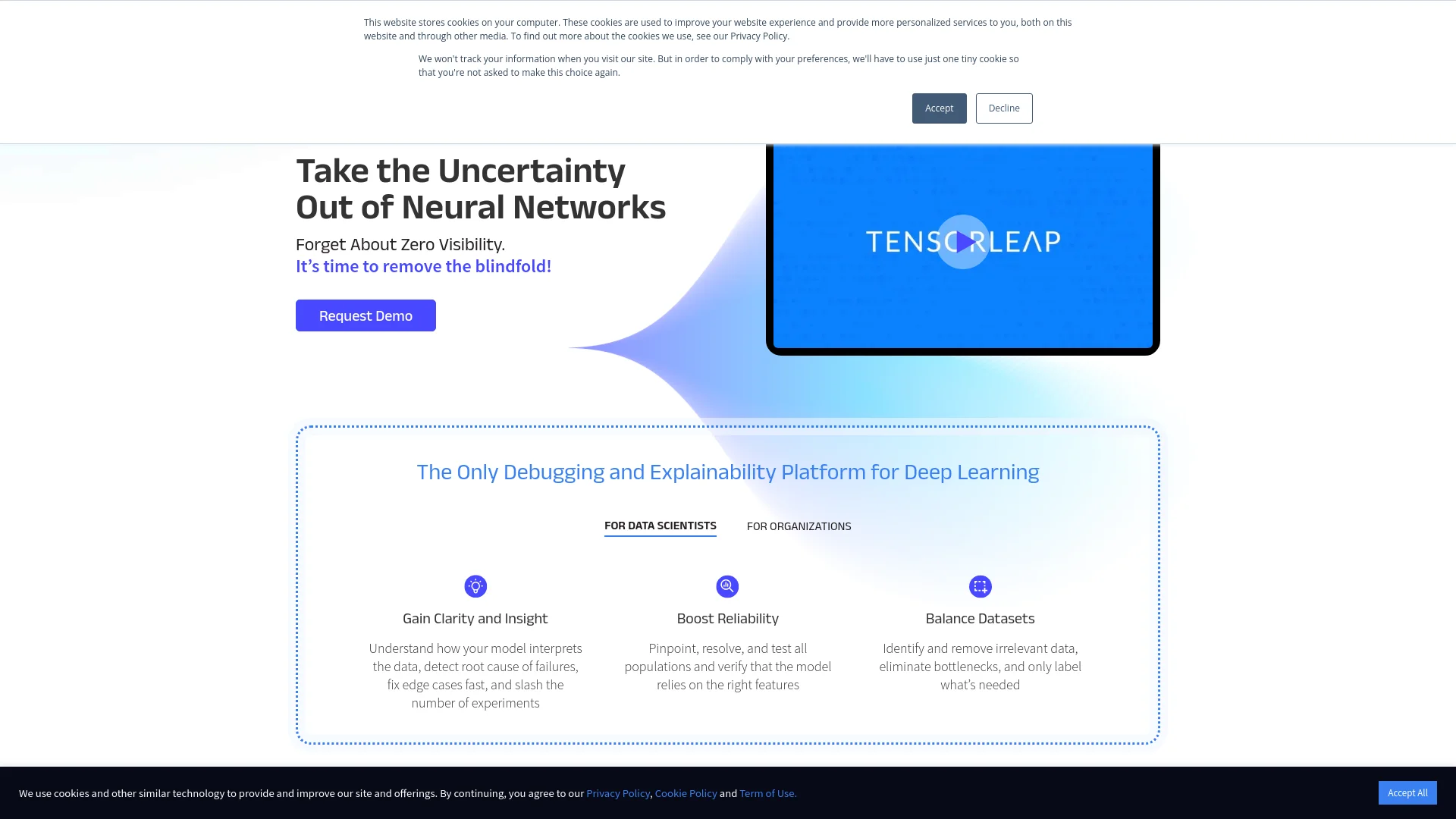
In a landscape where deep learning models are becoming the backbone of technological advancement, TensorLeap emerges as a pivotal tool. This platform is dedicated to debugging and explainability in deep learning, designed specifically to enhance the transparency and efficiency of neural network development. For data scientists and organizations alike, TensorLeap offers a robust suite of features aimed at demystifying the inner workings of complex models, thereby accelerating development cycles and ensuring reliability.
TensorLeap stands out by providing unparalleled visibility into the neural network development process. Its ability to swiftly identify and rectify model failures and to ensure that models are built on solid, empirical foundations sets it apart in the realm of AI development tools.
TensorLeap excels at enhancing the reliability and efficiency of deep learning models, making it an indispensable tool for data scientists and organizations focused on AI innovation. Its unique debugging and explainability capabilities, combined with powerful optimization tools, offer significant advantages in developing robust, effective neural networks.
Who is Using TensorLeap?
Data Scientists
Utilizing the platform to gain insights into model behavior and streamline the debugging process.
AI Research Institutions
Employing TensorLeap to push the boundaries of what's possible with neural networks.
Tech Companies
Integrating the tool to enhance product offerings through more reliable AI models.
Healthcare Sector
Applying the tool to improve diagnostic algorithms and patient data analysis.
Uncommon Use Cases
Used by financial analysts for risk assessment models; adopted by automotive companies for developing autonomous driving technologies.
Key Features
Rating Breakdown
Pricing Plans
Free Trial
- Start with a robust free trial to explore the functionalities without any initial investment
Subscription Plans
- Detailed pricing plans are available upon request through the official TensorLeap website
TensorLeap Use Cases
Model failure analysis
Detect failure modes, edge cases, and domain gaps in neural-network behavior.
Outcome: Identify root causes and prioritize fixes.
Dataset curation
Analyze populations, remove redundancy, prioritize labeling, and identify dataset gaps.
Outcome: Improve coverage while reducing unnecessary labeling and data.
Model optimization
Use analysis to guide losses, hyperparameters, retraining subsets, and architecture changes.
Outcome: Reduce blind experimentation and improve model performance.
Production monitoring
Monitor deployed models for drift, regressions, and changing behavior.
Outcome: Receive visibility into production degradation and apply corrective fixes.
Model explainability
Inspect model features, latent spaces, samples, metrics, visualizations, and prediction behavior.
Outcome: Understand why models make particular decisions.
Workflow Ideas with TensorLeap
Integrate and analyze a model
- 1Install and authenticate the Leap CLI
- 2Upload the dataset script and model
- 3Evaluate the model and inspect analysis results
Debug a model failure
- 1Detect failure modes and affected populations
- 2Inspect visualizations, metadata, and metrics
- 3Apply a targeted data or model fix and re-test
Improve dataset efficiency
- 1Explore dataset populations and clusters
- 2Identify redundant or underrepresented samples
- 3Prioritize labeling and curate the next training set
How TensorLeap fits into your stack
API Access
Offers extensive API capabilities for custom integrations.
Documentation and Support
Provides comprehensive documentation and support to facilitate integration and usage.
Flexible Deployment
Compatible with major cloud platforms and can be deployed in various environments.
Team Collaboration Features
Enhances team collaboration with tools for sharing insights and iterations.
Pros
- +Enhanced Model Reliability: By focusing on the right features and data, TensorLeap boosts the overall confidence and performance of models.
- +Speed in Development: Claims to develop neural networks up to 10x faster by leveraging data-driven insights and analytics.
- +Cost Efficiency: Reduces resource utilization and maximizes team productivity, effectively cutting down development costs.
- +Improved Data Handling: Offers tools to balance datasets and mitigate biases, which is crucial for building fair and effective models.
Cons
- −Learning Curve: New users may require time to fully grasp the extensive features and methodologies employed by TensorLeap.
- −Niche Focus: Primarily caters to users with deep learning applications, which may not be suitable for those looking for broader AI toolsets.
- −Integration Complexity: While powerful, integrating TensorLeap with existing systems and workflows might challenge some organizations.
Limitations & when to consider alternatives
Known limitations
- Model integration is required. Users must provide integration scripts, configuration files, and an integration test before using the platform.
- Supported model formats are constrained. Core documentation lists ONNX and H5 model support, with additional import formats documented for TensorFlow and PyTorch.
- Windows server installation is unsupported. The on-premises server must run on Ubuntu or macOS; Windows is listed as unsupported for the server.
- Cloud persistent storage is temporary. Cloud persistent storage at /nfs/ is intended as a cache and is regularly cleaned.
- Setup requires infrastructure. On-premises deployment requires server resources, GPU dependencies, exposed connectivity, and installation of the Tensorleap server.
Look elsewhere when
- You need a native mobile application.
- You need a browser extension.
- You need multilingual conversational AI.
- You need an AI coding assistant that generates code.
How to Use TensorLeap
- 1
Explore a range of tutorials and documentation available on the TensorLeap website, covering everything from basic setup to advanced operational techniques.
Who is TensorLeap For?
Robotics teams
Tensorleap is positioned for teams debugging and improving neural networks used in robotics.
Autonomous-vehicle teams
The platform targets autonomous-driving and ADAS model behavior, edge cases, and production failures.
Healthcare AI teams
Healthcare is listed as an industry where Tensorleap helps analyze and improve deep-learning models.
Manufacturing teams
Manufacturing organizations can use Tensorleap for model debugging, dataset curation, and optimization.
Data scientists
Tensorleap documentation specifically describes data scientists using the platform to understand failures and improve models.
Frequently Asked Questions
What is Tensorleap?
Tensorleap is a deep-learning debugging, observability, and explainability platform for analyzing model behavior, datasets, and failures.
How does Tensorleap integrate with existing models?
Users connect datasets and models through integration scripts, integration tests, and the Leap CLI. Supported model formats include ONNX and H5.
Can Tensorleap be deployed on-premises?
Yes. Tensorleap documents on-premises or local server installation, with clients connecting through the browser and CLI.
What types of analysis does Tensorleap provide?
The platform supports guided error analysis, unit testing, dataset analysis, visualizations, metrics, model evaluation, and explainability.
Can Tensorleap train models?
Yes. Documentation describes training from scratch, retraining, and evaluating models inside the platform.
What model formats does Tensorleap support?
Documentation lists ONNX and H5, and the import workflow also describes TensorFlow SavedModel, H5, JSON, and PyTorch ONNX formats.
Community reviews
Be the first to share your experience.
Sign in to leave a review for TensorLeap.
TensorLeap Alternatives
Looking for alternatives to TensorLeap? Here are similar tools in the same category:
Learn to Master TensorLeap
With Skill Leap courses
Get in-depth training on TensorLeap and 50+ other AI tools with our expert-led video courses.
Start 7-Day Free Trial