
Temporal Technologies
Ensures resilient, fault-tolerant applications with durable execution.
Key Takeaways
- What it is
- Ensures resilient, fault-tolerant applications with durable execution.
- Pricing
- Freemium · $0.05 per execution
- Best for
- Durable Execution
- Open Source
- Event-Driven Architecture
- Rating
- 4.5/5
What is Temporal Technologies?
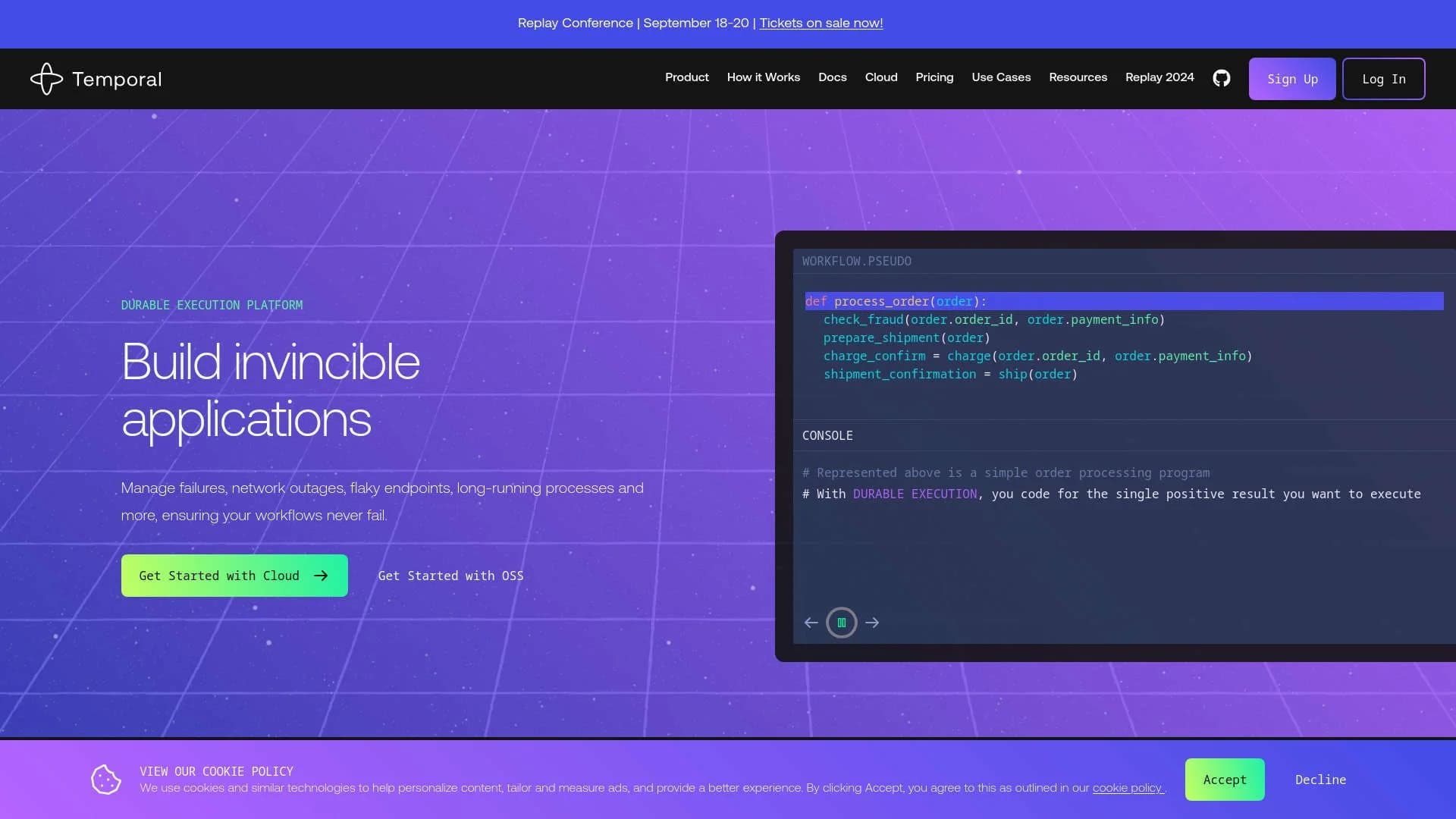
Temporal Technologies revolutionizes the way developers build and manage distributed systems. At its core, Temporal Technologies offers a durable execution platform that ensures applications are resilient against failures, network outages, and other disruptions. Designed for developers and enterprises, it simplifies the development of reliable and scalable systems by abstracting the complexities of infrastructure management.
Temporal Technologies stands out with its durable execution capability, a game-changer for building reliable, fault-tolerant applications. Its ability to abstract away the complexities of distributed systems and focus on business logic sets it apart, enabling developers to deliver reliable systems faster.
Temporal Technologies excels in providing durable execution capabilities, making it an essential tool for developers and enterprises seeking to build reliable, scalable, and fault-tolerant systems. Its focus on simplifying the complexities of distributed systems while delivering robust performance and flexibility makes it a standout choice in the AI tool landscape.
Who is Using Temporal Technologies?
E-commerce Businesses
Utilizing Temporal for reliable order processing and inventory management.
Financial Institutions
Employing the platform for secure and consistent transaction processing.
Healthcare Providers
Leveraging Temporal to ensure fault-tolerant patient data management systems.
Logistics Companies
Using Temporal for robust and reliable supply chain management.
Uncommon Use Cases
Adopted by educational institutions for teaching distributed systems; utilized by non-profits for managing volunteer coordination workflows.
Key Features
Rating Breakdown
Pricing Plans
Free Tier
Free
- Experience Temporal with a free tier offering
Pro Tier
$0.05 per execution
Which Temporal Technologies plan should you pick?
Start with Open Source for self-hosting or Essentials for basic Temporal Cloud workflows; upgrade to Business or Enterprise for larger workloads, SAML SSO, SCIM, and expanded support.
Open Source
Good for teams that need the Temporal Service, SDKs, CLI, and UI on their own infrastructure.
Essentials
Good for basic Temporal Cloud workflows needing managed infrastructure, user roles, API keys, audit logging, and workflow management.
Business
Good for teams scaling Temporal that need larger included usage, commitments, and SAML SSO.
Enterprise
Good for enterprise and mission-critical workloads needing larger usage allocations, SCIM, 24/7 support, and technical onboarding.
Temporal Technologies Use Cases
AI agents and pipelines
Build durable AI agents, MCP workflows, and AI pipelines that coordinate tools and long-running execution.
Outcome: AI processes continue through failures and retain their execution state.
Infrastructure automation
Orchestrate long-running, failure-resilient infrastructure deployments and automation.
Outcome: Deployments can retry, recover, and roll back safely.
Order fulfillment
Coordinate order-processing steps across services and keep the order moving when one service fails.
Outcome: Orders avoid brittle, manually recovered process failures.
Payment processing
Build durable workflows for payment and transaction processes requiring strict reliability and state management.
Outcome: End-to-end payment workflows complete, retry, roll back, or commit gracefully.
Human-in-the-loop workflows
Pause workflows for approvals, validation, or other human decisions before continuing execution.
Outcome: Human input becomes a durable part of the application process.
Workflow Ideas with Temporal Technologies
Durable AI agent workflow
- 1Define the AI application as a Temporal Workflow
- 2Orchestrate interactions with tools and distributed data stores
- 3Retry failed or invalid model calls until the workflow completes
Infrastructure deployment workflow
- 1Request infrastructure through a self-service interface
- 2Run multi-step provisioning and deployment activities
- 3Coordinate retries, monitoring, and safe rollback
Secure platform lifecycle workflow
- 1Trigger credential rotation or lifecycle management
- 2Execute the required security operations across platform systems
- 3Record structured execution history for governance and debugging
How Temporal Technologies fits into your stack
API Access
Developers can harness Temporal's API for custom integrations.
Polyglot Development
Supports development in multiple programming languages, enabling seamless integration into diverse tech stacks.
Temporal Cloud
Provides a serverless, scalable solution for running Temporal services without the hassle of managing infrastructure.
Pros
- +Reliability: Temporal makes applications inherently durable, reducing failures by 10-100X.
- +Scalability: Abstracts infrastructure complexities, allowing for seamless scaling of distributed systems.
- +Community Support: Boasts a growing and active community, providing ample resources and support.
- +Flexibility: Supports multiple programming languages and can be integrated into various applications, from transaction processing to applied AI.
Cons
- −Initial Learning Curve: Requires some time to get accustomed to its advanced features and concepts.
- −Limited Third-Party Integrations: While powerful, it currently supports a limited number of third-party platforms out-of-the-box.
Limitations & when to consider alternatives
Known limitations
- Cloud API keys expire. Temporal Cloud API keys expire according to their configured expiration date, with a maximum expiration time of two years.
- Self-hosted deployments require operational ownership. Customers running Temporal Self-Hosted are responsible for maintaining software patches and upgrades.
- SAML SSO is paid. SAML authentication is a paid Temporal Cloud feature and is included in the Business plan and above.
- Cloud usage is metered. Temporal Cloud pricing measures Actions, capacity, storage, and support or plan fees.
Look elsewhere when
- You need a native mobile app for operating workflows.
- You need built-in model fine-tuning or custom model training.
- Your primary need is a visual no-code workflow builder.
How to Use Temporal Technologies
- 1
Explore the comprehensive tutorial series on YouTube, covering everything from basic setup to advanced features of Temporal Technologies.
Who is Temporal Technologies For?
Platform engineering teams
Temporal helps platform teams orchestrate infrastructure, build internal control planes, provide developer self-service, and automate secure lifecycle management.
AI application and agent developers
Temporal provides durable workflows, orchestration, retries, state handling, and observability for complex AI applications.
Startups
Temporal Cloud offers a startup program, technical onboarding, design reviews, production-readiness support, and worker tuning.
Financial services teams
Temporal is positioned for reliable, durable workflows such as payments, ledgers, and other mission-critical financial processes.
Enterprise application teams
Temporal Cloud provides managed infrastructure, high availability, scaling, enterprise security, access controls, and support.
Frequently Asked Questions
What is Temporal?
Temporal is an open-source platform for building reliable applications with durable, fault-tolerant Workflow execution.
What is Temporal Cloud?
Temporal Cloud is the fully managed Temporal Service for running critical applications securely at scale.
Can Temporal be self-hosted?
Yes. Temporal Self-Hosted is open source and runs on infrastructure controlled by the customer.
How does Temporal pricing work?
Temporal Cloud uses pay-as-you-go pricing based on Actions, capacity, storage, and plan-level support fees.
Does Temporal support AI applications?
Yes. Temporal provides durable workflows, orchestration, retries, state handling, human-in-the-loop interactions, and integrations for AI applications and agents.
Does Temporal provide enterprise access controls?
Yes. Temporal Cloud provides roles, permissions, API keys, service accounts, audit logging, and SAML SSO.
Community reviews
Be the first to share your experience.
Sign in to leave a review for Temporal Technologies.
Temporal Technologies Alternatives
Looking for alternatives to Temporal Technologies? Here are similar tools in the same category:
Learn to Master Temporal Technologies
With Skill Leap courses
Get in-depth training on Temporal Technologies and 50+ other AI tools with our expert-led video courses.
Start 7-Day Free Trial