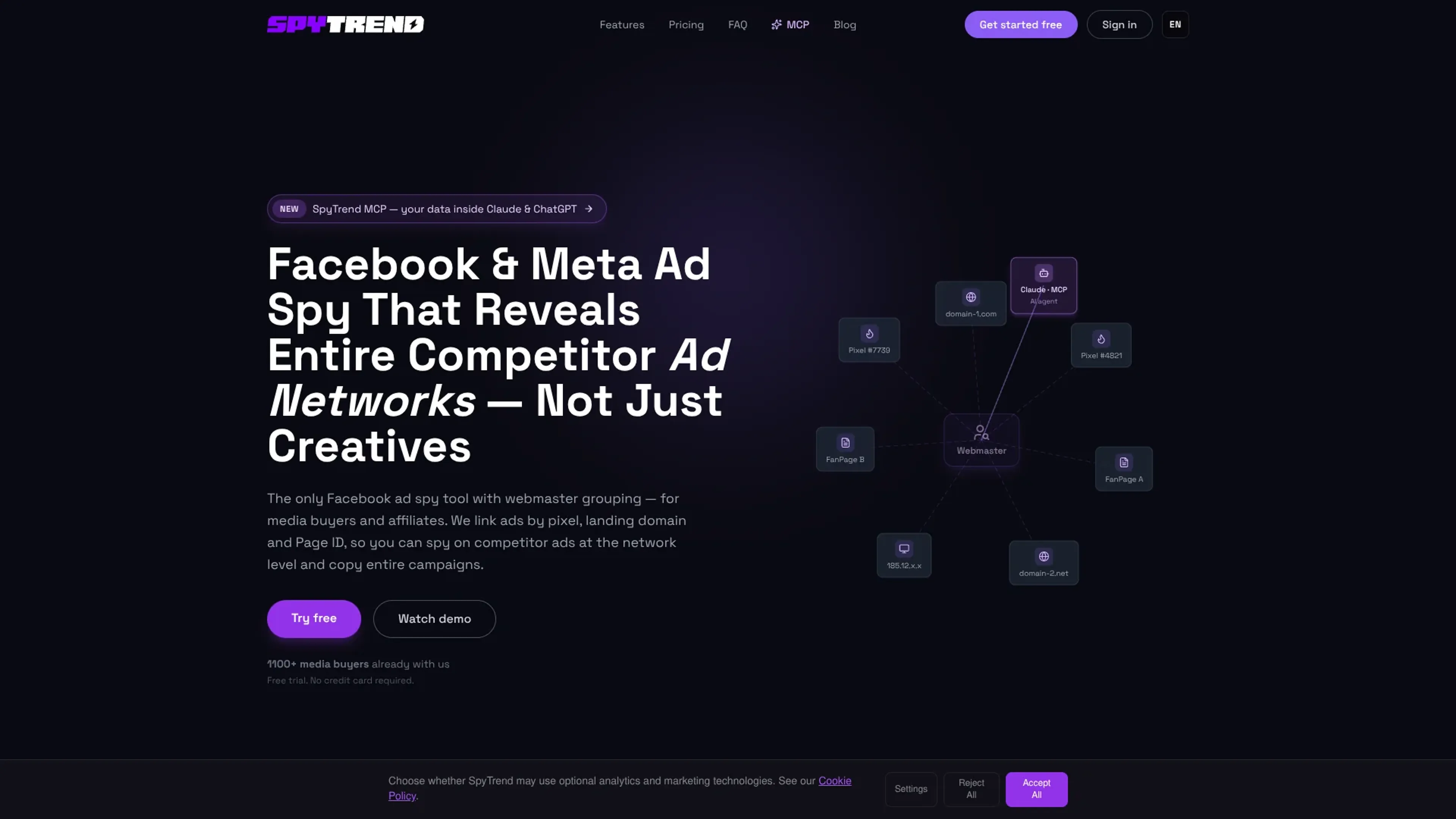
SpyTrend is a Facebook, Meta, and TikTok ad intelligence platform for performance media buyers, affiliates, and growth teams who need to see entire competitor ad networks instead of isolated creatives. It groups ads by webmaster identity across pixels, domains, fan pages, and IPs, then layers in filters for vertical, geo, and profitability. Teams use it to shorten manual ad research and feed structured data into AI assistants.
Key Features:
Webmaster Grouping and Identity Resolution: Groups ads by pixel, domain, Page ID, and IP so marketers can inspect a competitor's entire operator ecosystem from a single profile instead of guessing which domains belong together.
Real-Time Meta and TikTok Ad Index: Indexes about 1.1 billion ads with roughly 230 million new creatives each month, tagged across 33 verticals, with search response times under one second.
Profitability and Revival Signals: Tracks how many days an ad has been active, supports filters like “Days Active > 5,” and detects paused-and-relaunched creatives so users can focus on campaigns with demonstrated spend.
Manual Tagging, Deduplication, and Creative Analytics: Lets users tag ads, hide unwanted creatives from future feeds, and collapse near-identical variants into one record using perceptual hash analysis.
Custom Keyword, Geo, and Trend Tracking: Collects all new ads that match user-defined keywords and geos and offers a Trends section where marketers define what counts as explosive growth to surface scaling campaigns.
AI Agent and MCP Integration: Provides an official MCP connector with 20 tools so AI agents in clients like Claude, ChatGPT, and Cursor can query SpyTrend's ad graph in plain language instead of manual filtering.
Pros
Network-level visibility: Webmaster grouping across pixels, domains, Page IDs, and IPs reveals multi-domain setups that classic single-ad spy tools skip. (spytrend.com)
Fresh, fast data: Real-time ingestion, search speeds under one second, and no 3 to 7 day lag put new Meta ads in front of users earlier than several rivals listed in its comparison table. (spytrend.com)
High signal for performance marketers: Vertical tags, Days Active filters, profitability and revival signals, and a Quick Win widget all focus attention on campaigns that are more likely to be spending profitably. (spytrend.com)
AI-friendly workflow: The MCP connector and AI-assistant integrations turn plain-language prompts into structured SpyTrend queries instead of long filter sessions. (spytrend.com)
Competitive pricing: A freemium Starter tier, a $79 Pro plan, and a lower entry price than several named competitors make it approachable for smaller teams. (spytrend.com)
Cons
Limited ad history on Pro: The Pro plan includes only 90 days of historical data, which can restrict long-run analysis without moving up. (spytrend.com)
Best suited to performance use cases: Official guidance says it is not aimed at brand marketers focused on awareness or teams whose main need is bulk creative downloads. (spytrend.com)
Channel scope is narrow: Product positioning centers on Facebook, Meta, and TikTok, so teams needing broader cross-channel monitoring may still keep separate tools. (spytrend.com)
Who is Using SpyTrend?
Performance media buyers at agencies: Use webmaster grouping and profitability filters to copy or counter the strongest competitor funnels in their clients' verticals.
Affiliate marketers and arbitrage teams: Monitor webmaster clusters in crypto and other high-intent niches to see which offers and landers are scaling.
Ecommerce and dropshipping operators: Filter by the e-commerce vertical and Days Active to quickly shortlist physical products with creatives that have already proven to sell.
Digital marketing agencies and consultants: Replace multi-day manual audits with webmaster-level campaign maps and reports for clients.
Product and growth analysts: Combine SpyTrend's Websites and traffic-correlation views with internal analytics to understand how Meta ads drive site visits.
Uncommon Use Cases: Building internal AI agents on top of the MCP connector to answer competitive-ad questions; experimenting with custom models that correlate webmaster activity with downstream conversion data.
Pricing:
Starter: $0 per month; limited ad database access, basic ad information, and basic search
Pro: $79 per month, or $63 per month when billed annually; unlimited searches, full webmaster grouping, pixel and landing intelligence, deduplication, data export, and 90 days of history for 1 user
Team: from $63.20 per seat per month, or from $50.40 per seat per month when billed annually; everything in Pro for 4 to 20 members, with centralized billing, invite links, and priority support
Additional AI Categories: Pro includes 1 AI category free; each extra category costs $50 per month
Disclaimer: Please note that pricing information may not be up to date. For the most accurate and current pricing details, refer to the official SpyTrend website.
What Makes SpyTrend Unique?
SpyTrend's defining strength is webmaster identity resolution: instead of only listing ads, it reconstructs full operator ecosystems across pixels, domains, fan pages, and IPs, then exposes that graph in both its UI and an MCP connector that AI agents can query directly, something its own comparison materials say competing ad spy tools do not offer.
How We Rated It:
Accuracy and Reliability: 4.4/5
Ease of Use: 4.0/5
Functionality and Features: 4.6/5
Performance and Speed: 4.8/5
Customization and Flexibility: 4.1/5
Data Privacy and Security: 4.5/5
Support and Resources: 3.9/5
Cost-Efficiency: 4.7/5
Integration Capabilities: 3.8/5
Overall Score: 4.3/5
Webmaster-Level Intelligence For Meta Ads:
SpyTrend gives performance-focused teams a fast, structured view of how Meta and TikTok advertisers actually operate, from pixels and domains to which creatives keep getting revived. It is especially strong for media buyers, affiliates, and agencies who care about profitable campaigns more than brand storytelling, and it becomes even more useful when wired into AI agents through its MCP connector. Teams that need longer history or broader channel coverage should treat it as a specialist tool rather than their only source of ad intelligence.