Sapien
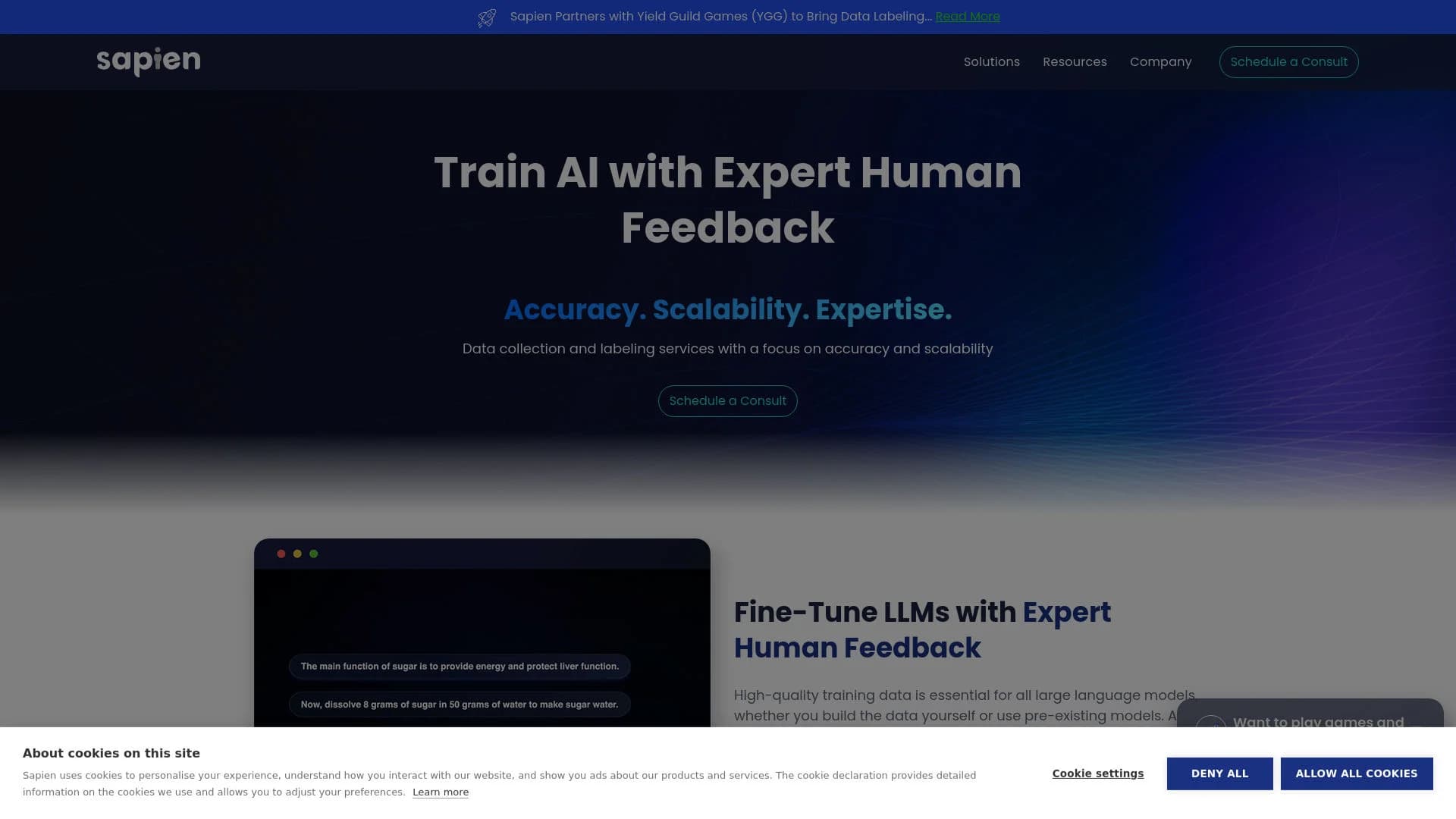
Human-augmented AI data labeling for scalable, high-quality training.
Key Takeaways
- What it is
- Human-augmented AI data labeling for scalable, high-quality training.
- Best for
- Expert Human Feedback
- Scalable Labeling Operations
- Customizable Labeling Solutions
- Rating
- 4.5/5
What is Sapien?
Sapien is a cutting-edge AI tool designed to optimize the efficiency and effectiveness of large language models (LLMs) through meticulous data labeling and human feedback integration. Positioned uniquely in the AI landscape, Sapien caters to industries and professionals who seek to enhance the performance of their AI models with high-quality, scalable training data. By emphasizing human-in-the-loop processes, Sapien ensures that each dataset is not only robust but also finely tuned to meet specific operational needs.
Sapien stands out with its robust integration of human intelligence in the AI training loop, significantly enhancing the accuracy and functionality of LLMs. Its ability to provide scalable, customized data labeling solutions sets it apart in the AI development space.
Sapien excels in providing top-notch data labeling and human feedback integration, making it an indispensable tool for enhancing AI models. Its standout feature of combining AI with expert human intelligence offers an unmatched advantage in creating highly accurate and scalable AI solutions. Whether for improving existing models or building new ones from scratch, Sapien offers the expertise and tools necessary to succeed in today's AI-driven landscape.
Who is Using Sapien?
EdTech Companies
Creating and refining educational content with accurate language models.
Insurance Firms
Improving document processing and customer interaction through better data understanding.
Logistics Companies
Optimizing route planning and freight classification through enhanced AI models.
Finance Sector
Using for risk assessment and compliance monitoring.
Uncommon Use Cases
Non-profit organizations for grant writing and reporting; startups in emerging markets for local language data handling.
Key Features
Rating Breakdown
Pricing Plans
Consultation-Based Pricing
- Offers tailored pricing plans based on specific project needs and scale
Sapien Use Cases
Labeling and annotation quality
Upload training data or annotation metadata and have validators review each item against a rubric.
Outcome: A measurable quality result and signed evidence that the data was checked.
AI output evaluation
Evaluate model answers, recommendations, labels, or other generated outputs using independent validators.
Outcome: Quality and consensus scores for the evaluated outputs.
Agent-behavior review
Review agent decisions and actions where correctness depends on context and expert judgment.
Outcome: A verifiable record of how the agent behavior was judged.
Security and compliance review
Convert expert findings and review results into structured validation tasks and an auditable report.
Outcome: Signed records that customers, auditors, and downstream systems can inspect.
Prompt-quality comparison
Compare prompts and evaluations that shape production AI behavior against a shared quality standard.
Outcome: Evidence showing where quality or reviewer agreement needs improvement.
Workflow Ideas with Sapien
Create a validation project
- 1Write a poq.md brief or prepare a poq.toml specification
- 2Upload a data folder and review the generated validator interface
- 3Finalize the project and begin validation
Run an API-driven evaluation
- 1Create an API key and verify connectivity
- 2Create a project with a JSON specification
- 3Upload files, process the session, and poll ingestion status
Produce and verify a quality report
- 1Have validators score datapoints against the rubric
- 2Wait for consensus and finalization
- 3Download the signed report and verify it offline
How Sapien fits into your stack
Flexible Integration Options
Designed to be compatible with various AI platforms and tools.
API Access
Integrates capabilities into existing systems through a well-documented API.
Custom Data Handling
Manages unique data types and formats specific to industry needs.
Pros
- +Accuracy and Scalability: Focus on precise data labeling and scalability makes it an ideal choice for enterprises looking to enhance their AI models.
- +Cost-Effective: Helps reduce overall project costs by optimizing the labeling process and providing customized solutions.
- +Diverse Industry Application: Expertise spans multiple industries, offering versatile solutions from healthcare to legal and EdTech.
- +Extensive Language Support: Ability to handle a vast array of languages and dialects makes it perfect for global projects.
Cons
- −Complex Setup: New users might find the initial setup and customization process somewhat complex.
- −Premium Pricing: The cost might be a consideration for small businesses or startups due to the high-quality, tailored services provided.
- −Limited Public Resources: More detailed public resources or community forums could enhance the user experience.
Limitations & when to consider alternatives
Known limitations
- Maximum file size. Individual uploaded files are limited to 5 GiB.
- Maximum project size. A single project can produce at most 1,000,000 datapoints.
- Binary ingestion requires a folder. The file_collection source supports folders of binary files, but not a single binary file.
- Limited nested JSON handling. Fields nested more than one level deep and arrays nested inside arrays are unsupported without preprocessing.
- Only one Markdown split level. Markdown sections can be split once; sections cannot then be divided into smaller pieces again.
Look elsewhere when
- You need a native mobile application.
- You need a general-purpose AI chat or coding assistant.
- You need fine-tuning or model training inside the product.
How to Use Sapien
- 1
Explore detailed tutorials and case studies on the Sapien Blog, offering insights from basic setup to advanced operational techniques.
Who is Sapien For?
AI builders
Builders can evaluate model outputs, agent behavior, prompts, and other AI work against explicit quality standards.
Data-quality teams
Data-quality teams can measure whether labels and datasets meet a defined standard and preserve the review evidence.
Auditors and reviewers
Auditors and expert reviewers can turn findings, security checks, compliance reviews, and expert judgments into signed records.
AI and agent evaluation teams
Teams can grade AI answers and agent steps with panels of reviewers instead of relying on a single grader.
Frequently Asked Questions
What is Sapien Proof of Quality?
Proof of Quality is a verification layer for AI work. It applies a customer-defined rubric, uses independent validators, measures consensus, and produces a verifiable record.
How does the PoQ workflow work?
Projects move through Define, Validate, and Attest. Data becomes reviewable datapoints, validators score them, and Sapien creates a signed PoQ Report.
Can I use Sapien through an API?
Yes. The Developer API manages projects, uploads, datapoints, consensus results, and PoQ Reports using bearer API keys.
What file types does Sapien support?
Supported inputs include CSV, JSON, image and PDF collections, other binary files, and Markdown documents.
What does a PoQ Report contain?
A report records what was reviewed, who reviewed it, the rubric used, the quality result, consensus strength, and attestation details. Reports are delivered as text, HTML, JSON, or JWS.
Can reports be verified without Sapien?
Yes. Text and HTML reports carry their signature and can be verified offline with trusted Sapien keys.
Community reviews
Be the first to share your experience.
Sign in to leave a review for Sapien.
Sapien Alternatives
Looking for alternatives to Sapien? Here are similar tools in the same category:
Learn to Master Sapien
With Skill Leap courses
Get in-depth training on Sapien and 50+ other AI tools with our expert-led video courses.
Start 7-Day Free Trial