
Retinai
Enhance ophthalmology with AI-driven data management and analysis.
Key Takeaways
- What it is
- Enhance ophthalmology with AI-driven data management and analysis.
- Best for
- Data Management Capabilities
- Advanced AI Analysis
- Global Collaboration Tools
- Rating
- 4.5/5
What is Retinai?
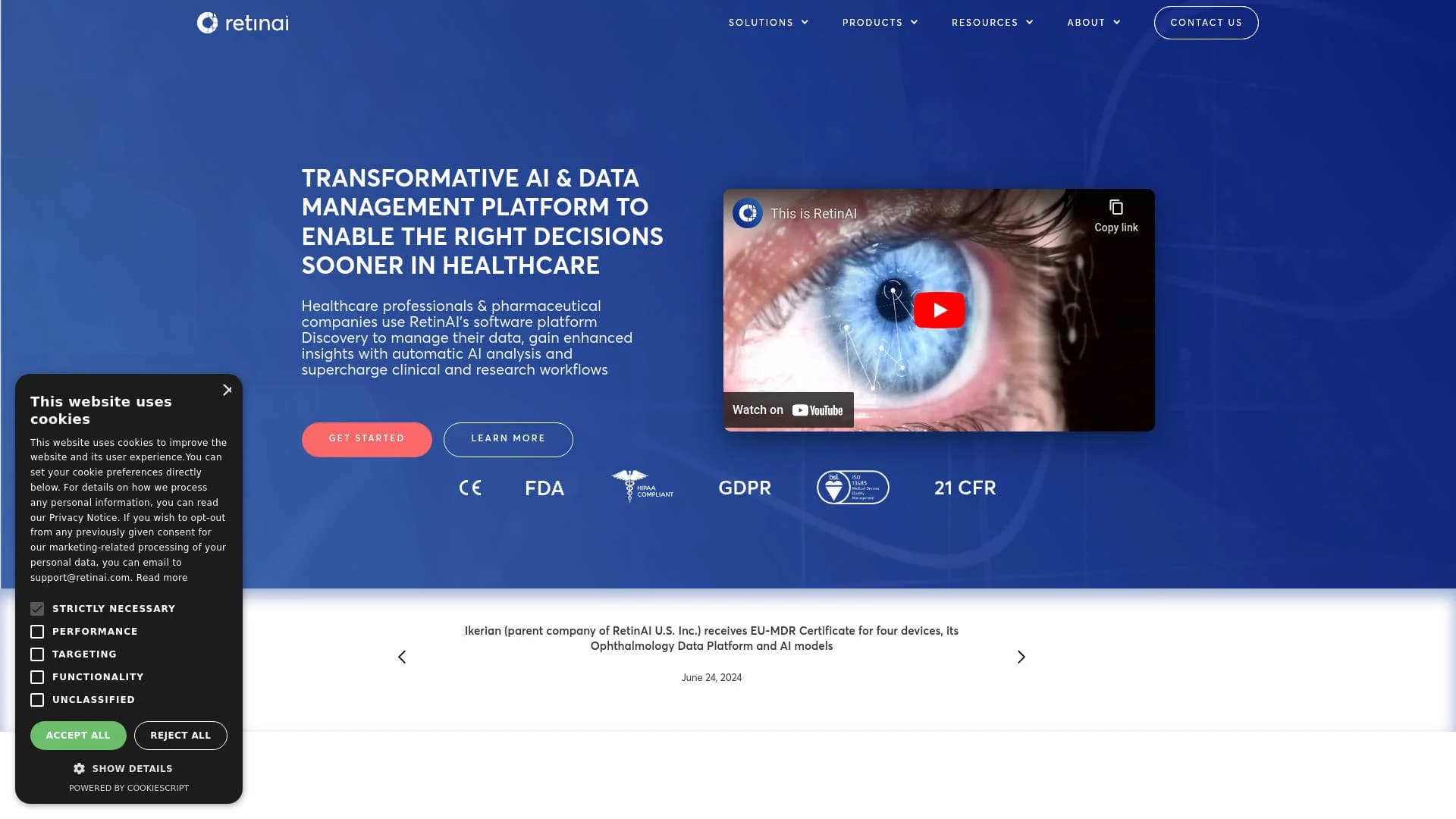
RetinAI is a transformative AI and data management platform designed specifically for the healthcare sector, particularly focusing on ophthalmology. This sophisticated tool empowers healthcare professionals and pharmaceutical companies to efficiently manage data, perform automatic AI analysis, and enhance clinical and research workflows. With its suite of applications and features, RetinAI aims to expedite the decision-making process in healthcare, providing faster, more accurate insights into patient care and disease management.
RetinAI stands out with its specialized focus on ophthalmology, integrating AI-driven insights with clinical data management. Its ability to support real-world evidence collection and multicenter collaboration makes it a unique and valuable tool in the field of medical research and patient care.
RetinAI excels in providing advanced AI-driven solutions and robust data management for the ophthalmology sector, making it an essential tool for healthcare professionals and researchers. Its specialized features, including CE-marked AI models and global collaboration tools, offer unmatched advantages in improving patient outcomes and enhancing clinical trials.
Who is Using Retinai?
Pharmaceutical Companies
Employing the platform to enhance drug development and clinical trials.
Ophthalmology Clinics
Utilizing advanced AI tools for patient diagnosis and management.
Academic Researchers
Leveraging the platform for conducting detailed ophthalmic research.
Healthcare Device Manufacturers
Integrating RetinAI’s solutions to improve device functionality and data handling.
Key Features
Rating Breakdown
Pricing Plans
Custom Pricing Model
- RetinAI offers tailored pricing based on the specific needs and scale of the user’s organization
Which Retinai plan should you pick?
RetinAI does not publish public pricing; start with the product edition matching your organization and request a demo for commercial access.
Discovery for Clinics
Good for ophthalmologists and optometrists who need AI-assisted patient management and clinical workflows.
Discovery for Clinical Studies
Good for pharma, CROs, and researchers who need multimodal clinical-study data collection and analysis.
Discovery UNITY
Good for pharma and life-sciences teams who need organization-wide data unification and research insights.
Retinai Use Cases
Clinical trial patient selection
Analyze retinal imaging and biomarkers to identify patients who may meet study criteria.
Outcome: Faster candidate identification and more efficient enrollment.
Retinal disease monitoring
Use OCT analysis, layer segmentation, fluid quantification, and biomarkers to evaluate disease progression.
Outcome: More consistent and data-driven disease assessment.
Real-world evidence
Aggregate clinical and imaging datasets, analyze patient populations, and study treatment outcomes.
Outcome: Deeper insights into disease progression and real-world treatment patterns.
Tele-ophthalmology
Centralize patient data and share it securely for remote evaluation and peer referrals.
Outcome: Immediate access to imaging and more streamlined referral workflows.
Automated OCT data intake
Use Discovery CONNECT to synchronize OCT scans from supported devices, optionally anonymizing DICOM data.
Outcome: Less manual uploading and faster availability of scans for review.
Workflow Ideas with Retinai
Automate OCT synchronization
- 1Install Discovery CONNECT on a Windows, Linux, or macOS computer
- 2Point CONNECT to the folder where the OCT device saves patient scans
- 3Configure scan history, scheduling, and optional DICOM anonymization
Review retinal imaging with AI
- 1Upload OCT, fundus, or other supported imaging data
- 2Run available RetinAI AI models for segmentation, biomarkers, or fluid analysis
- 3Review the resulting measurements and insights in Discovery
Collaborate on a clinical dataset
- 1Organize patient acquisitions and visits in Discovery workbooks
- 2Invite collaborators to the dataset
- 3Assign appropriate permission levels for review, analysis, or collaboration
How Retinai fits into your stack
Multi-Format Support
Handles a wide range of data formats, enhancing flexibility in data usage.
Cloud-Based Collaboration
Facilitates seamless collaboration across different geographic locations and institutions.
Regulatory Compliance
Meets stringent data privacy and security regulations, ensuring user trust and safety.
Vendor Neutral
Compatible with various imaging devices and data types, promoting interoperability.
Pros
- +Enhanced Efficiency: Streamlines data collection and analysis, significantly reducing the time required for these processes.
- +Improved Accuracy: AI algorithms provide precise measurements and analyses, improving diagnostic and treatment accuracy.
- +Scalability: Suitable for various users from individual clinicians to large pharmaceutical companies.
- +Security and Compliance: Ensures data security and compliance with major standards like GDPR and HIPAA.
Cons
- −Complexity in Initial Setup: May require a detailed initial setup and some technical knowledge to fully utilize all features.
- −Specialization Limitation: Primarily focused on ophthalmology, which might not be applicable for other medical fields without specific modules.
- −Cost Consideration: While offering substantial benefits, the cost might be a consideration for smaller clinics or researchers.
Limitations & when to consider alternatives
Known limitations
- Discovery CONNECT supports selected OCT devices. Automatic synchronization is documented for Heidelberg Spectralis, Zeiss Cirrus, Topcon Maestro, and Topcon Triton devices.
- CONNECT currently uploads up to two years of clinic OCT data. RetinAI states that additional uploading capacity requires contacting the company.
- Trial evaluation is limited. The public evaluation offering allows up to three de-identified OCT scans and is intended for evaluation and educational purposes.
- Some AI modules are research-use-only in the United States. RetinAI states that certain biomarker, fluid, and layer-segmentation modules are designated RUO in the USA.
- RetinAI is specialized in ophthalmology. The documented platform and models focus on retinal imaging, ophthalmic clinical data, and related research workflows.
Look elsewhere when
- You need a general-purpose AI assistant rather than an ophthalmology platform.
- You need a native mobile application.
- You need publicly documented developer API endpoints.
How to Use Retinai
- 1
Create a Discovery account
Register through RetinAI's Discovery access flow and wait for credentials, which the site says are provided within 12–24 hours.
- 2
Upload supported data
Add OCT scans, fundus images, DICOM datasets, PDFs, JPEGs, PNGs, or TIFFs so they can be centralized and analyzed.
- 3
Run AI analysis
Use available RetinAI models for retinal layer segmentation, fluid segmentation, biomarker analysis, or disease-progression assessment.
- 4
Organize datasets
Structure patient visits and acquisitions in workbooks to track longitudinal data and evaluate trends.
- 5
Invite collaborators
Invite colleagues and assign permission levels when multiple stakeholders need to review or work with the same datasets.
- 6
Automate device uploads
For supported OCT devices, install Discovery CONNECT, select the source folder, and configure synchronization and anonymization settings.
Who is Retinai For?
Pharma and life sciences
Discovery supports clinical development, real-world evidence, patient selection, endpoint analysis, and commercialization research.
Clinics and hospitals
The platform centralizes clinical and imaging data, supports AI-assisted assessment, and enables tele-ophthalmology workflows.
Clinical and academic researchers
Researchers can organize multimodal datasets, analyze retinal images, collaborate in real time, and use research-use-only models.
Ophthalmologists
Discovery provides retinal image management, AI analysis, biomarker assessment, referrals, and treatment-support workflows.
Optometrists
Optometrists can use tele-ophthalmology, referral workflows, alerts, and patient screening capabilities.
Frequently Asked Questions
What is RetinAI Discovery?
RetinAI Discovery is a cloud-based ophthalmology data-management platform with integrated AI models for imaging analysis, collaboration, and clinical or research workflows.
What types of data can Discovery manage?
Discovery supports OCTs, fundus images, DICOM datasets, PDFs, JPEG, PNG, and TIFF files, along with other clinical and multimodal data.
Who is Discovery designed for?
RetinAI names pharma and life sciences companies, clinics and hospitals, clinical and academic researchers, ophthalmologists, and optometrists as users.
Can Discovery analyze retinal images?
Yes. Its AI models analyze OCT volumes, segment retinal layers and fluid, quantify biomarkers, and support disease assessment.
Can collaborators work together in Discovery?
Yes. Users can invite collaborators to access and work with datasets using different permission levels.
What is Discovery CONNECT?
Discovery CONNECT is a desktop feature that automatically syncs OCT data from supported imaging devices to RetinAI Discovery.
Community reviews
Be the first to share your experience.
Sign in to leave a review for Retinai.
Retinai Alternatives
Looking for alternatives to Retinai? Here are similar tools in the same category:
Learn to Master Retinai
With Skill Leap courses
Get in-depth training on Retinai and 50+ other AI tools with our expert-led video courses.
Start 7-Day Free Trial