Reshape Biotech
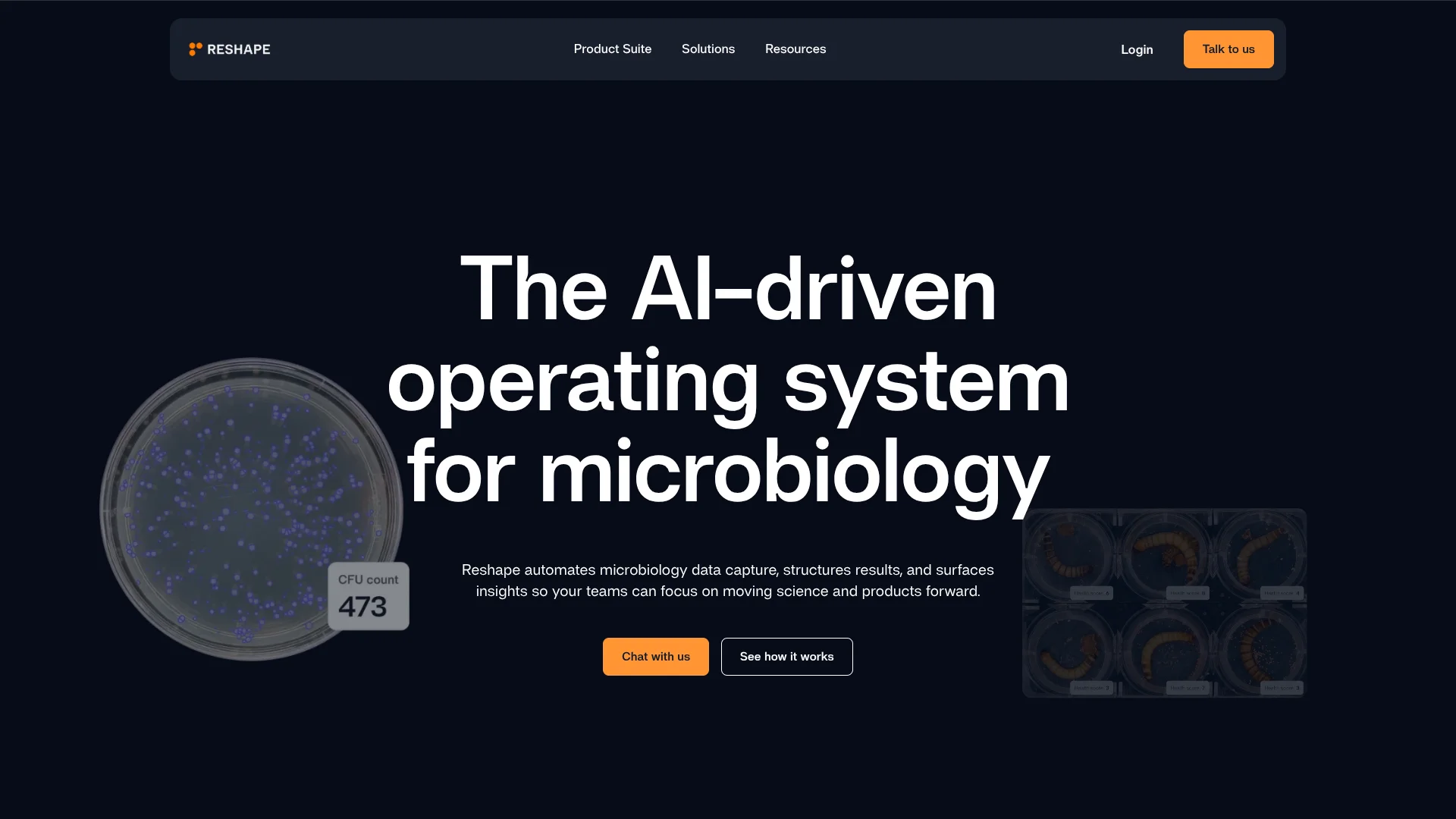
AI-powered Petri dish analysis for microbiology research and quality-control labs.
Key Takeaways
- What it is
- AI-powered Petri dish analysis for microbiology research and quality-control labs.
- Best for
- Experiment-driven discovery
- AI image analysis
- High-throughput Imaging Device
- Rating
- 4.2/5
What is Reshape Biotech?
Reshape Biotech turns microbiology plate experiments into structured images and AI-analyzed results for research and quality-control labs. Its imaging devices capture samples over time or screen Petri dishes in batches, while its cloud software ties results to experiment details. This replaces manual image capture, counting, and scattered records with a more repeatable way to track what happened in a lab.
For quality control, Reshape connects sample setup and barcodes to AI analysis, result categories, and physical plate sorting. Images, metadata, and results stay linked in a searchable record, so teams can trace a result back to the sample and review it later.
Reshape is best suited to microbiology teams that run repeated plate-based experiments or high-volume QC testing. It is specialized rather than a general AI tool, and its automated capture depends on Reshape imaging hardware. The key question is whether its devices and assay workflows match your lab’s methods.
Who is Using Reshape Biotech?
Microbiology researcher
Experiment comparisons help reveal how organisms perform across different conditions.
Quality-control microbiologist
Automated screening and result sorting help focus review on unexpected or borderline plates.
Laboratory operations manager
Sample tracking and standardized records make it easier to monitor routine testing across shifts.
Food safety laboratory manager
AI analysis and linked records support consistent plate-based testing and audit preparation.
Uncommon Use Cases
Tracking seed germination and root or shoot length; measuring insect life-stage changes such as hatchability and mortality.
Key Features
Rating Breakdown
Pricing Plans
Subscription Model
- Pricing is tailored based on laboratory size and needs
Custom Quotes
- Available upon request to fit specific requirements and budget constraints
Which Reshape Biotech plan should you pick?
Start with Start-up for a small lab, upgrade to Growth lab for broader automation and permissions, or choose Industry lab for custom models and unlimited seats.
Start-up
Good for small teams needing one lab platform, up to 10,000 images or videos monthly, one basic AI model, and up to three seats.
Growth lab
Good for labs needing unlimited media, multiple AI models, role-based permissions, data validation, and up to 10 seats.
Industry lab
Good for industry teams needing custom AI analysis, a model builder, LIMS integration, and unlimited team seats.
Reshape Biotech Use Cases
Microbial experiment screening
Plate maps and captured images keep experimental conditions connected to AI analysis for later comparison.
Outcome: Structured, searchable experiment results.
High-volume QC testing
Automated imaging and classification help labs process Petri-dish samples with less manual review.
Outcome: Consistent results with documented sample records.
Reviewing outliers
Predefined thresholds flag unexpected or borderline results for human review.
Outcome: Scientists can focus attention on plates that need judgment.
Comparing growth over time
Time-lapse image capture supports analysis of microbial growth dynamics and assay outcomes.
Outcome: A time-resolved view of growth.
Sharing results with lab systems
API-based data transfer can connect Reshape results and experiment metadata with a LIMS or ELN.
Outcome: Structured results available in connected data systems.
Workflow Ideas with Reshape Biotech
Compare experimental conditions
- 1Define experiment details and plate layouts in Reshape.
- 2Capture endpoint or time-lapse images with an imaging device.
- 3Compare AI-analyzed results across conditions and create a linked report.
Run a traceable QC batch
- 1Set up sample batches and generate plate IDs and barcodes.
- 2Screen plates with the High-throughput Imaging Device.
- 3Review flagged results and retain the linked images and records.
Send results to a lab system
- 1Connect Reshape through its API to a LIMS, ELN, or data management system.
- 2Sync experiment metadata with the relevant samples.
- 3Return structured analysis results to the connected system.
How Reshape Biotech fits into your stack
Lab imaging devices
Reshape imaging devices capture plate images for AI analysis. The High-throughput Imaging Device is designed for Petri-dish QC screening.
Cloud experiment records
The cloud platform stores images, results, and metadata in a searchable record that teams can review and share.
LIMS and ELN systems
The Reshape API can sync experiment metadata and return analysis results to laboratory information and electronic notebook systems.
Lab reports
Reports can link conclusions directly to their supporting images, results, and metadata.
Pros
- +Linked records: Images, results, and metadata stay together for review and audit preparation.
- +Less manual screening: AI analysis and automated plate handling reduce repetitive plate review.
- +Experiment context: Plate layouts and assay conditions remain connected to analysis results.
- +Lab-system data transfer: The API supports sending structured results to a LIMS or ELN.
Cons
- −Specialized scope: The product is built for microbiology plate workflows, not general-purpose AI tasks.
- −Hardware dependence: Automated image capture and high-throughput screening rely on Reshape imaging devices.
- −No public price list: Teams need to contact Reshape to learn the cost for their setup.
Limitations & when to consider alternatives
Known limitations
- High-throughput device plate format. The High-throughput Imaging Device specifications list standard 90 mm Petri dishes.
- Network requirement. Reshape recommends at least 50 Mb/s upload and download per device, with low latency.
- Lab verification remains necessary. For ISO 17025 use, the laboratory still needs to verify performance under its own conditions and document method equivalence.
Look elsewhere when
- You need a general-purpose AI tool for writing, coding, or unrelated office work.
- Your workflow depends on automated analysis of images that were not captured through Reshape devices.
- Your lab needs a device that supports plate formats other than the High-throughput Imaging Device's standard 90 mm Petri dishes.
How to Use Reshape Biotech
- 1
Check workflow fit
Book a product demo to discuss your assay, plate formats, and lab process with Reshape.
- 2
Set up the experiment
Record the experiment context and define plate layouts so results retain their sample details.
- 3
Capture samples
Run endpoint or time-lapse imaging with the relevant Reshape imaging device.
- 4
Review AI analysis
Check structured results, flagged outliers, and the images linked to each result.
- 5
Compare and share
Explore results across experiments, create linked reports, or transfer data through the Reshape API.
Who is Reshape Biotech For?
Research and development teams
Structured capture and comparison can help teams track how microbes respond across experimental conditions.
Microbiology quality-control labs
Automated screening and traceable records support repeatable testing and faster review of flagged results.
Food and water testing labs
The platform supports plate-based quality-control methods, including several listed ISO methods.
Labs working with biological assays
Imaging and AI analysis cover applications such as growth kinetics, seed scoring, and fluorescence.
Frequently Asked Questions
Does Reshape Biotech publish its prices?
The official site does not show a public price list. Contact Reshape or book a demo to discuss pricing for your lab.
Can Reshape connect to a LIMS or ELN?
Yes. Its API supports syncing experiment metadata and returning analysis results to a LIMS, ELN, or other data management system.
Does Reshape analyze images with AI?
Yes. Its models analyze images captured by Reshape devices for applications such as colony counting, growth kinetics, and fluorescence.
Does the High-throughput Imaging Device work with any plate format?
Its specifications list standard 90 mm Petri dishes.
Can Reshape share results across lab teams?
Yes. The cloud platform supports sharing experiments and results across teams and sites.
Community reviews
Be the first to share your experience.
Sign in to leave a review for Reshape Biotech.
Reshape Biotech Alternatives
Looking for alternatives to Reshape Biotech? Here are similar tools in the same category: