
Replicant
Transform customer service with AI-driven voice automation and scalability.
Key Takeaways
- What it is
- Transform customer service with AI-driven voice automation and scalability.
- Pricing
- $750 per month
- Best for
- Voice AI Technology
- Automation of Routine Tasks
- Scalability
- Rating
- 4.5/5
What is Replicant?
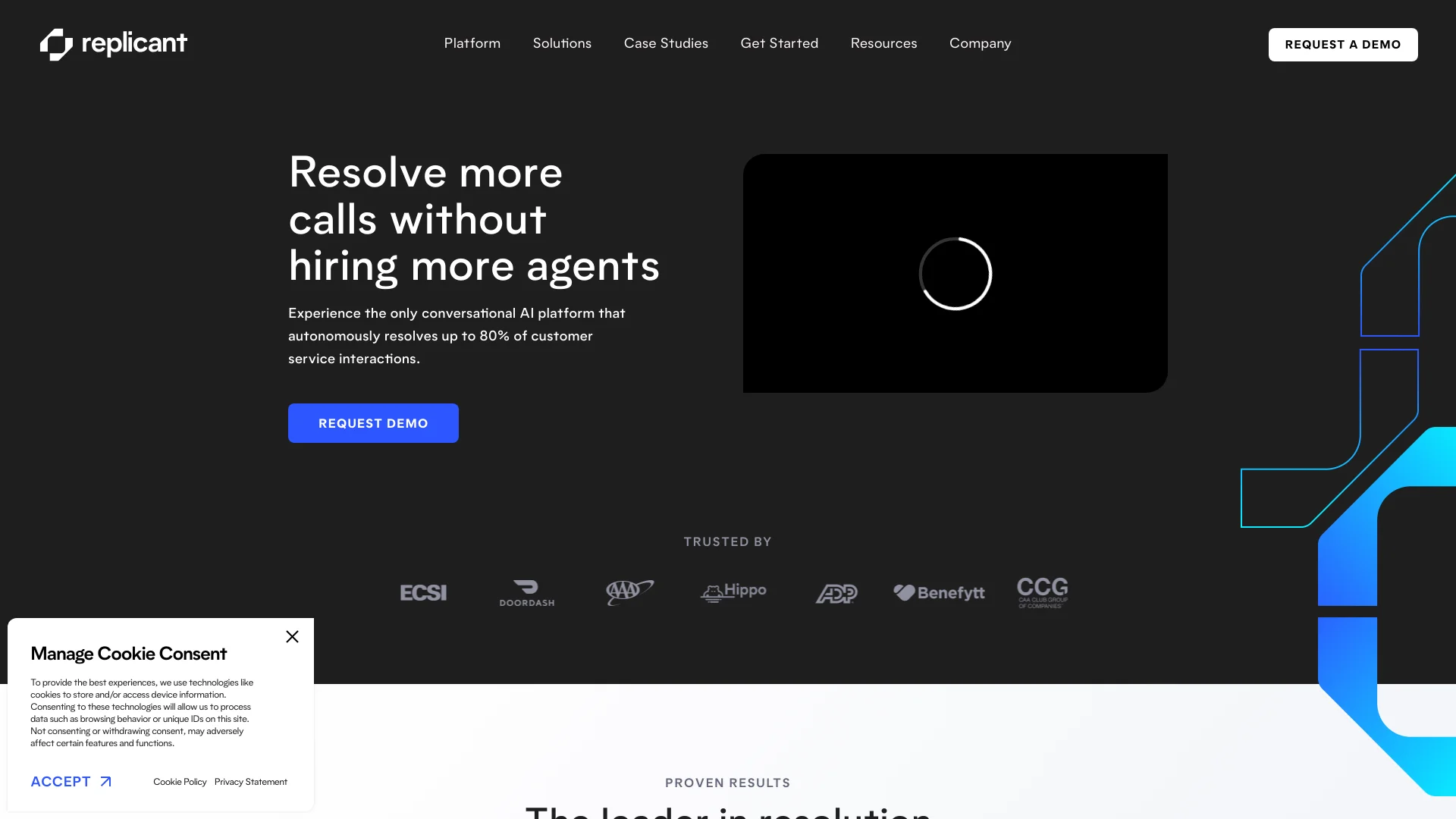
Replicant is a cutting-edge AI tool designed to transform the way businesses handle customer service interactions. At its core, Replicant's solution is built to automate and streamline communication between companies and their customers, ensuring efficient, scalable, and cost-effective customer service operations. Tailored primarily for customer support teams, this tool leverages powerful conversational AI to handle a wide range of customer queries without human intervention, thus freeing up human agents to tackle more complex issues.
Replicant stands out with its exceptional voice AI technology, which not only understands natural language but also responds in a way that mimics human conversational patterns. This capability is a game-changer for businesses looking to automate their customer service without compromising the quality of interaction.
Replicant excels in providing automated, efficient, and scalable customer service solutions, making it an essential tool for businesses aiming to enhance their customer support operations. Its standout feature of advanced voice AI technology offers an unmatched advantage in automating complex interactions, setting it apart in the realm of customer service AI tools.
Who is Using Replicant?
Telecommunications Companies
Utilizing the tool to manage routine customer inquiries and service modifications.
Retail Businesses
Employing AI to handle high volumes of customer service requests during peak seasons.
Healthcare Providers
Automating appointment scheduling and patient inquiries.
Banking Institutions
Using the tool for handling transaction inquiries and customer account management.
Uncommon Use Cases
Non-profit organizations use Replicant for donor engagement and support; event management companies automate participant inquiries and registration processes.
Key Features
Rating Breakdown
Pricing Plans
Standard Plan
$750 per month
- Basic features
Enterprise Plan
- Custom pricing based on specific needs and volume of interactions
Which Replicant plan should you pick?
Start with Quick Start to prove conversational-AI ROI, upgrade to Professional for broader workflows and concurrency, and choose Enterprise for fully customized deployments and advanced compliance.
Quick Start
Good for teams that need to rapidly prove conversational-AI ROI with core AI answers, CCaaS integration, transcription, voices, and analytics.
Professional
Good for teams that need common conversation flows, two additional system integrations, flexforms, unlimited concurrent calls, and six-language support.
Enterprise
Good for enterprises that need unlimited integrations, A/B testing, PCI/HIPAA compliance, named delivery resources, continuous workflow updates, and 35-plus supported languages.
Replicant Use Cases
Automate customer service requests
Use AI agents to handle tier-one customer requests across voice, chat, and SMS.
Outcome: More requests resolved end-to-end with less human handling.
Automate outbound calls
Place outbound calls for ordering, customer updates, information collection, or appointment-related workflows.
Outcome: Higher capacity during demand spikes and fewer repetitive tasks for agents.
Automate two-way SMS
Send and receive confirmations, updates, links, entry codes, and short follow-up information through conversational SMS.
Outcome: Fewer callbacks and faster asynchronous resolution.
Analyze customer conversations
Generate summaries, sentiment insights, dispositions, improvement areas, and customized scorecard assessments.
Outcome: Better visibility into performance and customer experience.
Identify automation opportunities
Analyze human conversations to find repetitive tasks and workflows suitable for AI automation.
Outcome: A prioritized roadmap for expanding automation.
Workflow Ideas with Replicant
Launch and optimize an AI agent
- 1Analyze human conversations to identify automation opportunities
- 2Build the agent with business logic, knowledge, workflows, and guardrails
- 3Test with synthetic customer data, deploy, and continuously improve
Resolve a request through SMS
- 1Start the customer interaction in voice, chat, or SMS
- 2Transfer relevant context into a two-way SMS workflow
- 3Complete the request asynchronously and retain an auditable conversation record
Improve agent and conversation performance
- 1Capture summaries, sentiment, dispositions, and improvement areas
- 2Apply customized scorecards to evaluate performance
- 3Use dashboards and recommendations to improve workflows and agent outcomes
How Replicant fits into your stack
Salesforce Integration
Enhances customer relationship management by syncing data with Salesforce.
Zendesk Compatibility
Integrates smoothly with Zendesk to streamline support ticket management.
API Access
Offers robust API for custom integrations, allowing businesses to tailor functionalities to their specific needs.
Cloud-Based Platform
Ensures easy deployment and maintenance without the need for extensive on-premise infrastructure.
Pros
- +Enhanced Customer Satisfaction: Reduces wait times and delivers 24/7 customer service, significantly improving overall customer satisfaction.
- +Cost Efficiency: Minimizes operational costs by automating routine support tasks and optimizing agent workload.
- +High Scalability: Adapts easily to varying levels of customer interaction, making it ideal for both small businesses and large enterprises.
- +Data-Driven Insights: Provides valuable insights into customer preferences and behavior, aiding in better service and business decisions.
Cons
- −Initial Setup Complexity: Requires initial configuration and training to align with specific business processes.
- −Dependence on Technical Infrastructure: Relies heavily on the existing IT infrastructure for optimal performance.
- −Limited Emotional Intelligence: While efficient, AI may not fully replicate the empathetic aspect of human interaction in complex customer service scenarios.
Limitations & when to consider alternatives
Known limitations
- Pricing is not publicly itemized. Replicant uses request-based, flexible pricing rather than publishing dollar amounts for its plans.
- Professional language support is limited. The pricing comparison lists 6 languages for the Professional plan, compared with 35-plus supported languages for Enterprise.
- Quick Start has limited concurrency. The pricing comparison lists 10 concurrent calls for Quick Start.
- Enterprise deployment is required for some advanced features. Unlimited integrations, A/B testing, PCI/HIPAA compliance, named delivery resources, and continuous workflow updates are listed under Enterprise.
Look elsewhere when
- You need a native mobile application.
- You need a browser extension.
- You need publicly disclosed self-serve pricing.
How to Use Replicant
- 1
Explore the comprehensive tutorial series on the official website and YouTube, covering everything from basic setup to advanced configuration and usage of Replicant.
Who is Replicant For?
Contact center leaders
Replicant helps automate high-volume customer service conversations, improve resolution rates, and manage fluctuating demand.
CX leaders
The platform provides conversation analytics, customer sentiment insights, agent scoring, and automation opportunities.
IT teams
Replicant offers enterprise integrations, SSO, API keys, security controls, and connections to existing systems.
Support leaders
Support teams can automate repetitive requests and reserve human agents for complex or sensitive interactions.
Enterprise organizations
Enterprise plans provide customized deployments, unlimited system integrations, compliance options, A/B testing, and continuous workflow updates.
Frequently Asked Questions
What channels does Replicant support?
Replicant supports voice, chat, and SMS automation, with shared workflows and conversational intelligence across channels.
How does Replicant pricing work?
Replicant uses flexible, pay-as-you-go pricing with Quick Start, Professional, and Enterprise plans. Customers request pricing based on their deployment.
What integrations does Replicant offer?
Replicant lists integrations with CCaaS, CRM, ERP, iPaaS, POS, and telephony systems including Genesys, Salesforce, Zendesk, ServiceNow, Shopify, and Cisco.
Does Replicant support single sign-on?
Replicant supports Google's identity platform and SAML2, including identity providers such as Okta, OneLogin, Ping, Google, and Microsoft.
How does Replicant handle human handoffs?
AI agents can transfer conversations to human agents while sharing transcripts, summaries, and relevant context.
How many languages does Replicant support?
Replicant states that its AI agents support more than 30 languages and dialects; its pricing page lists 6 languages for Professional and 35-plus supported languages for Enterprise.
Community reviews
Be the first to share your experience.
Sign in to leave a review for Replicant.
Replicant Alternatives
Looking for alternatives to Replicant? Here are similar tools in the same category:
Learn to Master Replicant
With Skill Leap courses
Get in-depth training on Replicant and 50+ other AI tools with our expert-led video courses.
Start 7-Day Free Trial