
Quanthealth
Streamline drug development with AI-powered clinical trial simulations.
Key Takeaways
- What it is
- Streamline drug development with AI-powered clinical trial simulations.
- Best for
- Clinical Trial Simulator
- Synthetic Evidence Generation
- Large Healthcare Model (LHM)
- Rating
- 4.4/5
What is Quanthealth?
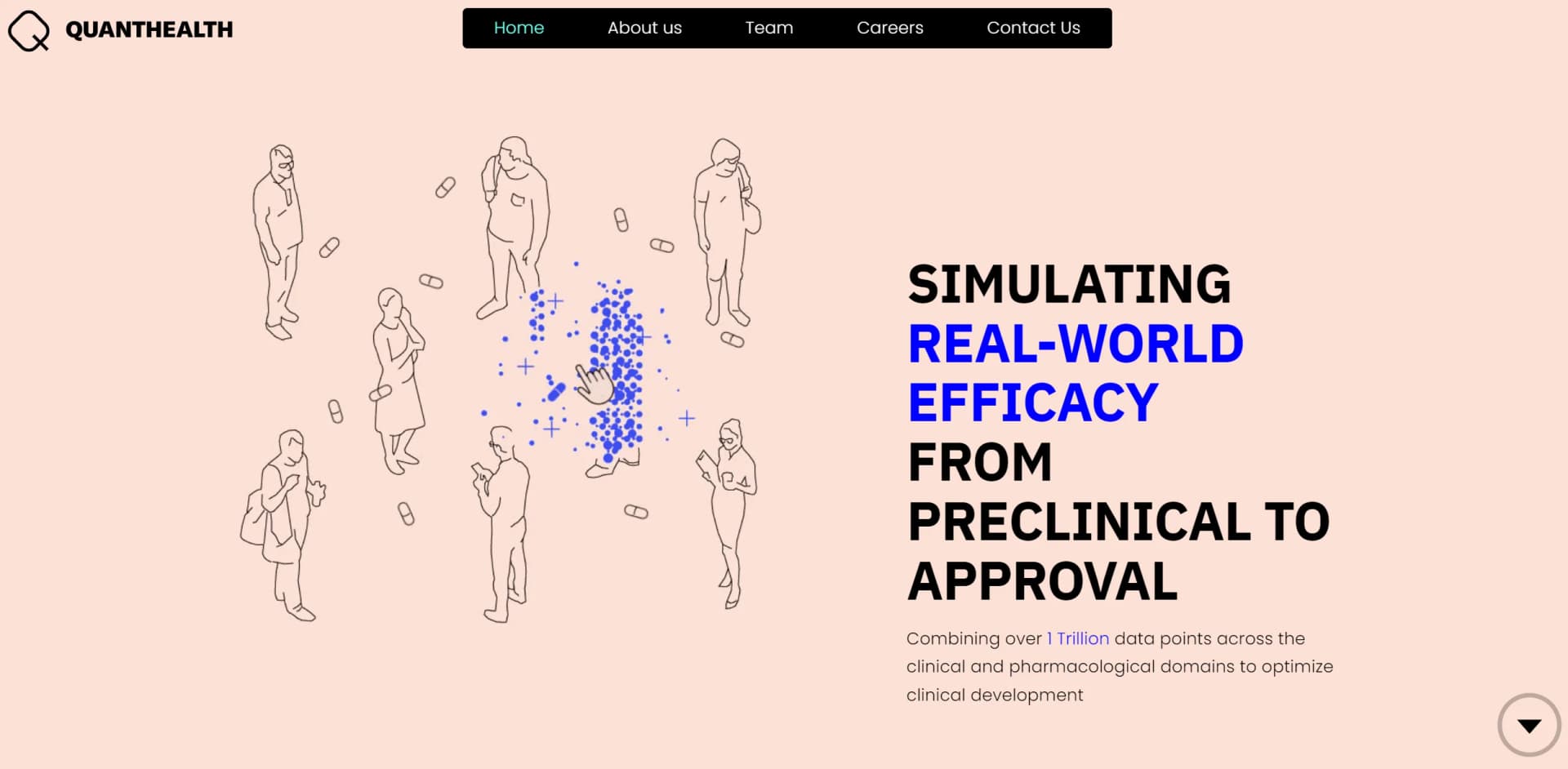
Quanthealth is a groundbreaking AI tool that is transforming the landscape of clinical trials and drug development. At its core, Quanthealth employs powerful artificial intelligence to simulate real-world clinical trial scenarios, allowing pharmaceutical companies to predict the efficacy and feasibility of drugs before they reach the clinical stages. This tool not only streamlines the drug development process but also significantly reduces the associated risks and costs.
Quanthealth stands out with its ability to integrate and analyze an immense volume of data points across varied clinical and pharmacological landscapes. Its unique Clinical Trial Simulator and Synthetic Evidence Generation platform are game-changers in predictive healthcare analytics, offering unprecedented insights into drug development and trial planning.
Quanthealth excels in providing sophisticated solutions for simulating and predicting clinical trial outcomes, making it an indispensable tool for those involved in drug development and pharmaceutical research. Its high accuracy and comprehensive data integration capability provide a significant competitive edge, ensuring that it remains at the forefront of technological advancements in healthcare.
Who is Using Quanthealth?
Pharmaceutical Companies
Employing the tool to enhance the efficiency of drug development.
Clinical Research Organizations (CROs)
Leveraging the tool for planning and executing more effective clinical trials.
Healthcare Analysts
Using the tool for predictive analysis and market research.
Biotech Startups
Adopting the tool for drug discovery and development processes.
Uncommon Use Cases
Utilized by academic researchers for educational purposes; employed by government health agencies for regulatory and policy-making analysis.
Key Features
Rating Breakdown
Pricing Plans
Enterprise Custom Solutions
- Tailored pricing based on the specific needs and scale of the organization
Quanthealth Use Cases
Protocol optimization
Users refine inclusion and exclusion criteria, treatment arms, control arms, outcomes, and endpoints before committing to a trial design.
Outcome: More informed clinical-trial design decisions.
Outcome prediction
Users generate virtual-trial results that mirror the depth and precision of actual trial data.
Outcome: Evidence for evaluating likely clinical outcomes.
Enrollment prediction
Users combine cohort definitions with site-level data and protocol parameters to predict recruitment curves.
Outcome: Expected site-level and global enrollment over time.
Market forecasting
Users compare predicted patient counts across geographical markets and patient cohorts.
Outcome: More informed strategic planning.
Portfolio prioritization
Users compare planned and ongoing studies using budget, probability of technical success, commercial forecast, and NPV.
Outcome: Evidence-based portfolio prioritization.
Workflow Ideas with Quanthealth
Optimize a clinical-trial protocol
- 1Define inclusion and exclusion criteria, treatment arms, controls, outcomes, and endpoints.
- 2Run virtual-trial simulations across protocol variations.
- 3Compare predicted clinical outcomes and refine the protocol.
Evaluate an asset for business development
- 1Search and evaluate candidate assets.
- 2Compare the asset with competing therapies and predicted outcomes.
- 3Use simulated evidence for diligence, valuation, or licensing decisions.
Prioritize a development portfolio
- 1Compare planned and ongoing studies using budget, PTS, commercial forecast, and NPV.
- 2Detect asset synergies, competition, and patient or market overlap.
- 3Identify portfolio gaps and opportunities for prioritization.
How Quanthealth fits into your stack
Data Compatibility
Seamlessly processes vast amounts of data from diverse sources.
API Access
Offers API integration for custom development and enhancement.
Cloud-Based Platform
Ensures easy access and scalability through cloud integration.
Security Compliance
Adheres to stringent data security and privacy protocols to protect sensitive information.
Pros
- +Risk Reduction: Drastically minimizes the uncertainties involved in drug development.
- +Cost Efficiency: Reduces the financial burden by predicting trial outcomes before actual implementation.
- +Time-Saving: Accelerates the drug approval process by facilitating faster decision-making.
- +High Accuracy: Delivers reliable predictions with a high degree of precision, thanks to its robust data integration.
Cons
- −Complexity of Use: May require a steep learning curve for users not familiar with AI and big data.
- −High Initial Investment: Potentially high upfront costs for integration and setup.
- −Niche Application: Primarily beneficial for pharmaceutical and clinical research organizations, which may not be applicable to smaller labs or startups.
Limitations & when to consider alternatives
Known limitations
- Enterprise access is demo-led. The public site directs prospective users to request a demo or book a meeting rather than providing self-serve signup.
- Outputs are simulations. QuantHealth provides virtual trial and predicted outcomes that mirror clinical-trial results; they are not actual clinical-trial results.
- Public pricing is unavailable. The official site does not publish plan names, prices, or public pricing tiers.
- Public developer documentation is unavailable. The official site does not publish API keys, endpoints, SDKs, or developer documentation.
- Security documentation may require access. The Trust Center says detailed security documentation can be requested and may require authorized access.
Look elsewhere when
- You need a native mobile app.
- You need a public developer API.
- You need self-serve pricing.
How to Use Quanthealth
- 1
Explore a range of tutorials and resources on the Quanthealth website, designed to help users maximize the tool's potential from setup to advanced functionalities.
Who is Quanthealth For?
Pharmaceutical and biotechnology companies
QuantHealth says its platform helps pharmaceutical and biotech companies simulate clinical-trial outcomes and support drug-development decisions.
Clinical development teams
Clinical development teams can optimize protocols, select indications, predict outcomes, forecast enrollment, and assess market potential.
Business development teams
Business development users can evaluate assets, perform comparative analyses, conduct diligence and valuation, and assess licensing opportunities.
Portfolio management teams
Portfolio teams can prioritize assets, identify synergies and competition, and find portfolio gaps and opportunities.
Frequently Asked Questions
What does QuantHealth do?
QuantHealth simulates drug-patient outcomes to support clinical-development, business-development, and portfolio-management decisions.
What clinical-development use cases does QuantHealth support?
The platform supports protocol optimization, indication selection, target product profiles, probability of technical success, market forecasting, and enrollment prediction.
Can QuantHealth simulate novel drugs?
Yes. QuantHealth says its model represents novel drugs using their targets, structures, and clinical context.
Can QuantHealth model patient subgroups?
Yes. The platform supports single-patient-outcome resolution and simulation of populations defined by inclusion and exclusion criteria.
Does QuantHealth require sponsor data?
QuantHealth states that competitive therapies can be evaluated with no sponsor data required.
How do organizations get started?
The official site directs organizations to request a demo or book a meeting.
Community reviews
Be the first to share your experience.
Sign in to leave a review for Quanthealth.
Quanthealth Alternatives
Looking for alternatives to Quanthealth? Here are similar tools in the same category:
Learn to Master Quanthealth
With Skill Leap courses
Get in-depth training on Quanthealth and 50+ other AI tools with our expert-led video courses.
Start 7-Day Free Trial