
Planck Data
Revolutionizes commercial insurance underwriting with generative AI-driven risk insights.
Key Takeaways
- What it is
- Revolutionizes commercial insurance underwriting with generative AI-driven risk insights.
- Best for
- GenAI-Driven Insights
- Comprehensive Data Coverage
- Customizable Risk Assessments
- Rating
- 4.6/5
What is Planck Data?
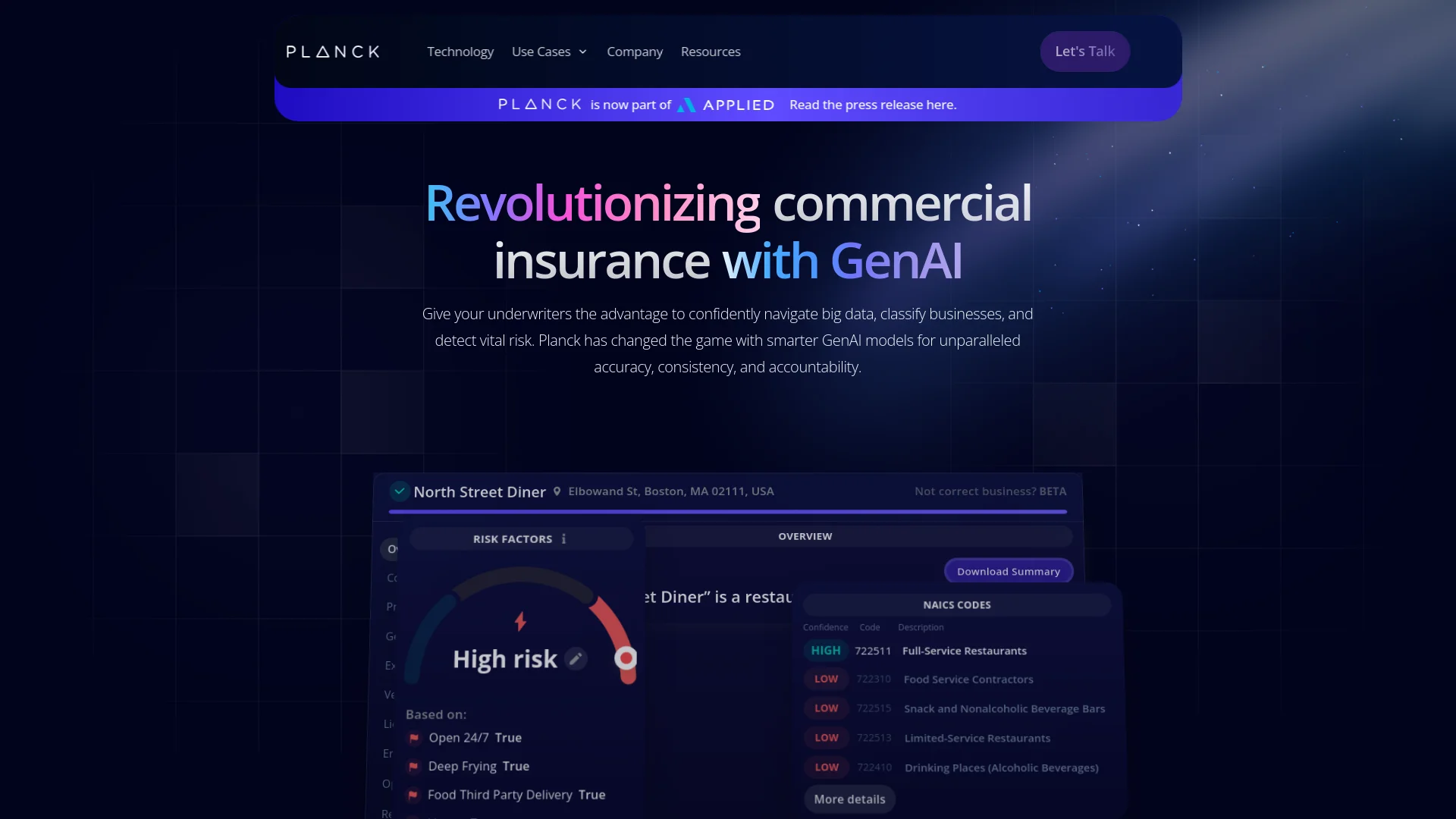
As a seasoned reviewer of AI tools, I've had the pleasure of exploring numerous innovative solutions, but Planck Data truly stands out in the realm of commercial insurance. This tool is revolutionizing the way underwriters interact with big data, offering them the ability to classify businesses accurately, detect vital risks, and navigate through extensive datasets with unprecedented confidence. Planck Data leverages sophisticated Generative AI (GenAI) models to provide users with unparalleled accuracy, consistency, and accountability in their underwriting processes.
Planck Data distinguishes itself with its high-level integration of GenAI, specifically tailored for commercial insurance underwriting. This unique approach not only provides comprehensive data analysis but also adapts to the specific needs of each organization, ensuring that the insights are not only accurate but also actionable and relevant to the user’s specific context.
Planck Data excels in transforming commercial insurance underwriting through its advanced GenAI capabilities. Its ability to provide detailed, evidence-backed risk assessments makes it an indispensable tool for insurance companies aiming to enhance their underwriting accuracy and efficiency. The unique customization and integration features ensure that it aligns perfectly with the specific needs of each business, making Planck Data a standout choice in the AI tool landscape for commercial insurance.
Who is Using Planck Data?
Commercial Insurance Companies
Utilizing the tool to enhance the accuracy and efficiency of their underwriting processes.
Risk Management Consultants
Employing Planck Data to provide detailed risk assessments and advisory services.
Regulatory Compliance Officers
Leveraging the tool to ensure that businesses meet industry-specific regulations and standards.
Business Analysts
Using the tool for detailed market analysis and risk forecasting.
Uncommon Use Cases
Educational institutions incorporate Planck Data in courses on risk management; financial analysts use it for predictive modeling in investment scenarios.
Key Features
Rating Breakdown
Pricing Plans
Subscription-Based Model
- Planck Data offers tailored subscription plans based on the size and needs of the business
Which Planck Data plan should you pick?
Start with PLUS Risk Workbench if underwriters need an interactive workspace; choose PLUS Data for API or data delivery, and upgrade to Planck Enterprise for enterprise-level requirements.
PLUS Data
Good for carriers who need underwriting data, classifications, insights, API integration, or UI access.
PLUS Risk Workbench
Good for underwriting teams who need GenAI-powered chat, reasoning, supporting data, and decision standardization.
Planck Enterprise
Good for organizations seeking enterprise-level Planck solutions.
Planck Data Use Cases
Submission prefill
Enter a business name and address so Planck can collect public data and complete application answers.
Outcome: Faster, more complete submissions with fewer errors and omissions.
Additional risk factors
Submit business identifiers and receive risk and underwriting insights that were not included in the original application.
Outcome: More accurate rating, pricing, and underwriting decisions.
Eligibility and exposure monitoring
Monitor an existing book of policies for changes in eligibility and exposure.
Outcome: Earlier detection of changing risks across the portfolio.
Audit recommendations
Upload in-force policy data and have Planck generate recommendations based on exposure changes.
Outcome: Reduced audit costs and improved premium collection.
Underwriting risk workbench
Use Planck PLUS Chat, classifications, evidence, and risk insights to investigate commercial risks.
Outcome: More consistent and explainable underwriting decisions.
Workflow Ideas with Planck Data
Automated submission-to-quote workflow
- 1Enter the business name and address in the submission form
- 2Have Planck collect public data and generate application answers
- 3Return the completed submission to the carrier for underwriting and quoting
In-force portfolio monitoring
- 1Send an existing policy book to Planck or connect the portfolio for scheduled monitoring
- 2Have Planck analyze policies and highlight eligibility or exposure changes
- 3Review returned alerts and take the required underwriting or audit actions
Risk-factor review
- 1Submit business identifiers and application details
- 2Have Planck generate additional risk factors and supporting insights
- 3Send the results through the API to underwriting systems and dashboards
How Planck Data fits into your stack
API Access
Allows seamless integration with other systems, enhancing flexibility and connectivity.
Custom Integration Capabilities
Planck Data can be tailored to work with existing corporate systems, ensuring a smooth workflow integration.
Real-Time Data Sync
Ensures that all data points are updated in real-time, providing the most current insights available.
Scalability
Designed to scale with your business, accommodating increasing amounts of data and more complex analysis needs without performance drops.
Pros
- +API-based delivery for carrier systems
- +Real-time business and risk insights
- +Automated underwriting from submission to bind
- +Image and video risk analysis
- +Policy monitoring and exposure alerts
Cons
- −Limited Focus: Currently optimized primarily for restaurants, bars, and taverns, which may limit its applicability for other business types.
- −Beta Stage Limitations: Being in the beta stage, some users may encounter technical glitches or errors.
- −Restricted Question Types: The system currently supports only "Yes" or "No" questions, which may not suffice for more complex queries.
How to Use Planck Data
- 1
Choose a delivery model
Select PLUS Data for API or UI access, or PLUS Risk Workbench for an interactive underwriting experience.
- 2
Submit business information
Provide a business name, address, and other identifiers so Planck can gather and analyze relevant data.
- 3
Review classifications and insights
Use risk classifications, confidence scores, supporting evidence, and additional risk factors to assess the business.
- 4
Ask underwriting questions
Use PLUS Chat to investigate specific risks and understand the rationale behind generated insights.
- 5
Automate decisions or monitoring
Configure underwriting processes, portfolio monitoring, or audit workflows to identify changes and required actions.
- 6
Return results to underwriting systems
Use Planck’s API to send generated risk factors, classifications, and insights into carrier systems and dashboards.
Who is Planck Data For?
Commercial insurance underwriters
Planck provides risk insights, classifications, evidence, confidence scoring, and conversational underwriting support.
Insurance carriers
Carriers can use Planck for submission prefills, additional risk factors, portfolio monitoring, and underwriting automation.
Insurance agents and brokers
Prefilled submissions reduce manual entry, errors, omissions, and back-and-forth with underwriters.
Business owners
Business owners can benefit from more complete application data and streamlined submission processes.
Actuarial and pricing teams
Planck provides additional risk factors and business classifications intended to improve pricing models and risk selection.
Frequently Asked Questions
How does Planck prefill submissions?
After receiving a business name and address, Planck collects and analyzes publicly available data, then automatically fills the submission form.
How does Planck monitor existing policies?
Planck analyzes the policies in a book on a predefined schedule, highlights exposure changes, and returns eligibility and exposure changes.
Can Planck work with underwriting guidelines and eligibility criteria?
Planck states that its insights can be configured to meet specific underwriting needs and eligibility criteria.
How does Planck provide additional risk factors?
Planck receives submission details, analyzes the business, generates additional risk and underwriting insights, and returns them through an API.
What does Planck PLUS Chat do?
PLUS Chat lets underwriters ask underwriting questions, receive data-based feedback, and review the rationale behind AI-generated insights.
How does Planck support audit recommendations?
Planck processes existing policies, identifies exposure changes, and produces recommendations for required follow-up actions.
Community reviews
Be the first to share your experience.
Sign in to leave a review for Planck Data.
Planck Data Alternatives
Looking for alternatives to Planck Data? Here are similar tools in the same category:
Learn to Master Planck Data
With Skill Leap courses
Get in-depth training on Planck Data and 50+ other AI tools with our expert-led video courses.
Start 7-Day Free Trial