Picogrid
Connects defense teams' sensors and unmanned systems into a shared mission picture.
Key Takeaways
- What it is
- Connects defense teams' sensors and unmanned systems into a shared mission picture.
- Best for
- Legion API
- Orion Command and Control
- Asset Integrations
- Rating
- 4.0/5
What is Picogrid?
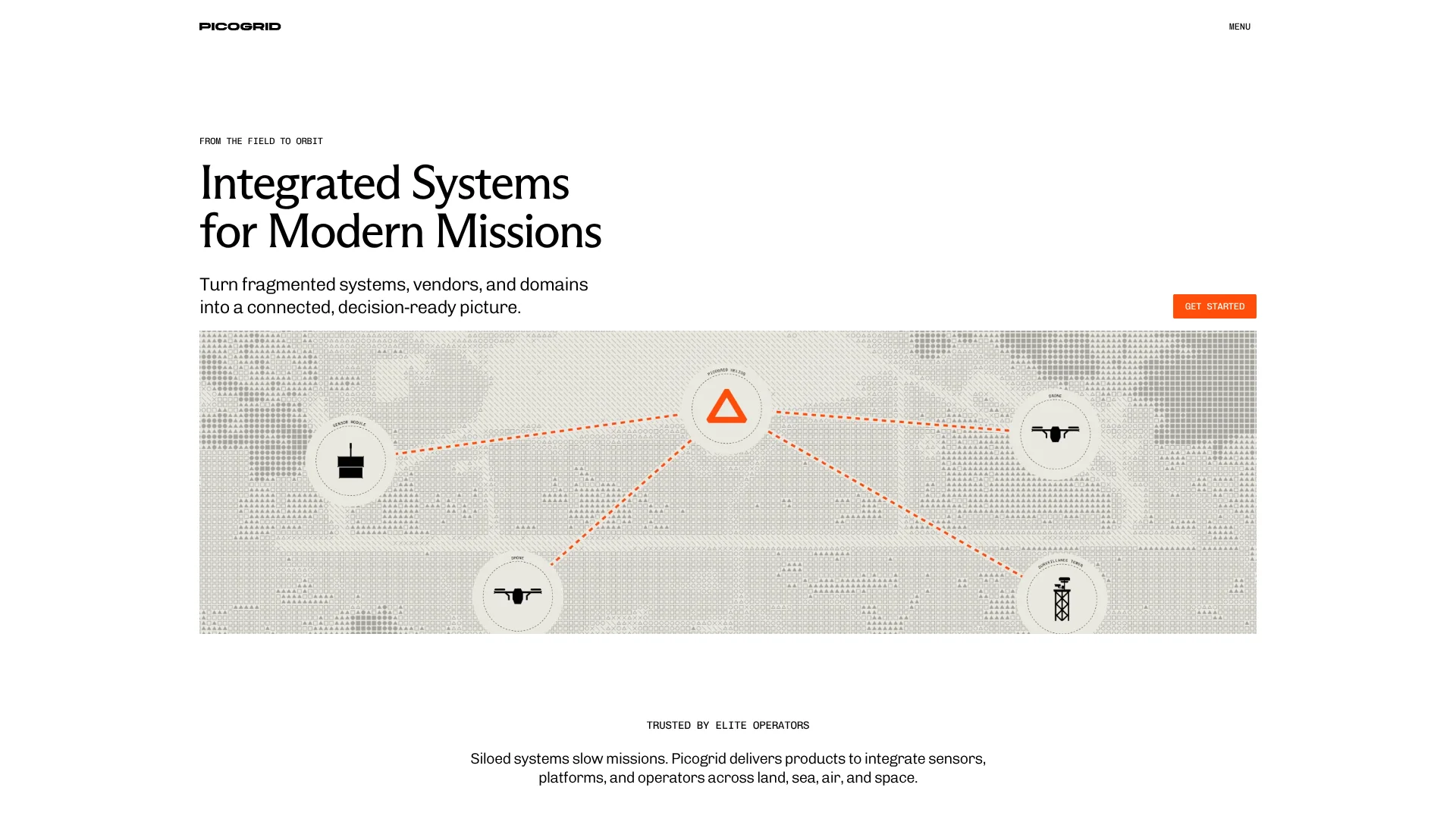
Picogrid connects sensors, unmanned vehicles, and other mission systems so operators can see their data and coordinate actions through shared tools. Its products include Legion, a platform and API for integrating assets; Orion, a browser-based command interface; and Expeditionary C2 Nodes, field hardware for connecting systems at the edge. The company serves defense, space, and public safety missions, where separate equipment can otherwise leave teams with an incomplete operational picture.
A defining capability is connecting physical mission equipment and software through the same integration layer, including Picogrid’s own field-ready hardware. Legion can route data and tasking between connected assets, while Orion presents live assets and feeds on a map; the platform also supports interfaces such as ATAK.
Picogrid is best suited to government and public safety organizations, mission-system integrators, and technology partners working with multiple sensors or autonomous systems. It is not a self-serve AI app: deployments involve mission-specific hardware or integrations, and Picogrid does not publish standard prices. Consider it when the problem is coordinating connected systems, not when you need a general-purpose AI tool.
Who is Using Picogrid?
Mission operators
A shared map and live feeds help operators monitor connected assets and respond to events.
Systems integration engineers
Legion’s API and integration tools help engineers connect mission equipment and software.
Sensor and drone teams
Teams responsible for field devices can send sensor data into a broader operational picture.
Command center analysts
Live streams, entity details, and notifications give analysts context across connected systems.
Uncommon Use Cases
Wildfire teams coordinating sensors and drones; satellite teams standardizing interfaces between legacy and newer systems.
Key Features
Rating Breakdown
Pricing Plans
Pricing
- Picogrid asks prospective customers to contact sales to discuss pricing and solutions.
Which Picogrid plan should you pick?
Picogrid does not publish self-serve plan tiers, so contact sales to discuss the mission, required integrations, and pricing.
Picogrid Use Cases
Connect sensors and unmanned systems
A shared integration layer brings data from different vendors into a coordinated mission view.
Outcome: Operators can monitor connected assets and route tasking through integrated systems.
Coordinate base security
Disconnected force-protection systems can contribute to a unified picture across air, ground, and maritime domains.
Outcome: Security teams gain shared awareness across connected systems.
Support satellite operations
Standardized interfaces help connect legacy and newer satellite systems with command-and-control software.
Outcome: Satellite data and control can be integrated with other mission systems.
Coordinate wildfire response
Sensor and drone information can feed a shared operational picture for wildfire detection and response.
Outcome: Teams can coordinate monitoring and response across connected assets.
Build AI-enabled mission workflows
Picogrid works with mission partners on AI workflows and edge analytics tailored to operational needs.
Outcome: AI-enabled capabilities can be developed for a specific mission environment.
Workflow Ideas with Picogrid
Monitor assets in Orion
- 1Connect mission assets and feeds through Legion.
- 2View asset locations and available streams on Orion’s map.
- 3Review events and use available controls to respond.
Connect a device through the Legion API
- 1Authenticate with an Orion account that belongs to an organization.
- 2Register the asset and add its location or feed data.
- 3Connect its data and tasking to the mission application.
Develop an edge integration
- 1Confirm access to an authorized Expeditionary C2 Node and its credentials.
- 2Use the ECN SDK to publish sensor data or handle tasking.
- 3Verify the application’s authorized access before live use.
How Picogrid fits into your stack
Mission systems
Legion connects physical assets and software, including sensors and unmanned systems, and routes their data and tasking.
Operator interface
Orion is the browser-based command interface for viewing assets, maps, live streams, and events.
Field hardware
Expeditionary C2 Nodes provide computing and connectivity for deployments at the edge.
Integration development
The Legion API and ECN SDK let authorized developers connect applications and devices to mission data.
Existing command tools
Picogrid lists ATAK among the command-and-control interfaces its open APIs can support.
Pros
- +Cross-vendor integration: Connects varied sensors and platforms through a shared operational system.
- +Operator map: Orion brings asset locations, streams, and events into a single map view.
- +Developer API: Legion documents endpoints for data, tasking, and video integrations.
- +Field deployment: Expeditionary C2 Nodes provide computing and connectivity for edge deployments.
Cons
- −Mission-specific setup: Getting value depends on connecting the equipment and feeds a particular operation needs.
- −No self-serve pricing: Buyers must contact Picogrid to discuss pricing and solutions.
- −Specialized focus: The product is built for mission operations rather than everyday AI writing or research.
Limitations & when to consider alternatives
Known limitations
- Organization access is required. Legion API use requires an Orion account that belongs to an organization.
- ECN use requires deployment credentials. Live ECN SDK use requires an authorized endpoint, integration identity, verified trust material, and approved credentials.
- Access depends on permissions. The ECN’s broker access rules determine which data an application can read or publish; connecting does not grant access.
- Standard prices are not published. Picogrid directs prospective customers to contact sales to discuss pricing and solutions.
Look elsewhere when
- You need a self-serve AI assistant for writing, research, or general questions.
- You need a product with publicly listed subscription prices and self-serve signup.
- Your team needs a general-purpose AI tool that can analyze uploaded personal documents or images.
How to Use Picogrid
- 1
Discuss the mission
Contact Picogrid to discuss pricing, the systems you need to connect, and the mission environment.
- 2
Set up access
An Orion account must belong to an organization before you can use the Legion API.
- 3
Connect assets
Choose existing integrations or work with Picogrid to connect the physical or digital systems your operation needs.
- 4
Build the operational view
Bring connected assets and streams into Orion so operators can review them on the map.
- 5
Extend with the API or SDK
Integration teams can use Legion’s API or the ECN SDK to connect applications to data and tasking they are authorized to access.
Who is Picogrid For?
Defense and government organizations
Teams coordinating sensors, unmanned systems, and command tools across mission environments are Picogrid’s core audience.
Space operations teams
Satellite operators can use Legion’s standardized interfaces to connect legacy and newer systems.
Public safety organizations
Wildfire response teams can connect sensor and drone data for shared situational awareness.
Technology partners and integrators
Vendors can connect their hardware or software to Picogrid’s mission-system ecosystem.
Frequently Asked Questions
What does Picogrid do?
Picogrid connects mission systems such as sensors, unmanned platforms, and command software. Its products include the Legion platform and API, Orion, and Expeditionary C2 Nodes.
Does Picogrid use AI?
Picogrid describes AI overlays in Orion and AI-capable edge computing for running models and analytics. It also works with mission partners on tailored AI workflows.
Does Picogrid publish prices?
Picogrid does not list standard prices on its public site. Its contact page invites prospective customers to discuss pricing and solutions with sales.
Can developers access a Picogrid API?
Yes. Legion has a documented API for entities, feeds, tasking, events, notifications, and video. API use requires an Orion account associated with an organization.
Does Picogrid have a mobile or desktop app?
Orion is described as a browser-based interface. Picogrid’s site and documentation do not confirm a native mobile or downloadable desktop app.
Community reviews
Be the first to share your experience.
Sign in to leave a review for Picogrid.
Picogrid Alternatives
Looking for alternatives to Picogrid? Here are similar tools in the same category: