
Opmed.ai
Revolutionize OR efficiency with AI-driven, network-optimized scheduling.
Key Takeaways
- What it is
- Revolutionize OR efficiency with AI-driven, network-optimized scheduling.
- Best for
- Network Science Optimization
- AI-Driven Predictive Insights
- Customizable Constraints
- Rating
- 4.5/5
What is Opmed.ai?
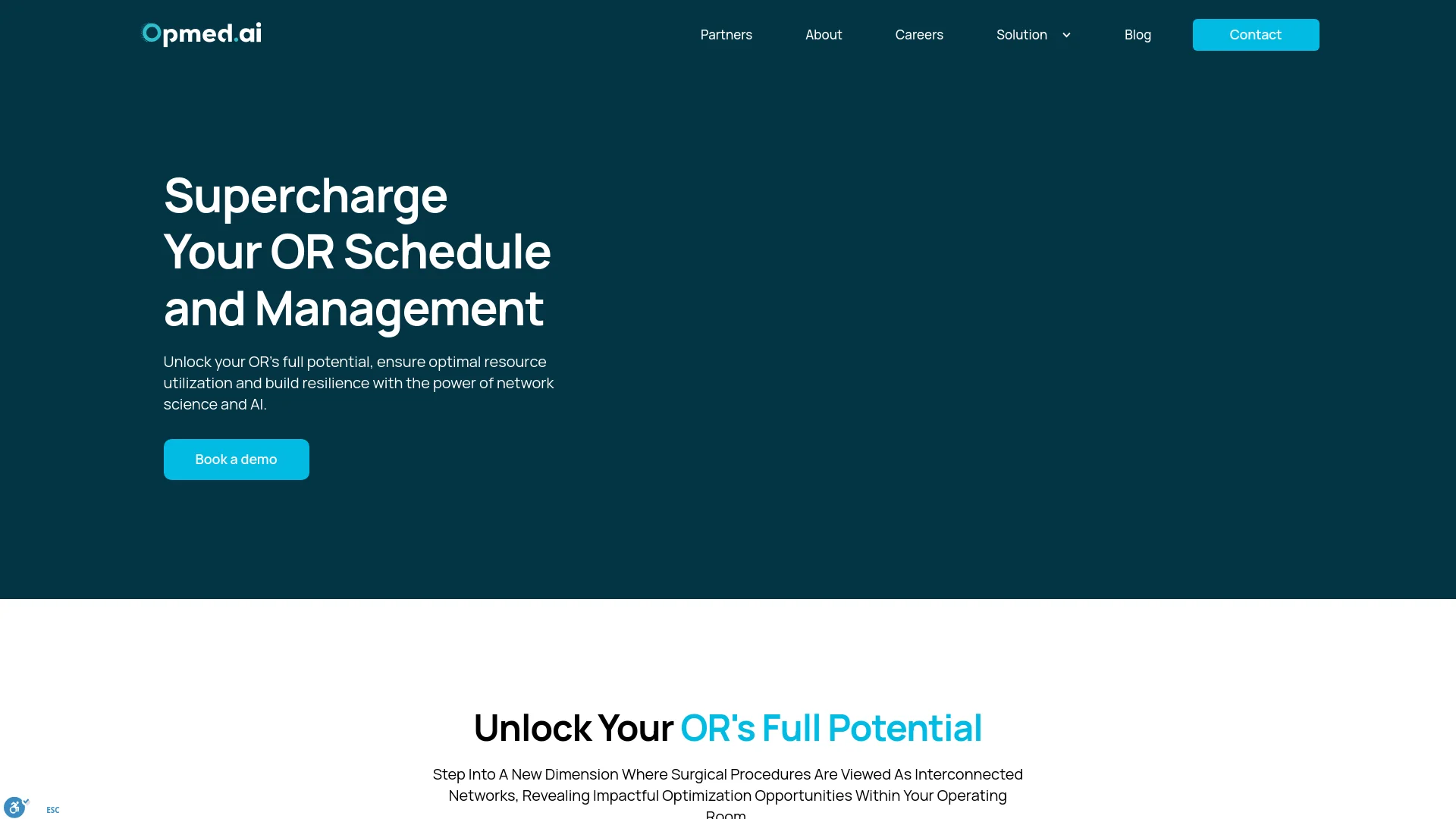
Opmed.ai is a cutting-edge platform designed to optimize operating room (OR) scheduling using artificial intelligence (AI) and network science. Aimed at healthcare facilities, this tool enhances OR efficiency, improves resource utilization, and boosts overall operational performance. By analyzing surgical procedures as interconnected networks, Opmed.ai uncovers optimization opportunities often missed by traditional scheduling methods, making it a valuable asset for hospitals aiming to streamline operations and improve patient care.
Opmed.ai distinguishes itself through its novel integration of AI and network science in OR management. This unique approach not only optimizes scheduling but also adapts to unexpected changes, ensuring consistent delivery of high-quality patient care.
Opmed.ai excels in revolutionizing OR operations with its AI and network science-driven approach to scheduling. By predicting and adapting to real-time changes, it enhances operational efficiency, optimizes resource utilization, and improves patient outcomes. For hospitals seeking to boost their OR performance, Opmed.ai offers a scientifically-backed solution that addresses both current and future needs, making it a valuable addition to healthcare operations.
Who is Using Opmed.ai?
OR Managers
Simplify scheduling, reduce downtime, and enhance block utilization.
Perioperative Leaders
Use data-driven insights to increase surgical volumes and minimize case overruns.
Hospital Leadership
Implement strategies to boost revenue per OR hour and reduce costs per case.
Surgical Leaders
Gain precise surgery duration estimates to enhance productivity and patient satisfaction.
Nursing Leaders
Manage nursing staff more effectively, reducing overtime costs and improving workflows.
Uncommon Use Cases
Employed by academic institutions for research on healthcare operations; tech companies explore its data integration capabilities for developing related applications.
Key Features
Rating Breakdown
Pricing Plans
Custom Quote
- Pricing is tailored to the specific needs and scale of the healthcare facility
Opmed.ai Use Cases
Operating-room schedule optimization
Build schedules using predicted case durations while coordinating rooms, staff, equipment, surgeon preferences, and PACU capacity.
Outcome: Increase utilization and reduce delays, overtime, and scheduling conflicts.
OR block management
Predict underutilized blocks, release unused time, and enable surgeons or schedulers to trade block time.
Outcome: Recapture otherwise wasted operating-room capacity.
NORA procedure scheduling
Predict procedure durations and no-shows, allocate optimal slots, and coordinate resources across CT, fluoroscopy, ultrasound, and MRI-guided procedures.
Outcome: Increase throughput while reducing overtime and disruption.
Healthcare staffing optimization
Forecast staffing needs, create equitable schedules, incorporate staff preferences, and coordinate allocation across multiple sites.
Outcome: Reduce coverage gaps, overtime, underutilization, and workload imbalance.
Rehabilitation scheduling
Coordinate multidisciplinary therapy schedules, forecast demand, balance therapist workloads, and anticipate equipment requirements.
Outcome: Improve operational flow while avoiding over-scheduling and bottlenecks.
Workflow Ideas with Opmed.ai
Plan, orchestrate, and reflow an OR day
- 1Build a day or week using predicted case lengths and staffed capacity.
- 2Assign rooms, resources, and blocks while honoring constraints and preferences.
- 3Reflow the plan when delays, cancellations, or add-ons occur and notify affected roles.
Recover unused block capacity
- 1Identify blocks likely to go unused from historical patterns.
- 2Notify relevant teams about potentially available time.
- 3Release, reassign, or trade block time to support additional cases.
Optimize procedural capacity
- 1Predict procedure duration, no-show risk, turnover needs, and equipment requirements.
- 2Match patients and procedures to slots according to waiting time, revenue, urgency, or other priorities.
- 3Dynamically reassign resources when urgent cases or disruptions occur.
How Opmed.ai fits into your stack
Existing OR Management Systems
Integrates easily with most current OR scheduling systems.
Data Privacy Tools
Compatible with various data privacy and security frameworks.
Healthcare Analytics Platforms
Can be used alongside other analytics tools for deeper insights.
Educational Tools
Suitable for academic settings to teach healthcare operations management.
Pros
- +Increased OR Efficiency: Can add 1-3 more cases per month through optimized scheduling.
- +Cost Reduction: Helps lower operating costs by 5%-15%, based on platform data.
- +Enhanced Resource Utilization: Reduces downtime and improves overall use of OR resources.
- +Data Privacy Compliance: Ensures user privacy by not requiring personal health or identification data.
Cons
- −Complexity of Network Science: May involve a learning curve for staff unfamiliar with network science principles.
- −Dependency on Quality Data: The effectiveness of the platform relies on the accuracy and completeness of the operational data provided.
- −Limited by User Adoption: Requires comprehensive adoption by all users within the facility to realize full benefits.
Limitations & when to consider alternatives
Known limitations
- Opmed complements rather than replaces the EMR. The EMR remains the system for documentation; Opmed is used for planning, optimization, and schedule reflow.
- Implementation is guided and workflow-specific. The company describes a guided rollout layered on top of current workflows rather than an instant self-serve deployment.
- The product is healthcare-operations focused. The documented offerings focus on hospitals, operating rooms, procedures, rehabilitation, staffing, and resource planning.
- Access is demo-led. The public website directs prospective customers to book a demo rather than presenting self-serve signup or public plan selection.
Look elsewhere when
- You need a native mobile application.
- You need a public developer API.
- Your primary need is clinical documentation rather than operational optimization.
How to Use Opmed.ai
- 1
Book a product demonstration
Start with Opmed’s demo-led process to discuss the hospital, procedural, staffing, or rehabilitation workflow you want to optimize.
- 2
Connect existing operational data
Use historical and EHR-related data to support predictions such as case duration, procedure duration, no-shows, staffing demand, and resource requirements.
- 3
Define constraints and priorities
Specify rooms, staff, equipment, PACU capacity, provider preferences, coverage rules, and whether the goal is higher volume, lower cost, or another operational priority.
- 4
Build and optimize schedules
Create schedules for cases, blocks, procedures, staff, rooms, and resources using Opmed’s optimization engine.
- 5
Monitor disruptions and reflow
When cancellations, delays, emergencies, or add-ons occur, use real-time reflow and notify affected roles.
- 6
Keep clinical documentation in the EMR
Use Opmed for scheduling intelligence and operational coordination while continuing to document clinical information in the existing EMR.
Who is Opmed.ai For?
Hospitals and health systems
Opmed helps healthcare organizations optimize operating rooms, staffing, equipment, resources, and procedural capacity.
Perioperative teams
OR teams can plan cases, blocks, rooms, staff, equipment, PACU capacity, and real-time schedule changes.
Surgeons and schedulers
The platform supports provider preferences, block allocation, block trading, and optimized case scheduling.
Rehabilitation centers
Opmed supports therapist coordination, workload balancing, equipment planning, and fluctuating patient demand.
Healthcare operations leaders
Leaders can optimize for increased procedure volume, reduced costs, improved utilization, and cross-site resource allocation.
Frequently Asked Questions
Does Opmed replace my EMR?
No. Opmed complements the EMR. The EMR remains the documentation system, while Opmed supports planning, optimization, and schedule reflow.
Can Opmed handle add-on and emergency cases?
Yes. Opmed finds feasible slots based on staffed rooms, required resources, and downstream impact.
Can provider and anesthesia preferences be modeled?
Yes. Opmed can model constraints and preferences so schedules reflect how teams operate.
How are schedule changes communicated?
Affected roles receive updates when cases move, resources change, or rooms are reassigned.
What does implementation look like?
Opmed describes a guided rollout layered on top of existing workflows, with documentation remaining in the EMR.
Community reviews
Be the first to share your experience.
Sign in to leave a review for Opmed.ai.
Opmed.ai Alternatives
Looking for alternatives to Opmed.ai? Here are similar tools in the same category:
Learn to Master Opmed.ai
With Skill Leap courses
Get in-depth training on Opmed.ai and 50+ other AI tools with our expert-led video courses.
Start 7-Day Free Trial