
Nullify AI
Turns confirmed vulnerabilities into reviewable pull requests for software teams.
Key Takeaways
- What it is
- Turns confirmed vulnerabilities into reviewable pull requests for software teams.
- Pricing
- Freemium · $800/yr
- Best for
- AI-Native Code Security
- Exploit Validation
- Autofix Pull Requests
- Rating
- 4.1/5
What is Nullify AI?
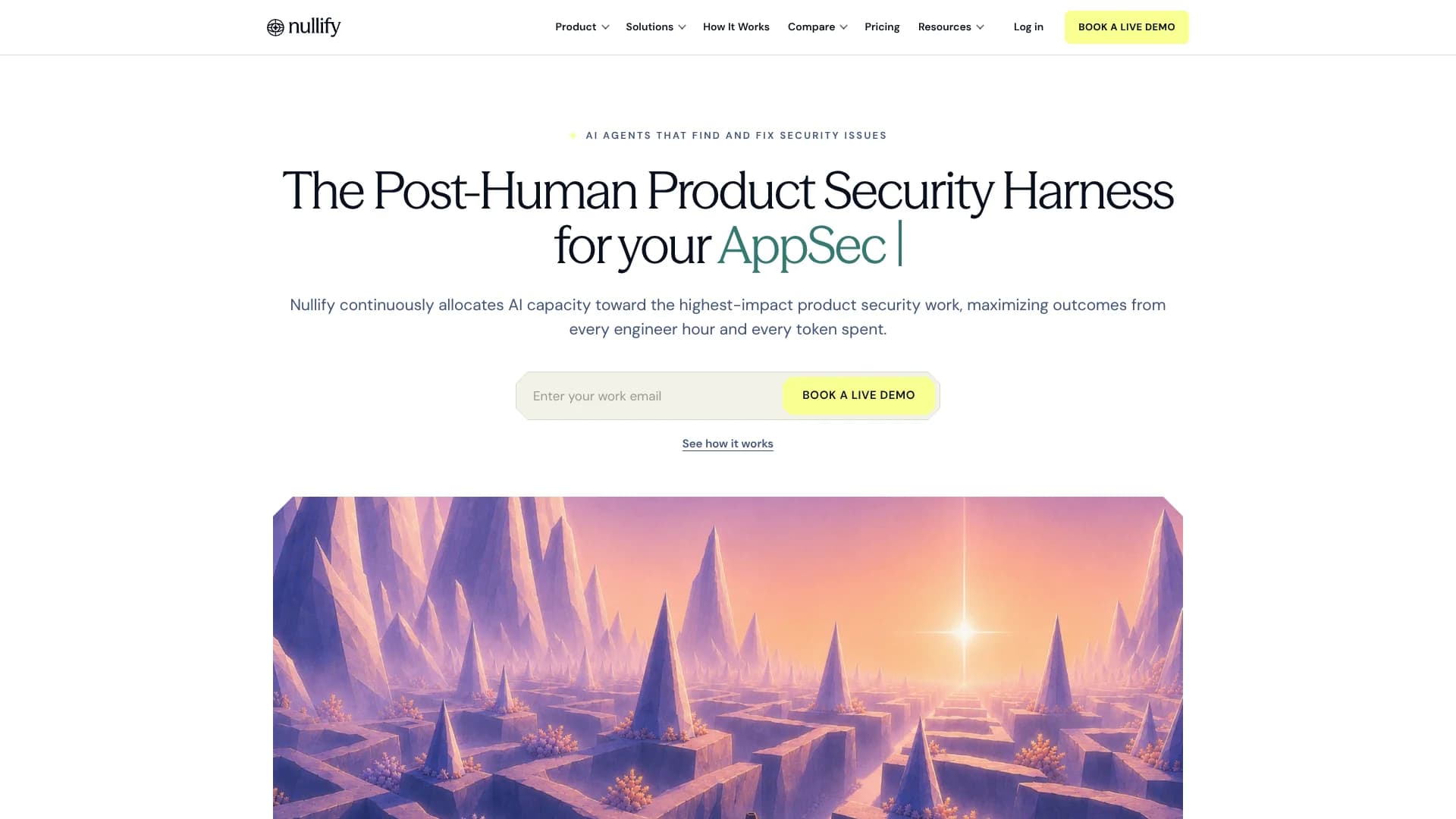
Nullify finds vulnerabilities across application code, dependencies, secrets, cloud environments, and APIs, then turns confirmed risks into pull requests your developers can review. Its AI agents reason about business logic, validate exploitability, rank findings against business context, and follow fixes through CI. Security teams get one workflow for detection, triage, remediation, ownership, and escalation.
Nullify validates in-scope API vulnerabilities by actively reproducing the attack and attaching request-and-response evidence, screenshots, or video before the finding reaches your team.
It fits software companies and security teams that need to reduce alert noise and close fixes at scale while keeping developers in GitHub or GitLab. The platform is aimed at organizations willing to connect source control, cloud accounts, and workflow tools, so it may be more than smaller teams need. Nullify is strongest when security work must end in a reviewed, merge-ready change.
Who is Using Nullify AI?
Application Security Engineers
They investigate validated findings, review exploit evidence, and send developers fixes with clear ownership.
Security Operations Leaders
Their goal is a smaller, ranked queue with campaigns, SLA tracking, and escalation when remediation stalls.
Platform Engineers
They connect repositories, cloud accounts, service ownership, and deployment context so Nullify can trace risk to the right team.
Software Developers
Developers review merge-ready security patches in pull requests and keep final approval over every change.
Compliance Managers
They use mapped cloud controls and program reporting to support security reviews and audit preparation.
Uncommon Use Cases
Teams can launch on-demand API pentests through the API; security leaders can pace bulk dependency upgrades with campaign limits.
Key Features
Rating Breakdown
Pricing Plans
Free Tier
Free
- Experience Nullify AI with a limited free trial
Pro Tier
$800/yr
Nullify AI Use Cases
Business-Logic Vulnerability Detection
Authorization, ownership, privilege, workflow, IDOR, and race-condition flaws are assessed through application context rather than signatures.
Outcome: Logic flaws that traditional pattern scanners may miss become ranked, actionable findings.
Validated API Pentesting
REST and GraphQL applications receive continuous or on-demand testing with authenticated flows and multi-stage exploit checks.
Outcome: Security teams get reproducible evidence of reachability and business impact.
Automated Vulnerability Remediation
A confirmed issue is turned into a minimal pull request that is tested through the build and followed through review.
Outcome: Developers receive a merge-ready security change instead of another ticket to investigate.
Backlog Reduction Campaigns
Security leaders group code, dependency, secret, and pentest findings around a defined objective and pace the work across teams.
Outcome: Progress is visible by team, with limits that reduce developer overload.
Cloud Compliance Monitoring
Cloud changes in AWS, GCP, Azure, and Kubernetes are checked against mapped security rules and traced to owning repositories.
Outcome: Audit evidence and remediation progress stay connected to live infrastructure changes.
Workflow Ideas with Nullify AI
From Finding to Pull Request
- 1Connect repositories and ownership data through GitHub, GitLab, Compass, or CODEOWNERS.
- 2Let Nullify validate risk, rank the finding, and identify the responsible team.
- 3Review the build-validated pull request and approve or revise it before merge.
Bulk Dependency Remediation
- 1Define a campaign for CVE-affected dependencies and select repositories, teams, or severity levels.
- 2Nullify assigns work using ownership and review capacity while limiting open pull requests.
- 3Track resolved and remaining findings, with Slack escalation for stalled work.
API Exploit Validation
- 1Connect an application and provide its API or authentication context.
- 2Launch an on-demand or scheduled pentest through the console, CLI, API, or GitHub Action.
- 3Review reproduction evidence and route confirmed findings into remediation.
How Nullify AI fits into your stack
Source Control
Nullify connects to GitHub, Bitbucket, and GitLab for repository assessment, pull-request reviews, ownership mapping, and autofix changes.
Developer Workflow
Security work reaches developers through pull requests, while Jira handles tickets and Slack carries notifications, campaign reminders, and escalations.
Cloud and Infrastructure
AWS, GCP, Azure, and Kubernetes connectors provide event-driven cloud audits and map findings back to repositories.
Automation and APIs
The REST API supports findings, autofix requests, pentest launches, campaigns, reporting, and administrative synchronization for enterprise tenants.
Ownership and Capacity
Compass, CODEOWNERS, commit history, service metadata, Jira workload, and review capacity help route each fix to a team that can act on it.
Pros
- +Proof-backed findings: API issues include reproducible exploit evidence rather than severity estimates alone.
- +Merge-ready remediation: Fixes arrive as pull requests that are checked against builds and tests.
- +Business-logic coverage: Reasoning about ownership, permissions, and workflows can expose flaws pattern scanners miss.
- +Workflow fit: GitHub, GitLab, Jira, Slack, Compass, and cloud connectors keep security work near existing engineering processes.
Cons
- −Enterprise-oriented buying process: Pricing is scoped around security work and requires a technical discussion.
- −Setup effort: Useful results require access to repositories, cloud environments, ownership data, and workflow tools.
- −Developer approval remains required: Nullify never auto-merges its pull requests.
Limitations & when to consider alternatives
Known limitations
- No automatic merging. Nullify prepares and manages pull requests, but a developer must review and approve every merge.
- Live exploit scope. Live evidence-backed exploitation covers REST and GraphQL API findings, while SPA and SSR coverage is handled through Bug Hunts.
- Open pull-request limits. Remediation campaigns keep no more than 3 open fix pull requests per repository and 5 per remediation plan.
- Enterprise API access. The documented Nullify REST API is available to enterprise tenants for automation, reporting, and connector use cases.
Look elsewhere when
- You need a self-serve security scanner with public tier pricing.
- Your team wants automatic pull-request merging with no human approval.
- Your main need is mobile or desktop security monitoring.
- Your application is outside the documented API testing scope and does not fit the Bug Hunts path.
How to Use Nullify AI
- 1
Connect Your Repositories
Install the GitHub or Bitbucket app, or connect GitLab, so Nullify can review code, map ownership, and open pull requests.
- 2
Add Workflow and Cloud Context
Connect Jira, Slack, Compass, and supported cloud accounts so findings can be assigned, escalated, and traced to deployed resources.
- 3
Configure Testing Scope
Provide application, API, authentication, and scope information for pentests or upload scope documents for document-based setup.
- 4
Review the Prioritized Findings
Start with findings ranked by severity, exploitability, reachability, and business impact rather than working through a raw scanner queue.
- 5
Run Autofix or a Campaign
Request a remediation pull request for an individual issue or define a campaign for a larger class of findings.
- 6
Approve the Merge
Review the proposed change in the normal pull-request workflow; Nullify validates fixes but never merges them automatically.
Who is Nullify AI For?
Security Teams
Security teams can reduce false-positive triage and track vulnerabilities from validation through remediation.
Software Companies
Software companies can place validated security fixes inside GitHub and GitLab pull-request workflows.
Security Leaders
Security leaders can define remediation campaigns, control automation, and report progress by team.
Compliance Programs
Compliance teams can use cloud audit findings, framework mappings, remediation metrics, and fix history as program evidence.
Frequently Asked Questions
How is Nullify priced?
Nullify uses outcome-based pricing tied to the security work performed, including vulnerabilities found, validated, and driven toward merge-ready fixes. The company scopes the work and provides pricing after a technical discussion.
Does Nullify offer a free plan?
The official pricing page does not publish a free plan. It describes a free proof of concept as part of the evaluation process.
Which integrations does Nullify support?
Documented integrations include GitHub, Bitbucket, GitLab, Jira, Slack, Compass, Microsoft Teams, AWS, Azure, GCP, and Kubernetes.
Can Nullify fix vulnerabilities automatically?
Nullify can generate and validate remediation pull requests, manage follow-up commits when checks fail, and escalate stalled work. Developers retain final merge approval.
Does Nullify replace existing scanners?
Nullify covers code security, secrets, cloud configuration, API pentesting, dependency risks, triage, and remediation in one prioritized workflow, but the company positions it as a product-security system rather than a guarantee that every other tool can be removed.
Community reviews
Be the first to share your experience.
Sign in to leave a review for Nullify AI.
Nullify AI Alternatives
Looking for alternatives to Nullify AI? Here are similar tools in the same category:
Learn to Master Nullify AI
With Skill Leap courses
Get in-depth training on Nullify AI and 50+ other AI tools with our expert-led video courses.
Start 7-Day Free Trial