
NeuroClues
Revolutionize neurological diagnostics with advanced eye-tracking technology.
Key Takeaways
- What it is
- Revolutionize neurological diagnostics with advanced eye-tracking technology.
- Best for
- Advanced Eye-Tracking Technology
- Early Disease Detection
- High Precision and Reliability
- Rating
- 4.6/5
What is NeuroClues?
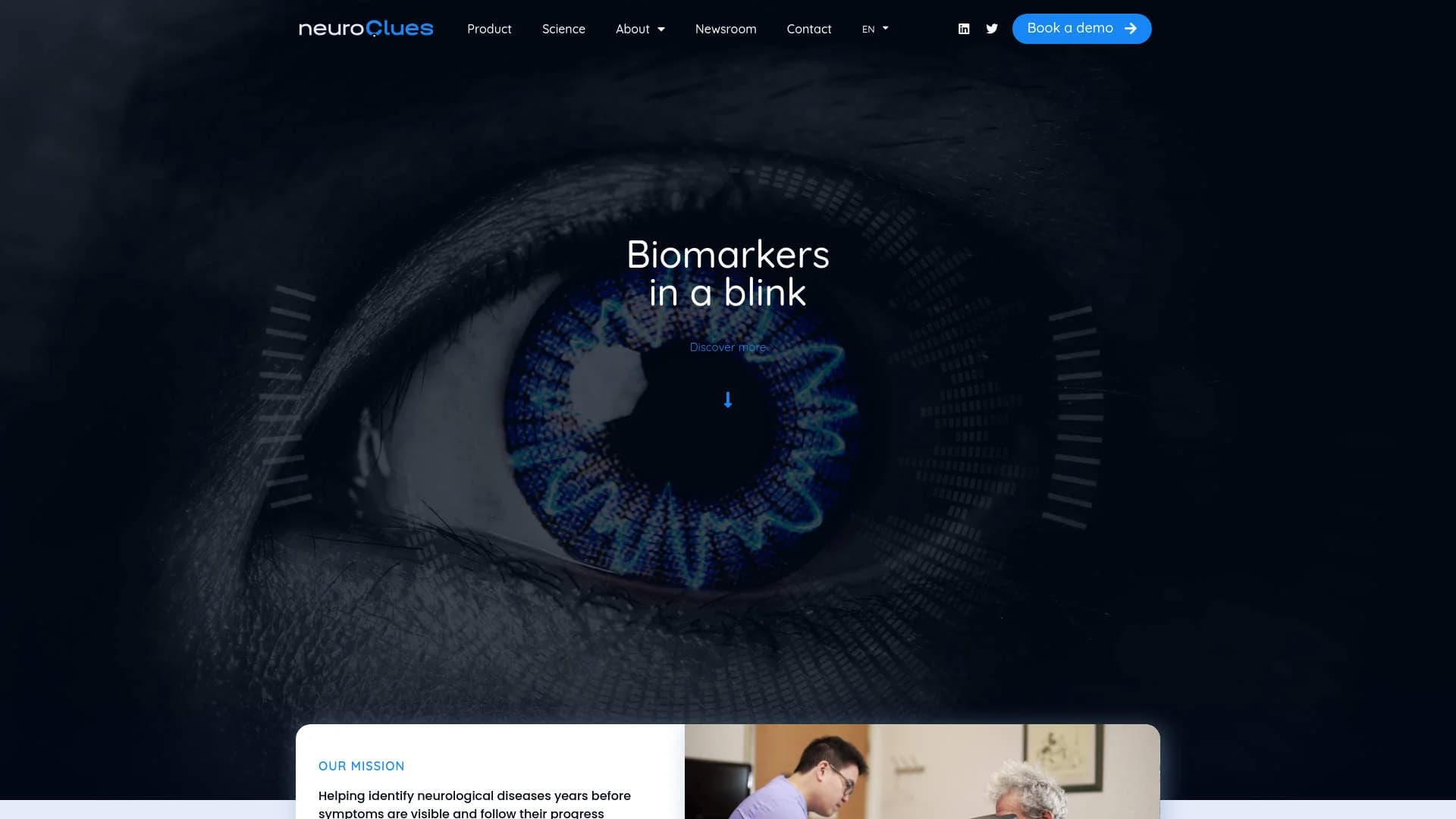
neuroClues is a pioneering tool designed to transform the diagnosis and monitoring of neurological diseases through advanced eye-tracking technology. Aimed at health practitioners, neuroClues provides quick, non-invasive, and robust biomarkers to detect neurological conditions before symptoms become apparent and to monitor their progression effectively. This innovative approach has the potential to revolutionize how neurological diseases are diagnosed and managed.
neuroClues is distinguished by its ability to predict the evolution of neurological diseases up to five years in advance. This forward-looking diagnostic capability, combined with its non-invasive and user-friendly design, sets it apart as a groundbreaking tool in the field of neurological diagnostics.
neuroClues stands out by providing advanced, accurate diagnostics for neurological conditions. Its ability to detect early signs of diseases and its user-friendly design make it a valuable addition to the medical diagnostics field. Once available commercially, neuroClues is expected to be a significant tool in monitoring and treating neurological health.
Who is Using NeuroClues?
Neurologists
Utilize the tool to enhance the accuracy and efficiency of neurological exams.
Research Institutions
Employ the technology to study and understand neurological disease progression.
Clinicians in Remote Areas
Benefit from the tool’s portability to provide advanced diagnostic capabilities in less accessible locations.
Educational Facilities
Use the tool for teaching purposes, helping medical students learn about neurological assessment techniques.
Uncommon Use Cases
Applied in sports medicine to assess concussions; used by geriatric specialists to monitor conditions like Alzheimer's.
Key Features
Rating Breakdown
Pricing Plans
Research Phase
- Not available for purchase as it is currently in the research and development stage
Which NeuroClues plan should you pick?
Start with the all-included leasing model after a personalized demo; upgrade or expand through custom protocols and broader clinical deployment when your practice needs additional indications or research workflows.
All-included leasing
Good for clinical practices that need the hardware, software, cloud platform, maintenance, and implementation support as one integrated offering.
NeuroClues Use Cases
Atypical parkinsonism assessment
Record saccades, fixation, and pursuit for patients with suspected atypical parkinsonian syndromes.
Outcome: Objective biomarkers and reference ranges support the diagnostic hypothesis.
Cerebellar syndrome assessment
Run cerebellar protocols for patients with suspected cerebellar impairment.
Outcome: Quantified oculomotor findings support clinical assessment and decision-making.
Longitudinal patient monitoring
Keep results associated with a subject profile and review consultations over time.
Outcome: Clinicians can track changes in eye-movement biomarkers.
Clinical research protocols
Create or commission custom protocols for advanced clinical and research objectives.
Outcome: Research teams can collect standardized eye-movement measurements tailored to their objectives.
Preventive screening research
Use eye-movement biomarkers in studies investigating early or presymptomatic neurological changes.
Outcome: Studies can examine pathological progression trends and early disease markers.
Workflow Ideas with NeuroClues
Atypical Parkinsonism Evaluation
- 1Select extrapyramidal evaluation protocols
- 2Record eye movements for approximately 10 minutes
- 3Review automatically computed biomarkers, timecourses, and the patient report
Cerebellar Assessment
- 1Select protocols for cerebellar assessment
- 2Record standardized saccade, fixation, and pursuit tasks
- 3Interpret the results alongside reference ranges and clinical findings
Longitudinal Monitoring
- 1Create or update the subject profile
- 2Associate each consultation with the subject history
- 3Compare results and reports across time
How NeuroClues fits into your stack
Data Sharing Capabilities
Facilitates easy sharing of diagnostic data among healthcare professionals.
Integration with Existing Medical Records Systems
Designed to integrate seamlessly with electronic health records, enhancing data accessibility and management.
Support for Multiple Operating Systems
Compatible with various operating systems to ensure broad usability.
Adaptability to Various Clinical Settings
Suitable for use in diverse clinical environments, from hospitals to private practices.
Pros
- +Enhanced Diagnostic Accuracy: Improves the certainty of diagnosing conditions such as Parkinson’s disease and other neurological disorders.
- +Time Efficiency: Offers rapid assessments, potentially within minutes, speeding up the diagnostic process.
- +Non-Invasive Method: Provides a patient-friendly, non-invasive diagnostic approach.
- +Portable and Shareable: Easy to transport and share results, facilitating collaborative clinical practice.
Cons
- −Pending Regulatory Approval: Currently in the research and development phase, awaiting regulatory clearance for commercial availability.
- −Specialized Training Required: Users may need specific training to fully utilize all features.
- −Dependence on Technological Compatibility: Requires compatible hardware and software environments for optimal performance.
Limitations & when to consider alternatives
Known limitations
- Clinical interpretation remains necessary. The company states that biomarkers should be interpreted in the context of the clinical question and broader neurological examination.
- Age requirement. The device is intended for identifying visual tracking impairments in human subjects aged five years and older.
- Dedicated hardware setup. The App runs on a dedicated computer physically connected to the neuroClues Lab.
- Reimbursement varies by country. Procedure reimbursement is available under existing codes in some countries, but amounts and eligibility vary.
Look elsewhere when
- You need a general-purpose developer API
- You need a mobile or browser-based tool
- You need general-purpose document or image analysis
How to Use NeuroClues
- 1
Explore detailed tutorials and guides on the neuroClues website to assist with basic setup and advanced operational techniques.
Who is NeuroClues For?
Neurologists
The platform supports objective eye-movement assessment, diagnosis, monitoring, and treatment decisions in neurological practice.
Movement-disorder specialists
It provides biomarkers for differential diagnosis of atypical parkinsonian syndromes and monitoring over time.
Clinicians assessing cerebellar syndromes
Standardized saccade, fixation, and pursuit recordings support objective cerebellar assessment.
Healthcare professionals
Projects can be shared with healthcare professionals for collaborative review while maintaining patient-data controls.
Clinical researchers
Custom protocols and research-oriented eye-movement biomarkers support advanced clinical and research objectives.
Frequently Asked Questions
What is neuroClues intended for?
neuroClues records, visualizes, and analyzes eye movements to support identification of visual tracking impairments in people aged five and older.
How long does an examination take?
The examination takes approximately 10 minutes and can be delegated to an assistant or nurse.
How are the results interpreted?
Biomarkers, eye-movement timecourses, videos, and reference ranges support interpretation alongside the broader neurological examination.
Is neuroClues reimbursed?
Electro-oculography is covered under existing procedure codes in several countries, including France and Belgium; reimbursement varies by country.
How is patient data secured?
The company states that it is ISO 27001:2022 certified, GDPR-compliant, and uses EU-based providers for EU customer data storage.
Community reviews
Be the first to share your experience.
Sign in to leave a review for NeuroClues.
NeuroClues Alternatives
Looking for alternatives to NeuroClues? Here are similar tools in the same category:
Learn to Master NeuroClues
With Skill Leap courses
Get in-depth training on NeuroClues and 50+ other AI tools with our expert-led video courses.
Start 7-Day Free Trial