Multiverse Computing
Revolutionize AI and optimization with quantum-inspired algorithms.
Key Takeaways
- What it is
- Revolutionize AI and optimization with quantum-inspired algorithms.
- Best for
- Powerful Algorithms
- Singularity Platform
- Diverse Industry Applications
- Rating
- 4.6/5
What is Multiverse Computing?
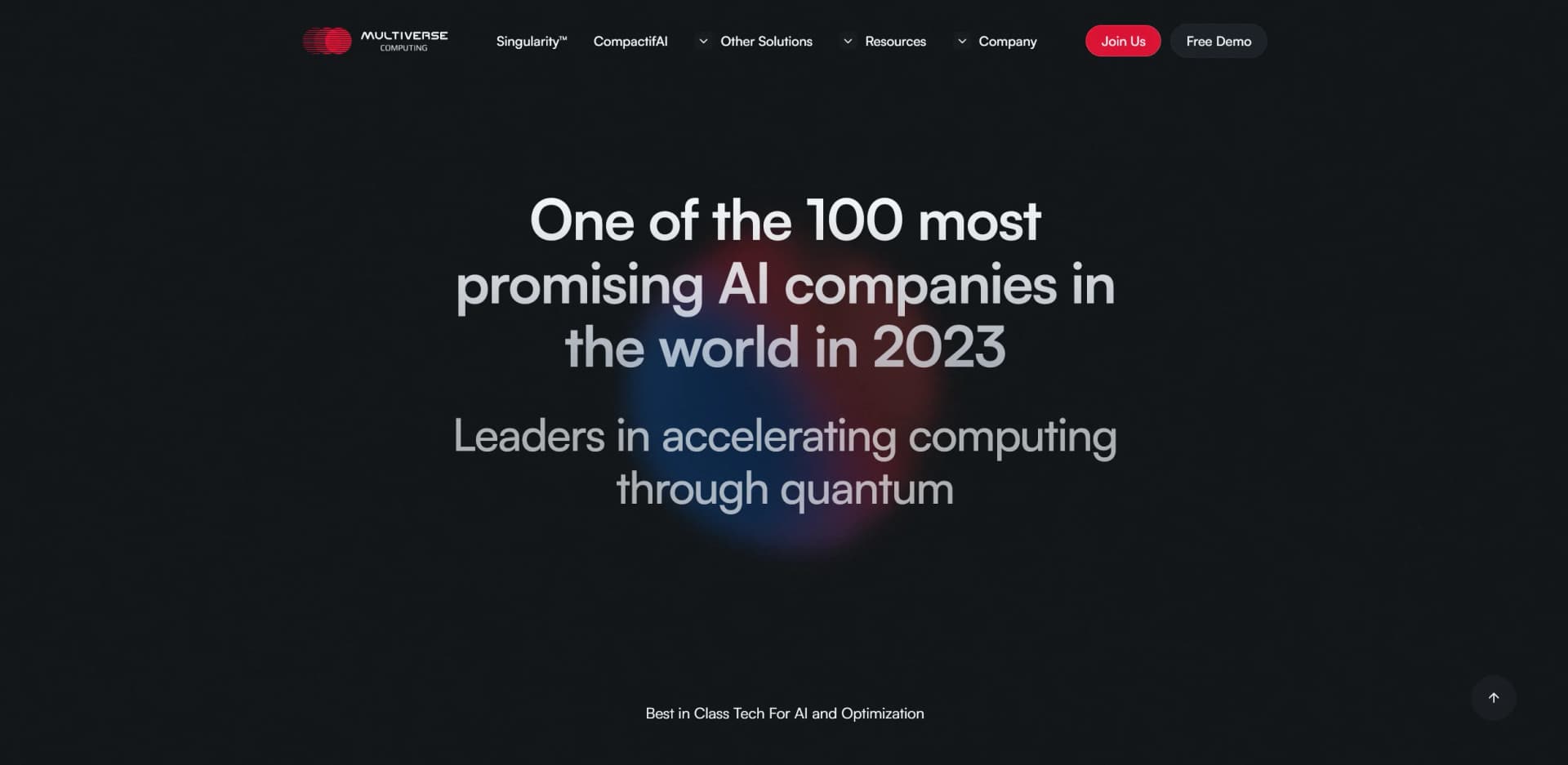
Multiverse Computing is a leading innovator in the field of AI and quantum computing. Recognized as one of the 100 most promising AI companies in 2023, Multiverse Computing focuses on solving complex computational problems and optimization challenges with their advanced platform, Singularity. This tool is designed to cater to industries such as finance, energy, manufacturing, and beyond, aiming to revolutionize AI applications and process optimization through quantum-inspired algorithms.
Multiverse Computing distinguishes itself by combining quantum computing with AI, addressing traditional computational limitations, and opening new possibilities for solving complex global issues such as climate change and renewable energy management.
Multiverse Computing excels in providing advanced, quantum-inspired AI solutions across various industries. The Singularity platform delivers significant cost savings, improved efficiency, and customized solutions that tackle critical AI and optimization challenges. Its focus on green technologies positions it as a key player in future sustainability efforts.
Who is Using Multiverse Computing?
Financial Institutions
Using quantum computing for intricate financial modeling and risk assessment.
Energy Companies
Optimizing energy distribution in renewable sectors.
Manufacturing Firms
Enhancing production efficiency through advanced predictive algorithms.
Healthcare Providers
Developing new methods for disease prediction and personalized treatment.
Uncommon Use Cases
Universities for educational purposes in quantum computing; research institutions for groundbreaking scientific discoveries.
Key Features
Rating Breakdown
Pricing Plans
Free Demo
- Offers a no-cost demonstration to explore the capabilities of Singularity
Custom Pricing
- Provides tailored pricing plans based on industry needs and usage scales
Which Multiverse Computing plan should you pick?
Start with the pay-as-you-go API for usage-based access; contact sales when you need a custom enterprise deployment.
Pay-as-you-go
Good for developers and teams who need API access to billed-per-use models without a fixed subscription.
Multiverse Computing Use Cases
AI model compression
Compress large language and other AI models into smaller, more portable versions.
Outcome: Lower memory, compute, storage, and energy requirements.
On-device inference
Run compressed models locally on mobile, embedded, edge, or other constrained hardware.
Outcome: Offline operation with lower latency and no cloud dependency.
Manufacturing computer vision
Deploy tensor-network and quantum-inspired vision models in industrial environments.
Outcome: Smaller, faster, and more accurate models with less training time.
Local weather forecasting
Improve local forecasts for applications such as wind-farm production planning.
Outcome: More precise production forecasts and potential operational savings.
Cybersecurity anomaly detection
Analyze cybersecurity traffic with anomaly-detection algorithms included in Singularity.
Outcome: Detect a wider range of attacks and characterize incidents more effectively.
Workflow Ideas with Multiverse Computing
Connect Cursor to CompactifAI
- 1Open Cursor settings and add the CompactifAI API key.
- 2Set the CompactifAI OpenAI-compatible base URL.
- 3Add and select a CompactifAI model, then confirm chat works.
Use CompactifAI with Claude Code
- 1Install Claude Code and LiteLLM.
- 2Create a LiteLLM configuration with the CompactifAI endpoint and API key.
- 3Start the proxy, configure Claude Code, select a CompactifAI model, and verify responses.
Expose models through GitHub Copilot
- 1Open the organization’s Copilot model settings.
- 2Add a CompactifAI API key and configure the provider endpoint.
- 3Select models for the organization, configure capabilities, and use them in the IDE.
How Multiverse Computing fits into your stack
Industry-Specific Solutions
Custom integrations with various industrial tools and platforms.
API Access
Provides APIs for developers to create custom applications and integrations.
Data Security
Adheres to high-level security protocols, essential for industries like finance and healthcare.
Advanced Research Tools
Supports advanced research with tools designed for scientific and engineering challenges.
Pros
- +Cost Efficiency: Significantly reduces the costs associated with training large language models, with potential savings up to $100 million.
- +High Adaptability: Customizable to meet the specific needs of various industries, offering a wide range of applications.
- +User-Friendly Interface: Despite its sophisticated technology, Singularity offers an intuitive interface for ease of use.
- +Innovative Technology: Integrates quantum physics with AI, offering a cutting-edge technological advantage.
Cons
- −Complex Technology: The underlying quantum computing concepts may pose a learning curve for new users.
- −Niche Applications: Primarily focused on large-scale industrial and scientific applications, which might not be suited for smaller businesses.
- −Limited Awareness: Quantum computing is an emerging field, which may limit immediate understanding and widespread adoption.
Limitations & when to consider alternatives
Known limitations
- Pay-as-you-go API pricing. The API charges by token or audio usage rather than offering a named recurring free plan.
- No built-in content guardrails. The API does not provide built-in security guardrails or content filtering; developers must implement them.
- Regional processing choices. The global endpoint may route requests to either the EU or US; region-specific endpoints are available when required.
- Model-dependent multimodality. Image and audio capabilities are available only for selected models.
- Foundry availability. The Foundry page currently labels the platform as coming soon.
Look elsewhere when
- You need a dedicated browser extension.
- You need a native desktop application.
- You need built-in content moderation.
- You need a conventional named subscription plan.
How to Use Multiverse Computing
- 1
Access a variety of tutorials and resources on the Multiverse Computing website to guide users from basic navigation to advanced functionalities of Singularity.
Who is Multiverse Computing For?
Digital natives
Use compact models to reduce GPU shortages, latency, and scaling constraints.
Corporations
Run efficient AI on existing infrastructure while preserving data sovereignty, privacy, and compliance.
Data centers
Increase capacity and throughput without adding racks through smaller, faster models.
Device manufacturers
Deploy low-power, offline AI on constrained devices and embedded hardware.
Mobile professionals and field operations
Use the CompactifAI app offline in low-connectivity, privacy-sensitive, or air-gapped environments.
Frequently Asked Questions
What is CompactifAI API?
It is an LLM inference service providing language models through an OpenAI-compatible API.
How does pricing work?
Pricing is pay-as-you-go and varies by model.
What programming languages can I use with the API?
The API is language-agnostic; any language capable of making HTTP requests can be used.
Does the API support streaming responses?
Yes. Chat Completions and Completions support streamed responses through Server-Sent Events.
Where is my data processed?
Requests stay within Multiverse Computing’s private network in EU and US data centers.
Do you train on my data?
Prompts, completions, and request data are not used to train, fine-tune, or improve models.
Community reviews
Be the first to share your experience.
Sign in to leave a review for Multiverse Computing.
Multiverse Computing Alternatives
Looking for alternatives to Multiverse Computing? Here are similar tools in the same category: