
MonaLabs
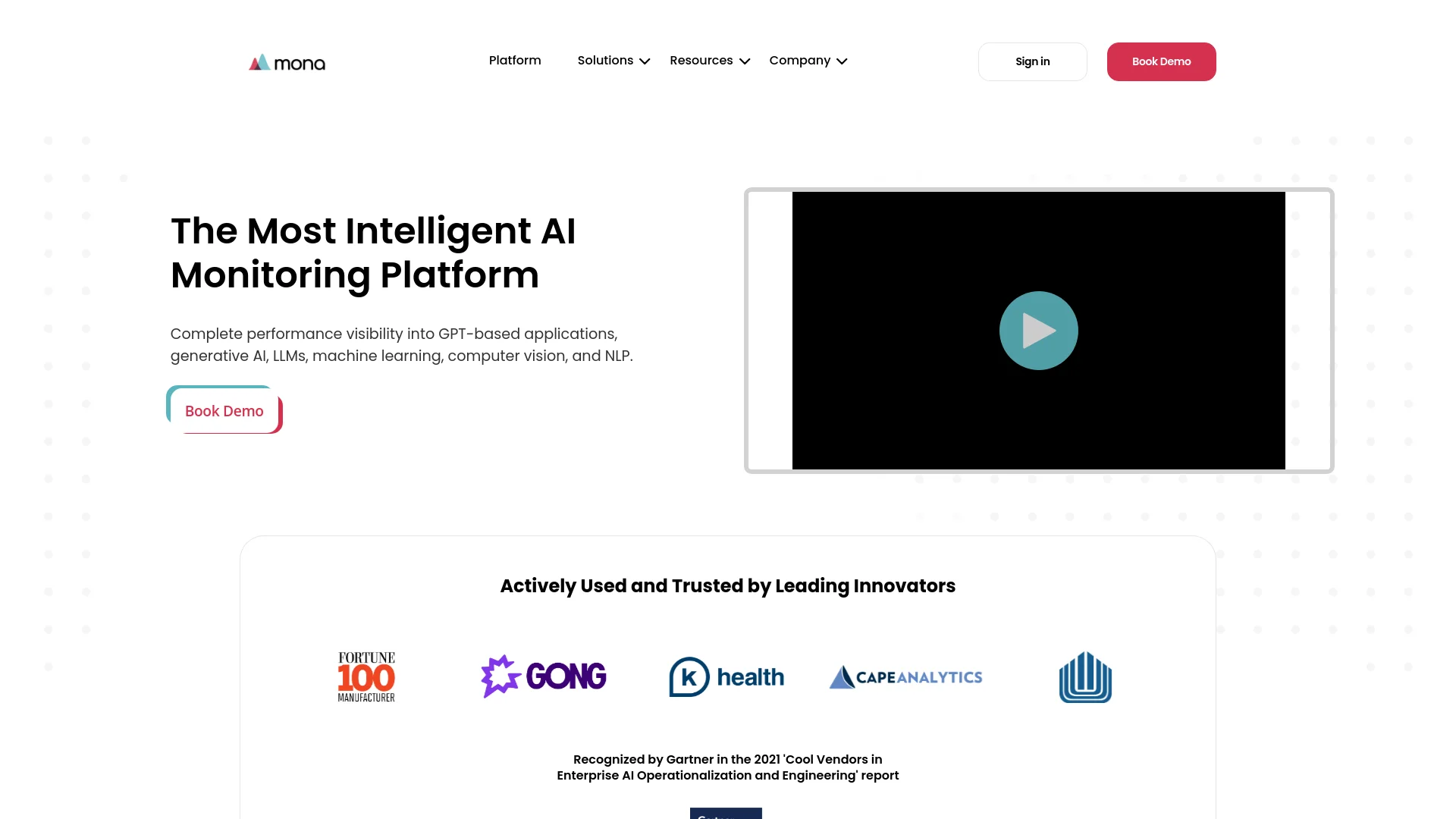
Monitor and optimize AI applications in real-time with MonaLabs.
Key Takeaways
- What it is
- Monitor and optimize AI applications in real-time with MonaLabs.
- Best for
- Real-Time Monitoring
- Automated Fairness Reports
- Custom Metrics Tracking
- Rating
- 4.6/5
What is MonaLabs?
MonaLabs is a cutting-edge AI monitoring platform designed to provide comprehensive oversight for applications built on AI technologies like GPT, machine learning, NLP, and more. Its core purpose is to ensure that these complex systems operate efficiently, ethically, and without bias, making it an indispensable tool for businesses leveraging AI technologies. By offering real-time insights and proactive issue resolution, MonaLabs simplifies the management of AI applications, ensuring they remain aligned with business goals and regulatory standards.
MonaLabs excels with its comprehensive monitoring capabilities, essential for any AI-driven business. Its real-time issue detection, diagnosis, and reporting, combined with a focus on AI fairness and ethical compliance, set it apart as a leader in responsible AI management.
MonaLabs excels in delivering robust, reliable AI monitoring solutions crucial for maintaining the integrity and performance of AI systems. Its automated fairness reporting ensures that AI applications operate without bias, providing a significant advantage in regulatory compliance and ethical operations. For any organization invested in AI, MonaLabs is an essential tool that enhances performance and trustworthiness in AI applications.
Who is Using MonaLabs?
Tech Giants
For monitoring large-scale AI deployments.
Healthcare Providers
To ensure AI-driven diagnostics are accurate and unbiased.
Financial Institutions
To monitor AI in fraud detection systems.
Retail Chains
For optimizing AI-driven inventory and logistics management.
Uncommon Use Cases
Non-profits using AI for predictive analytics in fundraising; universities for research on AI system behaviors.
Key Features
Rating Breakdown
Pricing Plans
Free Trial
- Offers a robust free trial period
Subscription Plans
- Pricing starts at a competitive rate
- Scaling with usage and features required
MonaLabs Use Cases
Detect model drift and outliers
Configure metrics and segments to identify drift, outliers, thresholds, and sudden changes in production data.
Outcome: Earlier visibility into model and data issues.
Monitor search-ranking models
Track real-time search-result ranking behavior and compare performance across relevant dimensions.
Outcome: Detect ranking issues before they affect users or business KPIs.
Monitor customer-lifetime-value predictions
Monitor batch prediction processes and custom metrics for marketing use cases.
Outcome: Identify changes in prediction behavior and performance.
Monitor fraud-detection systems
Apply configurable monitoring to fraud-detection models and their business-relevant segments.
Outcome: Surface anomalies before they create downstream business risk.
Send AI insights to operational tools
Forward Mona data and insights to New Relic, Datadog, and notification platforms.
Outcome: Centralize AI-monitoring signals with existing operational workflows.
Workflow Ideas with MonaLabs
Configure and monitor an AI system
- 1Define fields, metrics, and segmentations
- 2Create Stanzas and Verses for anomaly detection
- 3Review generated insights and investigations
Send production data through the Python SDK
- 1Install the Mona Python SDK
- 2Send production data to Mona
- 3Review anomalies and insights in the dashboard
Route Mona insights to operations tools
- 1Configure an external integration such as New Relic or Datadog
- 2Add the required integration keys or notification settings
- 3Send new Mona insights to the external dashboard or incident workflow
How MonaLabs fits into your stack
API Flexibility
Easily integrates with existing business systems through robust APIs.
Cloud Compatibility
Works with major cloud platforms like AWS, Google Cloud, and Azure.
Custom Integration Support
Offers support for bespoke integrations to meet specific business needs.
Wide-ranging Tech Stack Adaptability
Compatible with diverse technology stacks.
Pros
- +Enhanced AI Reliability: Ensures AI systems function as intended with minimal downtime.
- +Proactive Problem Solving: Identifies and addresses issues before they affect end-users or critical business metrics.
- +Scalability: Adapts to increasing demands without loss of performance.
- +User Empowerment: Provides tools for users to adjust parameters and monitor outcomes effectively.
Cons
- −Complexity: The depth of features may overwhelm new users initially.
- −Integration Time: Integration can be time-consuming depending on the existing infrastructure.
- −Cost Perception: Initial investment may seem high before realizing ROI.
Limitations & when to consider alternatives
Known limitations
- Historical-data limitations in New Relic. The New Relic integration only processes new data; historical data is not supported by New Relic.
- Production focus. Mona’s documentation recommends monitoring after models are integrated into production; purely experimental models may be too early for deployment of monitoring.
- Data-ingestion dependency. Organizations still establishing data-ingestion processes may need to streamline those processes before implementing monitoring.
- Configuration required. Mona requires users to define fields, metrics, segmentations, Stanzas, Verses, and notification settings for their monitoring context.
Look elsewhere when
- You need a native mobile app.
- You need a browser extension or desktop installer.
- You need document or image analysis rather than AI-system monitoring.
- You need model fine-tuning or custom-weight training.
How to Use MonaLabs
- 1
Explore a variety of tutorials, from basic setup to advanced monitoring techniques, on MonaLabs’ official website and YouTube channel.
Who is MonaLabs For?
Data science teams
Mona helps teams monitor model behavior, data quality, metrics, segments, and production anomalies.
Machine-learning teams
The platform is designed for teams operating models and AI systems in production.
AI product and engineering teams
Mona provides visibility into AI applications, model versions, business metrics, and downstream performance.
Teams responsible for AI governance
Mona can monitor dimensions such as demographic or business segments and surface unusual behavior.
Organizations using production AI systems
Mona is positioned for organizations that need proactive monitoring before model issues affect business KPIs.
Frequently Asked Questions
What does Mona monitor?
Mona monitors AI and machine-learning applications, models, data pipelines, metrics, segments, and anomalies in production.
How does Mona detect anomalies?
Users configure fields, metrics, segmentation, and Verse types such as drift, outliers, sudden changes, thresholds, and segment-size changes.
Can Mona send data through an SDK?
Yes. Mona provides an open-source Python SDK for securely sending data and uploading configurations.
Can Mona integrate with external monitoring tools?
Yes. Official documentation covers integrations and notifications for tools including New Relic, Slack, Microsoft Teams, Google Chat, PagerDuty, Opsgenie, and Datadog.
Can administrators manage users?
Yes. Administrators can invite users, assign viewer, participant, or admin roles, and remove users.
Does Mona support SSO?
The official documentation includes a dedicated SSO (Single Sign-On) capability.
Community reviews
Be the first to share your experience.
Sign in to leave a review for MonaLabs.
MonaLabs Alternatives
Looking for alternatives to MonaLabs? Here are similar tools in the same category:
Learn to Master MonaLabs
With Skill Leap courses
Get in-depth training on MonaLabs and 50+ other AI tools with our expert-led video courses.
Start 7-Day Free Trial