ModelOp
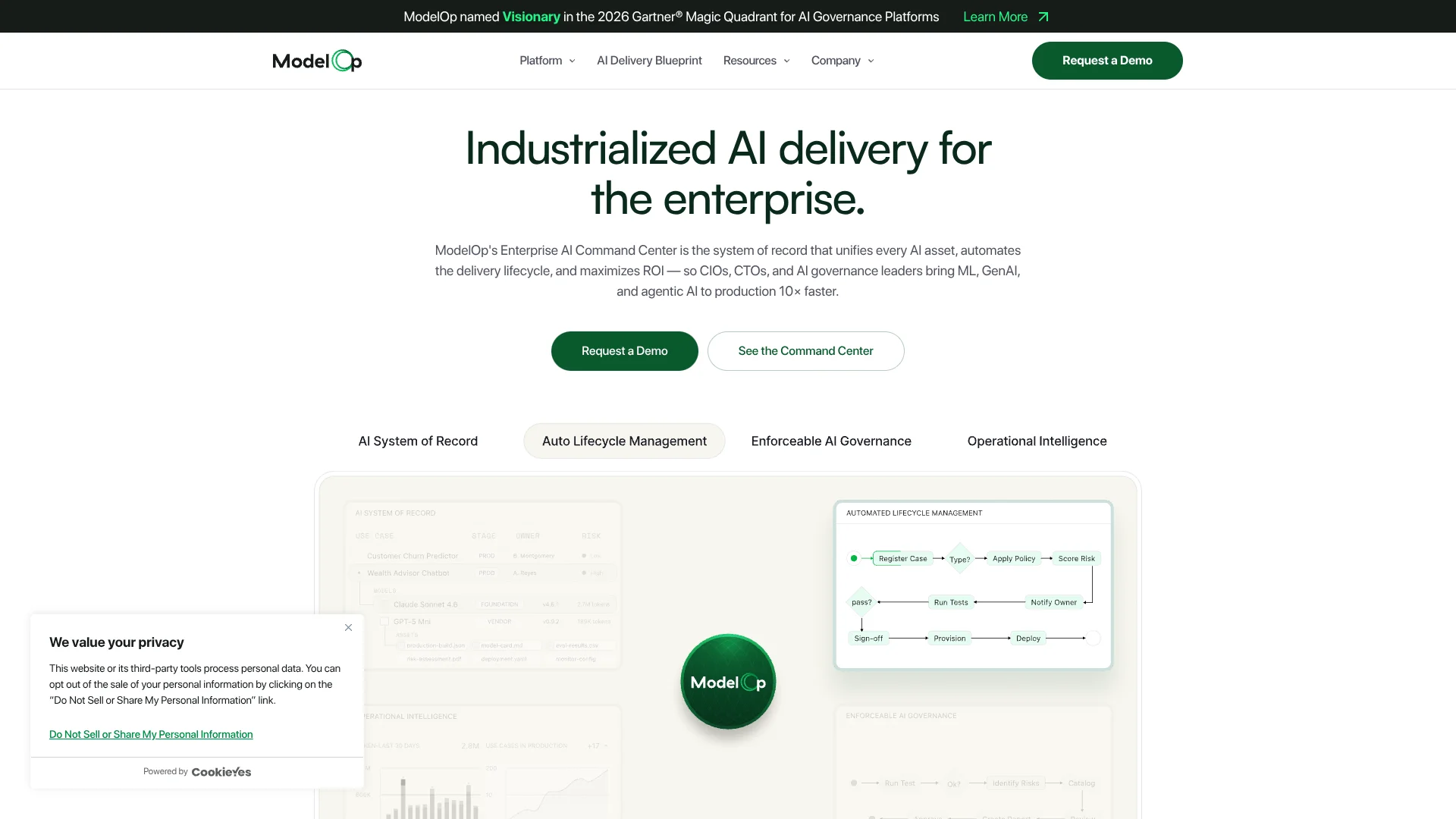
Enterprise AI governance that tracks models, agents, risks, and approvals.
Key Takeaways
- What it is
- Enterprise AI governance that tracks models, agents, risks, and approvals.
- Best for
- AI System of Record
- Automated Risk Tiering
- Lifecycle Workflows
- Rating
- 4.2/5
What is ModelOp?
ModelOp gives large organizations a central system of record for ML models, generative AI, agentic systems, and third-party AI. It tracks ownership, risk, approvals, production status, usage, cost, and business value while coordinating the teams involved in bringing AI into production. The platform is built for CIOs, AI governance leaders, risk teams, data scientists, and enterprise technology groups.
ModelOp governs AI across systems that were built and deployed in different places, including internal models, vendor tools, agents, and AI embedded in software. Its Enterprise AI Command Center sits above development, execution, security, GRC, ITSM, and data systems instead of replacing them.
ModelOp fits regulated enterprises that need traceable approvals, policy enforcement, continuous monitoring, and audit-ready evidence across a large AI portfolio. It is less suitable for individuals, small teams, or developers seeking a self-serve model-building tool. Its value comes from coordinating enterprise AI delivery rather than generating content or code.
Who is Using ModelOp?
Chief AI Officers and CIOs
Portfolio dashboards show where AI is deployed, what it costs, who owns it, and which initiatives create value.
AI Governance Teams
Governance teams standardize intake, risk tiering, control mapping, approvals, monitoring, and audit evidence.
Legal, Risk, and Compliance Leaders
Regulatory controls, review records, model cards, and lifecycle evidence support defensible oversight.
IT and Architecture Leaders
Existing AI, data, security, GRC, and ITSM systems remain in place while ModelOp coordinates work across them.
Model Owners and Data Scientists
Model teams can move systems toward production through defined reviews and controls without bypassing governance.
Uncommon Use Cases
Track AI embedded in third-party software and discover unregistered agents or MCP-connected tools; attribute token usage and tool calls to business use cases.
Key Features
Rating Breakdown
Pricing Plans
Contact sales
- Built for enterprise AI lifecycle management and governance.
- Available for on-premises, private cloud, and hybrid deployment.
- Request a demo to discuss your AI portfolio, technology stack, and deployment needs.
Which ModelOp plan should you pick?
Start with the Enterprise Plan if your organization needs governed delivery across multiple AI systems, teams, environments, and regulatory requirements.
Enterprise Plan
Good for large organizations that need centralized AI inventory, lifecycle workflows, policy enforcement, monitoring, and portfolio reporting.
ModelOp Use Cases
AI Inventory and Discovery
A central registry reveals what AI exists, where it runs, who owns it, and how it is performing.
Outcome: Better visibility across the enterprise AI portfolio.
Risk-Based Governance
Risk tiers determine which controls, reviews, and approvals an AI use case needs.
Outcome: More consistent oversight without applying the same process to every system.
Production Delivery
Cross-functional workflows move AI from intake through implementation, testing, approval, deployment, and ongoing review.
Outcome: Faster movement from an AI idea to a governed production system.
Regulatory Evidence
Lifecycle activity, validation summaries, model cards, approvals, and control results are captured for review.
Outcome: Audit-ready documentation across AI deployments.
AI Cost and Value Management
Usage dashboards connect tokens, throughput, tool calls, cost, risk, and ROI to business use cases.
Outcome: Stronger decisions about which AI initiatives to scale, change, or retire.
Workflow Ideas with ModelOp
Govern a New AI Use Case
- 1Register the use case with its purpose, data, owner, and intended outcome.
- 2Apply risk tiering and generate the required controls.
- 3Route the use case through security, legal, risk, compliance, and business approvals.
Move a Model Into Production
- 1Connect the model or agent to its use case and lifecycle record.
- 2Run testing for performance, bias, drift, and other required risks.
- 3Approve deployment and continue monitoring the production system.
Track AI Portfolio Value
- 1Review token usage, tool invocations, throughput, cost, and risk by use case.
- 2Compare AI initiatives by business unit, geography, lifecycle stage, or risk tier.
- 3Scale high-value systems and investigate or retire underperforming ones.
How ModelOp fits into your stack
AI Development and Execution
ModelOp sits above model registries, AI development platforms, agent platforms, and execution environments. It coordinates governance without replacing the tools teams use to build or run AI.
Enterprise Systems
The platform connects AI work with data, security, GRC, ITSM, and other enterprise systems so reviews and approvals follow existing organizational processes.
Governance and Compliance
Policies, risk tiers, controls, approvals, testing, and evidence are managed through shared workflows instead of separate spreadsheets or disconnected tickets.
Monitoring and Operations
Production signals such as drift, bias, performance, token usage, throughput, tool invocations, and cost feed portfolio-level oversight.
Agentic AI
ModelOp can bring agents, MCP-connected tools, agent cards, and A2A assets into the same inventory and governance lifecycle.
Pros
- +Enterprise-wide visibility: Tracks internal, third-party, traditional, generative, and agentic AI in one inventory.
- +Policy-driven workflows: Routes reviews and approvals based on risk, controls, and organizational responsibilities.
- +Works with existing systems: Integrates across AI development, execution, data, security, GRC, and ITSM environments.
- +Deployment flexibility: Runs on-premises, in private cloud, or in hybrid environments with data referenced in place.
- +Portfolio-level insight: Connects AI usage and cost to business use cases, owners, risk, and value.
Cons
- −Enterprise focus: The platform is designed for large organizations rather than individual users or small teams.
- −Sales-led access: Public self-serve pricing and a free plan are not available.
- −Implementation effort: Value depends on connecting ModelOp to an organization's existing AI and enterprise systems.
Limitations & when to consider alternatives
Known limitations
- No Public SaaS Deployment. The Enterprise AI Command Center installs in the customer's environment, including on-premises, private cloud, or hybrid environments.
- No Public Self-Serve Pricing. ModelOp directs prospective customers to sales and demo requests rather than publishing standard online subscription prices.
- Enterprise Integration Required. The platform is designed to coordinate existing AI, data, security, GRC, ITSM, and enterprise systems rather than operate as a standalone model-building workspace.
Look elsewhere when
- You need a consumer chatbot or general-purpose AI writing tool.
- You need a self-serve model registry or model development environment.
- Your team wants a low-cost product with public monthly pricing.
- You need a native mobile, desktop, or browser application.
How to Use ModelOp
- 1
Define the AI Inventory
Bring models, agents, vendor AI, and use cases into the Enterprise AI Command Center so ownership and lifecycle status are visible.
- 2
Connect Existing Systems
Link ModelOp with the AI development, execution, data, security, GRC, and ITSM systems your organization already uses.
- 3
Set Policies and Controls
Map internal policies and external regulations to risk tiers, model types, geographies, and lifecycle events.
- 4
Run Intake and Reviews
Route each AI initiative through the required business, technical, privacy, security, legal, risk, and compliance steps.
- 5
Monitor Production AI
Track performance, bias, drift, prompt vulnerabilities, usage, cost, and policy issues after deployment.
- 6
Use Portfolio Insights
Review cost, risk, ownership, and business value to decide which AI initiatives deserve more investment.
Who is ModelOp For?
Financial Services
Financial institutions can govern model risk, document controls, and maintain evidence across regulated AI deployments.
Healthcare, Pharmaceuticals, and Biotech
Healthcare organizations can establish risk-based oversight for AI use cases across departments and environments.
Consumer Packaged Goods and Retail
Retail and CPG organizations can track AI initiatives, improve delivery operations, and enforce enterprise policies.
Defense, Government, and Public Sector
Public-sector teams can organize AI governance around agency policies, regulations, and oversight requirements.
Enterprise AI Programs
Organizations with many AI projects can connect delivery, governance, monitoring, cost, and value in one operating layer.
Frequently Asked Questions
What does ModelOp do?
ModelOp manages the enterprise AI lifecycle from use-case intake and risk tiering through testing, approval, deployment, monitoring, and retirement.
Does ModelOp replace MLOps or model registries?
No. ModelOp sits above development and execution systems, coordinating lifecycle, governance, monitoring, and audit work across them.
Can ModelOp govern generative and agentic AI?
Yes. It supports ML, generative AI, agentic AI, traditional models, first-party systems, third-party AI, MCP-connected tools, and agent assets.
Where does ModelOp run?
The Enterprise AI Command Center runs on-premises, in a private cloud, or in a hybrid environment. ModelOp states that it references data in place rather than copying or transferring it.
What systems does ModelOp integrate with?
Published examples include MLflow, Amazon Bedrock, Amazon SageMaker, Azure ML, Vertex AI, ServiceNow, Jira, Databricks, Power BI, Amazon S3, Amazon Redshift, and Amazon DocumentDB.
How much does ModelOp cost?
ModelOp does not publish a standard public price. Prospective customers are directed to request a demo or contact sales.
Community reviews
Be the first to share your experience.
Sign in to leave a review for ModelOp.
ModelOp Alternatives
Looking for alternatives to ModelOp? Here are similar tools in the same category: