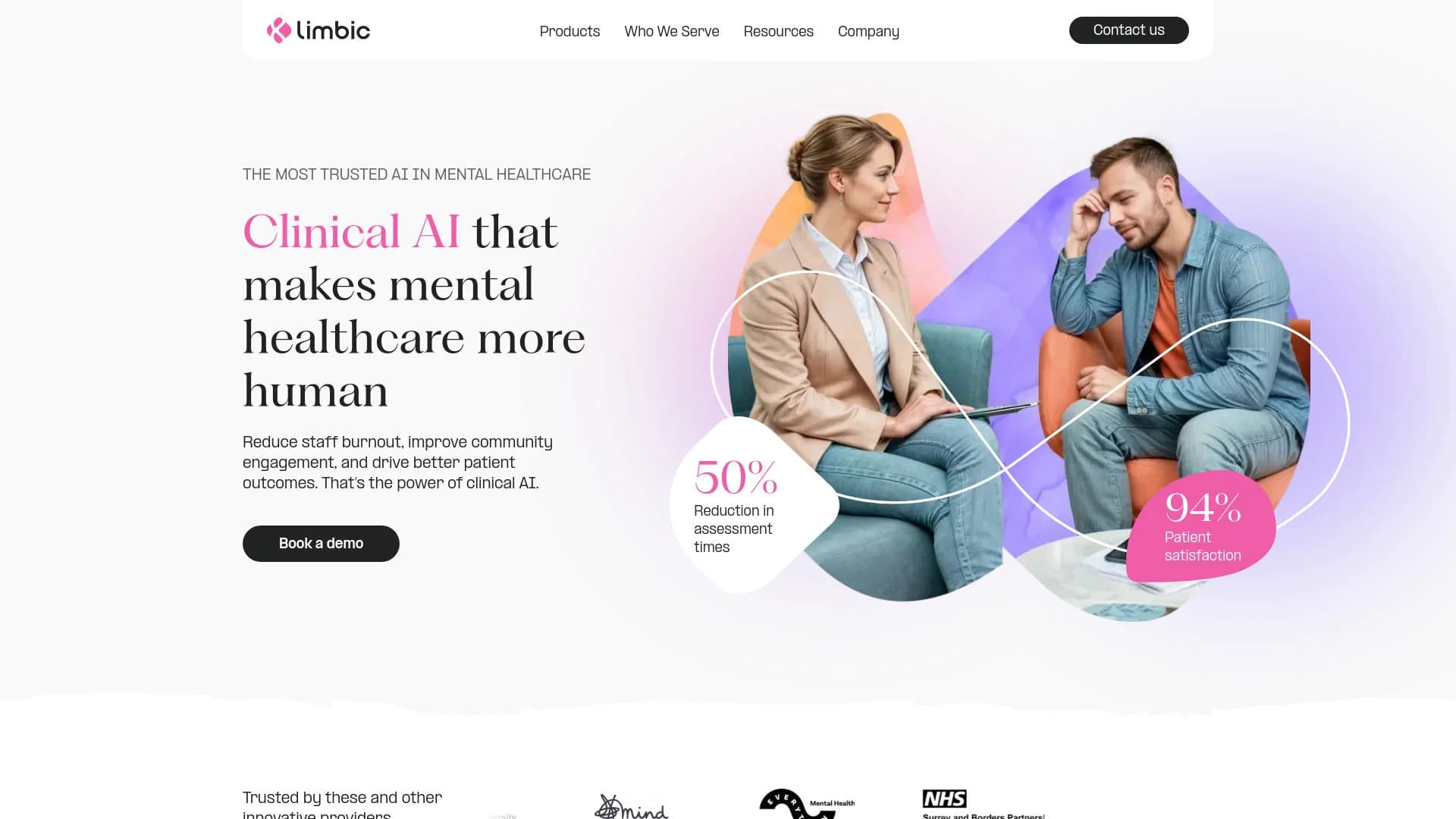
Limbic
Revolutionize mental health care with AI-driven assessments and therapy.
Key Takeaways
- What it is
- Revolutionize mental health care with AI-driven assessments and therapy.
- Best for
- AI-Powered Clinical Assessments
- Risk Stratification
- Automated Therapeutic Content Delivery
- Rating
- 4.6/5
What is Limbic?
Limbic is an advanced AI tool designed specifically for mental healthcare providers. It leverages cutting-edge artificial intelligence technologies to support therapists and clinicians in delivering more effective and efficient mental health care. By integrating AI into various stages of the mental health care pathway, Limbic aims to save valuable clinical time, enhance patient outcomes, and optimize the overall impact of healthcare services.
Limbic distinguishes itself with its deep integration of AI into mental health care, particularly through AI-enhanced assessments and risk stratification. Its ability to significantly reduce administrative burdens and improve clinical outcomes sets it apart in the healthcare technology landscape.
Limbic excels at enhancing the efficiency and effectiveness of mental health care through its sophisticated AI-driven tools. It is especially valuable for therapists and healthcare providers seeking to streamline assessments, improve patient engagement, and manage care pathways more effectively. With high ratings in accuracy, reliability, and security, Limbic is an essential tool for modern mental healthcare.
Who is Using Limbic?
NHS Mental Health Clinics
Over 40% of NHS clinics utilize Limbic to enhance clinical efficiency.
Private Therapists
Many private practitioners use Limbic to handle increasing patient volumes.
Academic Institutions
Used for research and training purposes in academic settings to educate future mental health professionals.
Corporate Wellness Programs
Adopted by businesses to provide scalable support for employee mental health.
Uncommon Use Cases
Applied in remote areas to bridge gaps in mental health services; used in emergency settings for rapid assessment and triage.
Key Features
Rating Breakdown
Pricing Plans
Subscription Model
- Operates on a subscription basis
- Pricing tailored to the size and needs of the healthcare provider
Custom Quotes
- Offers customized pricing based on the services and scale of implementation
Limbic Use Cases
Patient intake and assessment
Patients complete conversational intake and assessment through Limbic Access.
Outcome: Clinicians receive clinical reports, risk levels, notes, assessment scores, and predicted diagnoses.
Clinical triage
Limbic evaluates patient needs and routes people to the appropriate level of care.
Outcome: Services can reduce assessment time and improve pathway decisions.
Between-session therapy support
Limbic Care provides conversational CBT-based support, therapeutic activities, and personalized coping strategies.
Outcome: Patients receive on-demand support between therapy sessions.
EHR workflow integration
Limbic connects intake information with cloud-based EHR and patient-management workflows.
Outcome: Staff spend less time manually entering referral and assessment information.
Crisis and risk identification
Limbic monitors interactions for crisis indicators and can alert clinical staff while offering crisis resources.
Outcome: Services can identify risk and take appropriate clinical action.
Workflow Ideas with Limbic
Website self-referral to clinician assessment
- 1Embed Limbic Access on the provider website
- 2Have the patient complete conversational intake and assessment
- 3Provide the clinician with the generated assessment and predicted diagnoses
Referral integration with patient-management software
- 1Collect referral and assessment information through Limbic Access
- 2Map captured details to the patient-management system
- 3Let clinical staff review the information and manage the patient pathway
Between-session CBT support
- 1Assign patients Limbic Care alongside their treatment plan
- 2Let patients complete conversational exercises and check in on demand
- 3Share relevant patient information with clinician-facing dashboards
How Limbic fits into your stack
Health Record Systems
Integrates seamlessly with existing electronic health record systems.
Multi-Language Support
Offers services in multiple languages to accommodate diverse patient populations.
API for Custom Integration
Provides APIs for further customization and integration into specific healthcare environments.
Security and Compliance
Adheres to strict data privacy and security regulations to ensure secure handling of patient information.
Pros
- +Time-Saving: Clinicians report up to a 25% reduction in time spent on assessments, allowing for more focus on patient interaction.
- +High Patient Approval: Achieves a 98.7% approval rate from patients, reflecting satisfaction with AI-enhanced processes.
- +Improved Treatment Pathways: Reduces changes in treatment pathways by 45%, leading to more stable and effective patient care.
- +Enhanced Accessibility: Includes tools like Limbic Access and Limbic Care to improve the accessibility and effectiveness of mental health care.
Cons
- −Complex Integration: Initial setup and customization may be complex, requiring technical support.
- −Learning Curve: New users might need time to fully understand and utilize the AI features.
- −Dependency on Tech Infrastructure: Requires robust digital infrastructure for optimal functionality, which may be challenging in less advanced settings.
Limitations & when to consider alternatives
Known limitations
- Not a substitute for professional care. Limbic states that its software does not provide medical advice, diagnosis, or treatment and should be used as part of a wider clinician-directed care plan.
- Provider invitation may be required. The mobile app listing says users should download the app only if invited by a healthcare provider.
- Browser access for Limbic Access. The Instructions for Use document describes Limbic Access as browser-based and requiring internet access.
- Availability varies by program and eligibility. Unpacked availability varies by state and eligibility, and some offerings are provided through healthcare or Medicare programs.
Look elsewhere when
- You need a downloadable desktop application.
- You need a public developer API with documentation and API keys.
How to Use Limbic
- 1
Extensive resources and tutorials are available to help healthcare providers effectively utilize Limbic’s AI tools.
Who is Limbic For?
Health plans
Limbic helps health plans triage members, expand access, and provide conversational support at scale.
Behavioral health providers
Providers can use Limbic for patient intake, assessment, triage, and clinical decision support.
Health systems
Health systems can use Limbic to deliver mental-health assessments and triage at the point of first contact.
NHS Talking Therapies
Limbic supports NHS Talking Therapies with self-referral, assessments, clinical workflows, and patient engagement.
Frequently Asked Questions
How do patients access Limbic Access?
Limbic Access is embedded into a provider’s website as a conversational intake and assessment channel.
Does Limbic support languages other than English?
The official app listing identifies English as the supported language.
How does Limbic use AI?
Limbic uses clinical AI for intake, triage, diagnostic decision support, CBT-based therapy support, and risk identification.
Is Limbic secure?
The Android listing states that data is encrypted in transit. Limbic also publishes privacy notices and security-related usage guidance.
Can Limbic work within an EHR?
Limbic Access is described as interoperable with cloud-based EHR systems, allowing patient data to be accessed from or imported into records.
Community reviews
Be the first to share your experience.
Sign in to leave a review for Limbic.
Limbic Alternatives
Looking for alternatives to Limbic? Here are similar tools in the same category: