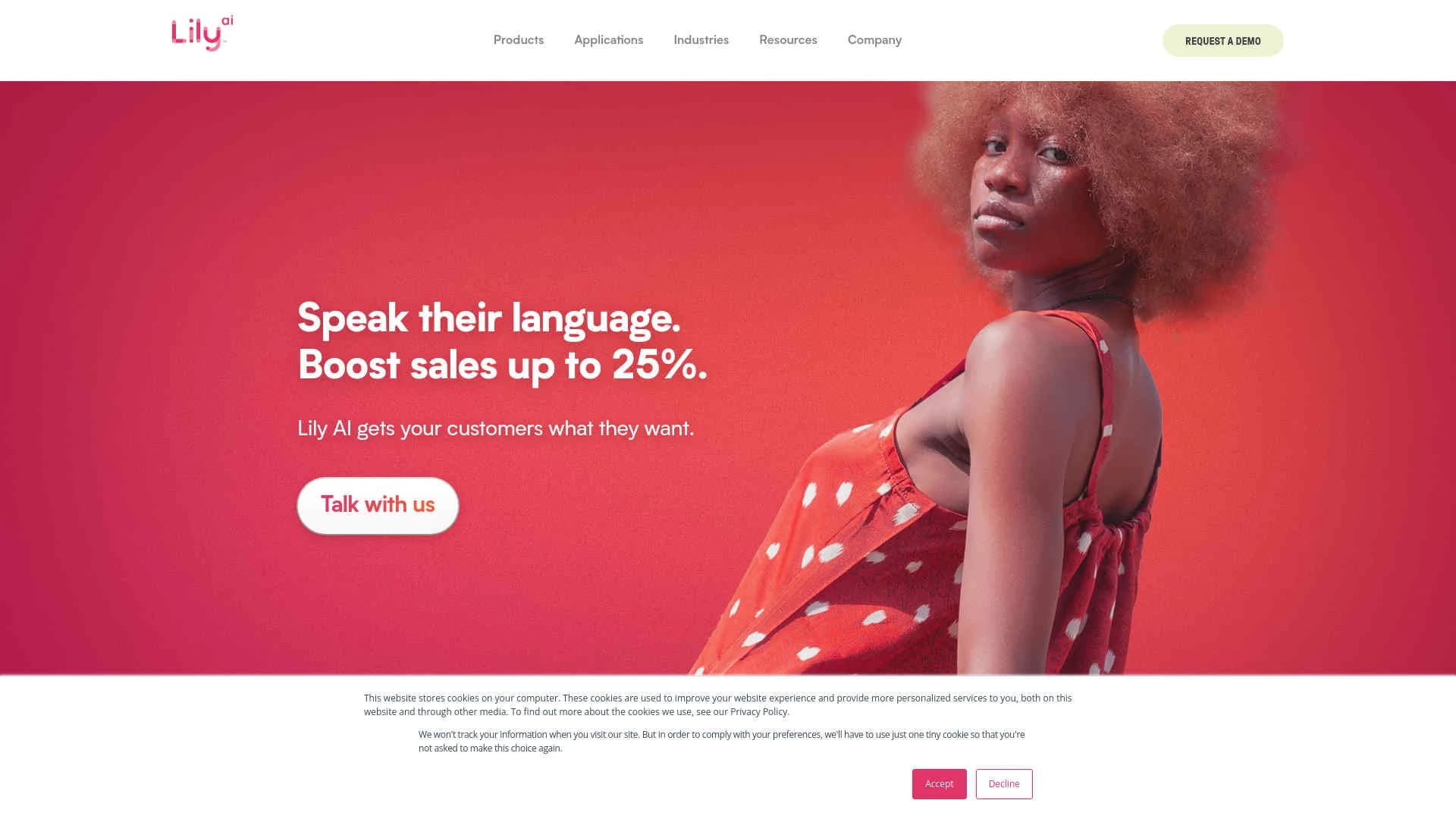
Lily AI
Transform e-commerce with AI-driven emotional customer insights.
Key Takeaways
- What it is
- Transform e-commerce with AI-driven emotional customer insights.
- Pricing
- $200 per month
- Best for
- Emotion Intelligence Technology
- Customer Insight Dashboard
- Real-Time Analytics
- Rating
- 4.3/5
What is Lily AI?
Lily AI is an innovative platform designed to enhance the e-commerce experience by leveraging advanced artificial intelligence to analyze customer emotions and preferences. This tool aims to transform product discovery and increase conversion rates by delivering highly personalized recommendations. Targeted at retailers and brands, Lily AI enhances the shopping experience for consumers by providing insights that drive better product suggestions and marketing strategies.
Lily AI stands out with its Emotion Intelligence technology, which provides a unique advantage by using emotional data to drive sales and enhance the e-commerce experience. This technology differentiates it from traditional analytics tools by focusing on emotional and behavioral insights to deliver more effective product recommendations.
Lily AI offers a transformative approach to e-commerce with its Emotion Intelligence technology, making it a crucial tool for enhancing personalized shopping experiences and improving conversion rates. Its ability to deliver detailed customer insights and adapt recommendations based on emotional data provides a competitive edge in the online marketplace, making it an essential platform for retailers and brands looking to optimize their e-commerce strategies.
Who is Using Lily AI?
E-commerce Retailers
Enhancing online shopping experiences with personalized product recommendations.
Fashion Brands
Gaining deeper insights into customer sentiment and trends for better product alignment.
Online Marketers
Creating targeted marketing campaigns based on detailed emotional and preference data.
Customer Experience Managers
Analyzing and improving customer service interactions using emotion-based insights.
Uncommon Use Cases
Applied by online educational platforms to recommend tailored learning materials; utilized by healthcare retailers for personalized product suggestions based on patient feedback.
Key Features
Rating Breakdown
Pricing Plans
Free Trial
- Available with a 30-day free trial for new users to explore Lily AI's capabilities
Standard Tier
$200 per month
Enterprise Solutions
- Offers custom pricing based on specific client needs
Lily AI Use Cases
Google Shopping optimization
Enrich titles, descriptions, attributes, categories, and feed data used by Google Shopping and Performance Max.
Outcome: Improved product visibility and measured revenue lift.
Meta catalog optimization
Improve Commerce Manager catalog completeness, variant coverage, product-set readiness, and delivery quality.
Outcome: Higher measured ROAS against a holdout.
Onsite search and merchandising
Enrich product data behind search, filters, facets, recommendations, PDPs, and category merchandising.
Outcome: More relevant results and improved onsite conversion.
AI discovery readiness
Optimize feeds, schema, and bot-facing content for answer engines and shopping agents.
Outcome: Improved machine readability and recommendation readiness.
Automated item setup
Populate structured fields and classify new products entering a catalog.
Outcome: Cleaner, more complete product records.
Workflow Ideas with Lily AI
Run a controlled catalog-enrichment test
- 1Connect a product feed or catalog
- 2Identify missing or weak product signals
- 3Generate enrichments and split test versus a control
- 4Measure lift and approve winning changes
Improve onsite search relevance
- 1Scan PDPs, attributes, filters, and facets for gaps
- 2Generate richer descriptions, synonyms, and structured attributes
- 3Launch an onsite controlled test
- 4Scale winning enrichments across the catalog
Prepare products for AI discovery
- 1Score feeds, schema, and bot-facing product content
- 2Enrich machine-readable product attributes
- 3Sync the improved data to supported AI-commerce surfaces
- 4Monitor readiness and recommendation-related performance
How Lily AI fits into your stack
Shopify Integration
Works seamlessly with Shopify to enhance e-commerce functionality.
Magento Compatibility
Fully compatible with Magento, offering extended features and functionalities.
API Access
Provides robust API access for custom integrations with various platforms.
Data Import Capabilities
Supports easy import of existing customer data for quick setup and integration.
Pros
- +Enhanced Customer Engagement: Boosts user interaction by offering tailored shopping experiences based on emotional and preference data.
- +Improved Conversion Rates: Increases sales through more relevant product recommendations, tailored to individual customer insights.
- +Scalable Solutions: Accommodates various sizes of retail operations, from small businesses to large enterprises.
- +Data-Driven Decisions: Provides actionable insights through real-time analytics, helping brands make informed decisions.
Cons
- −Complex Integration: Integration with existing systems may require technical support or assistance.
- −Higher Costs for Premium Features: Advanced features may come at a higher cost, which could be a barrier for smaller retailers.
- −Dependence on Data Quality: The effectiveness of the recommendations depends on the quality and accuracy of the customer data provided.
Limitations & when to consider alternatives
Known limitations
- AI placement is not guaranteed. Lily states that it improves readiness and input quality, while AI platforms control placement, ranking, citation, and selection.
- Lily does not replace existing commerce infrastructure. The platform improves product intelligence distributed by feed managers, catalog systems, and commerce stacks.
- Pricing is quote-based. Pricing depends on catalog size, use cases, markets, channels, and managed ad spend rather than a public rate card.
- Results vary by catalog and starting point. Lily says outcomes depend on the catalog and starting condition, with controlled tests used to validate lift.
- Human approval remains required. Teams review proposed changes and approve what ships before broad deployment.
Look elsewhere when
- You need guaranteed placement in ChatGPT, Gemini, or another AI surface.
- You need a replacement for your feed manager or commerce stack.
- You need a self-serve fixed-price plan.
How to Use Lily AI
- 1
A range of tutorial resources is available, covering everything from basic setup to advanced features, to help users get the most out of Lily AI.
Who is Lily AI For?
Retailers
Lily Max helps retailers improve catalog quality, product discovery, onsite search, and paid-channel performance.
Brands
Brands use Lily Max to make product catalogs more understandable to search engines, ad platforms, and AI agents.
Performance marketers
Performance teams can run controlled tests and measure revenue or ROAS lift against a control.
Feed managers
Feed managers can enrich the underlying product intelligence before it is distributed across commerce surfaces.
Agencies and platform partners
Agencies can manage multiple client catalogs and surfaces from one workspace with separated reporting.
Frequently Asked Questions
What is Lily Max?
Lily Max is Lily AI’s product-intelligence engine for enriching catalogs, testing product signals, and improving commerce performance.
Who is Lily Max for?
It is built for retailers, brands, performance marketers, and feed managers that depend on product discovery.
Which channels and surfaces does Lily Max support?
It supports Google Ads, Meta Ads, AI discovery and agentic commerce, and onsite search and merchandising.
How does Lily Max work?
The system detects product-data gaps, generates enrichments, launches controlled experiments, measures lift, and scales what works.
Does Lily Max replace an existing catalog or commerce stack?
No. Lily Max improves the product intelligence distributed by existing feed managers, catalog systems, and commerce platforms.
Does Lily Max guarantee AI placement or citation?
No. Lily improves readiness and input quality, but AI platforms control placement, ranking, citation, and selection.
Community reviews
Be the first to share your experience.
Sign in to leave a review for Lily AI.
Lily AI Alternatives
Looking for alternatives to Lily AI? Here are similar tools in the same category: