
InHEART
Revolutionizes cardiac care with AI-driven 3D heart modeling.
Key Takeaways
- What it is
- Revolutionizes cardiac care with AI-driven 3D heart modeling.
- Best for
- Unparalleled Anatomical Insights
- Optimized Treatment Strategies
- Significant Time Reduction
- Rating
- 4.7/5
What is InHEART?
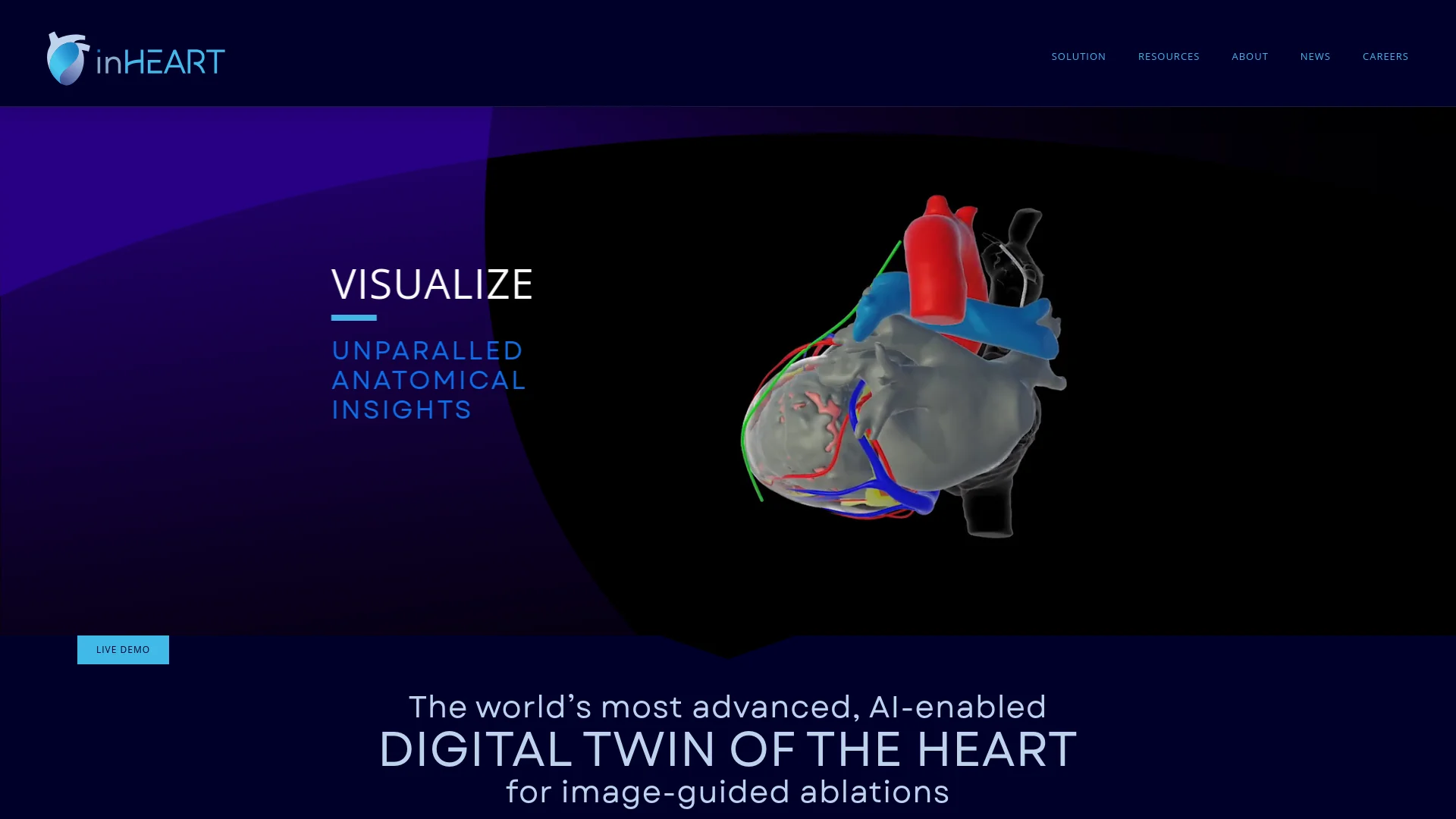
As a reviewer who has explored numerous AI tools, I find inHEART particularly fascinating. This cutting-edge software operates as a digital twin of the heart, utilizing AI to provide unprecedented anatomical insights and optimized treatment strategies for cardiac care. Developed for healthcare professionals, especially in the field of cardiac electrophysiology, inHEART aims to revolutionize the way heart diseases, particularly arrhythmias, are treated. By creating highly detailed 3D models from CT and MR images, the tool allows for precise and personalized treatment planning, making it a significant advancement in medical technology.
inHEART stands out as the world's most advanced AI-enabled digital twin of the heart. Its ability to reduce procedure times significantly and improve the success rate of treatments makes it a game-changer in the field of cardiac electrophysiology. The seamless integration with existing systems and its data-driven insights into cardiac anatomy set it apart from other medical imaging tools.
inHEART excels in providing detailed and precise cardiac imaging, making it an essential tool for cardiologists and electrophysiologists. Its unique ability to create a digital twin of the heart offers an unmatched advantage in the planning and execution of personalized treatment strategies. The significant reduction in procedure times and improved treatment outcomes underscore its value in modern healthcare.
Who is Using InHEART?
Cardiac Electrophysiologists
Utilizing the tool for detailed planning and execution of ablations.
Cardiology Departments
Employing inHEART for advanced cardiac procedural planning.
Academic Medical Centers
Using the tool for research and training in cutting-edge cardiac care technologies.
Healthcare Technology Integrators
Implementing inHEART in advanced healthcare systems for improved patient outcomes.
Uncommon Use Cases
Used in telemedicine for remote diagnosis and treatment planning; integrated in medical education for training on cardiac imaging.
Key Features
Rating Breakdown
Pricing Plans
Subscription-Based Model
- InHEART is available through a subscription model
- Details of which can be accessed directly from the company
Custom Pricing
- Pricing is tailored based on the specific needs and scale of the healthcare institution
InHEART Use Cases
Pre-procedural ablation planning
Physicians review a patient-specific digital heart model before the procedure begins.
Outcome: Better-informed treatment strategies and less intraprocedural planning.
Image-guided ventricular tachycardia ablation
Teams visualize scar, anatomy, and collateral structures and integrate the model into mapping systems.
Outcome: More precise targeting during VT ablation.
Cardioneuroablation planning
Clinicians use the online platform and cardiac models to support cardioneuroablation procedures.
Outcome: Simpler and faster procedure preparation.
Cardiac anatomy visualization
Users interactively explore cardiac anatomy, principal structures, collateral structures, and myocardial tissue characteristics.
Outcome: A detailed view of the patient's unique cardiac structure.
EAM system integration
Teams transfer or use inHEART models with major electroanatomic mapping systems during procedures.
Outcome: Image-guided procedural support inside the lab.
Workflow Ideas with InHEART
CT/MRI to digital heart model
- 1Upload anonymized patient CT or MRI 2D scans
- 2Let inHEART algorithms generate a 3D rendered model
- 3Visualize the digital twin of the patient's heart
Pre-procedure ablation planning
- 1Review cardiac anatomy and tissue characteristics before the procedure
- 2Develop a treatment strategy using the patient-specific model
- 3Use the model during the procedure through EAM integration
Scar-guided VT ablation
- 1Analyze scar, wall thinning, calcifications, and related structures
- 2Identify relevant anatomical and tissue targets
- 3Integrate the model into the electroanatomic mapping workflow
How InHEART fits into your stack
Major EAM Systems Compatibility
Fully compatible with all leading electroanatomic mapping systems.
Data Integration
Supports integration with hospital information systems for comprehensive data analysis.
Cloud-Based Features
Offers cloud-based capabilities for easier access and scalability.
Multi-Platform Support
Accessible on various digital platforms, ensuring flexibility in usage.
Pros
- +Enhanced Precision in Treatment: Offers targeted treatment strategies by accurately pinpointing arrhythmogenic areas in the scar tissue.
- +Cost-Effective: By reducing procedure time and improving success rates, inHEART can lead to significant cost savings for healthcare facilities.
- +User-Friendly Interface: Designed to be intuitive, it simplifies the complex process of cardiac imaging and treatment planning.
- +Data-Driven Decisions: Empowers physicians with data to make informed decisions quickly and efficiently.
Cons
- −Specialized Training Required: Users may need specific training to fully utilize all the features and capabilities of the tool.
- −High Dependency on Image Quality: The effectiveness of the tool heavily relies on the quality of CT and MR images provided.
- −Limited to Cardiac Applications: As a specialized tool, its use is confined to cardiac care, which might not be as versatile for broader medical applications.
Limitations & when to consider alternatives
Known limitations
- Specialized clinical scope. The documented product is focused on cardiac imaging, digital heart models, and image-guided ablation workflows.
- CT/MRI input requirement. The documented upload workflow specifically references anonymized patient CT or MRI 2D scans.
- Model turnaround time. The site states that proprietary algorithms produce 3D rendered models with a 24-hour turnaround.
- Supported browser requirement. The portal states that inHEART is intended for Chrome or Edge and may have issues in unsupported browsers.
- Clinical-system integration focus. The named integrations are electroanatomic mapping systems, including Carto, Rhythmia, Ensite, and Affera.
Look elsewhere when
- You need a native mobile application.
- You need a public developer API.
- You need general-purpose code generation.
How to Use InHEART
- 1
For those interested in mastering inHEART, the company provides extensive training resources, including webinars and live demos, which are available on their official website.
Who is InHEART For?
Cardiac electrophysiologists
They use patient-specific 3D cardiac models to plan and guide ablation procedures.
Physicians
Physicians can review each patient's anatomy and tissue characteristics before entering the lab.
Healthcare professionals
The platform provides cardiac imaging insights and treatment-planning support for healthcare professionals.
Hospitals
inHEART reports use across partner hospitals and supports integration into clinical EAM workflows.
Frequently Asked Questions
What is inHEART?
inHEART is an AI-enabled digital twin of the heart for image-guided cardiac ablations.
What inputs does inHEART use?
The workflow accepts anonymized patient CT and MRI 2D scans uploaded to the inHEART server.
How quickly are models produced?
inHEART states that its proprietary algorithms produce 3D rendered models with a 24-hour turnaround.
Which cardiac structures can be visualized?
The platform visualizes cardiac anatomy, collateral structures, and tissue characteristics such as scar, calcifications, and wall thinning.
Which mapping systems does inHEART integrate with?
The site names Carto, Rhythmia, Ensite, and Affera, and states compatibility with major electroanatomic mapping systems.
How can an organization request access?
The site directs organizations to contact inHEART for a customized presentation or demo.
Community reviews
Be the first to share your experience.
Sign in to leave a review for InHEART.
InHEART Alternatives
Looking for alternatives to InHEART? Here are similar tools in the same category:
Learn to Master InHEART
With Skill Leap courses
Get in-depth training on InHEART and 50+ other AI tools with our expert-led video courses.
Start 7-Day Free Trial