Immunai
Immune-cell intelligence helps biopharma teams make smarter drug development decisions.
Key Takeaways
- What it is
- Immune-cell intelligence helps biopharma teams make smarter drug development decisions.
- Best for
- AMICA Data Foundation
- AMICA-One
- AMICA-Reason
- Rating
- 4.4/5
What is Immunai?
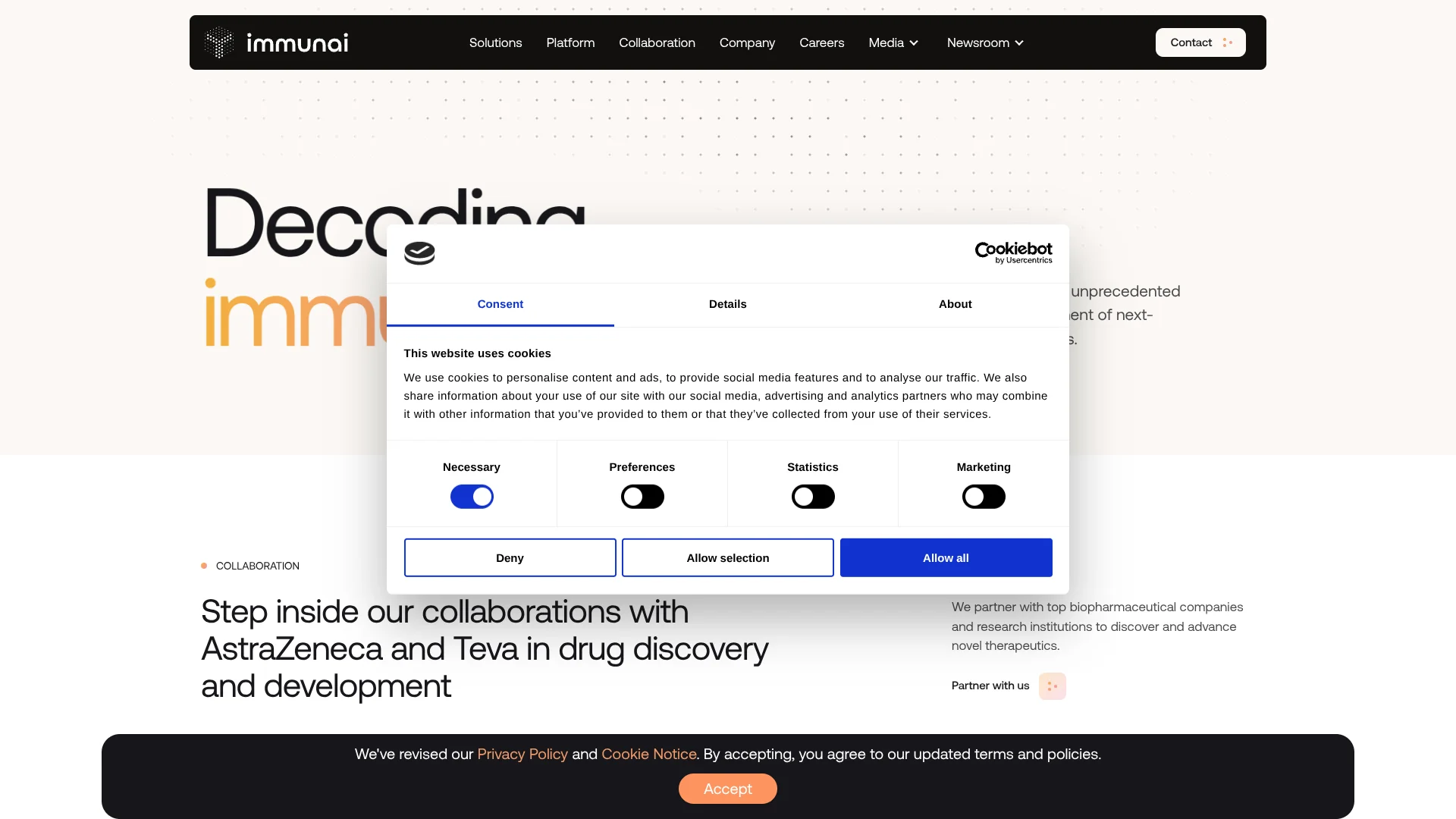
Immunai helps biopharmaceutical companies make better drug development decisions by combining single-cell multiomics, machine learning, functional genomics, and clinical data. Its AMICA data foundation links immune-cell biology to disease, treatment response, and patient outcomes. Teams can apply the platform to target discovery, preclinical evaluation, and clinical trial design.
Immunai connects patient-derived immune data with laboratory validation and recommendation narratives, so research teams can trace a suggested target or patient subgroup back to biological evidence.
The platform fits pharma teams and research institutions working on immune-related diseases, especially oncology and autoimmune conditions. It is not a self-serve AI app with public plans, mobile apps, or a general-purpose workspace. Immunai is built for partnered scientific programs where the company helps shape the research question and analysis.
Who is Using Immunai?
Drug Discovery Scientists
Target discovery teams rank molecular targets against human disease biology and therapeutic relevance.
Translational Scientists
Translational teams connect preclinical findings with possible clinical biomarkers and treatment strategies.
Clinical Development Leaders
Clinical teams evaluate patient subgroups, dose choices, treatment combinations, and drug mechanisms of action.
Computational Biologists
Computational biology teams work with harmonized single-cell data and machine-learning analyses to investigate immune features.
Principal Investigators
Academic investigators bring defined cohorts and research questions into Immunai's data-for-data collaboration model.
Uncommon Use Cases
Comparing immune features across standard-of-care datasets; supplying publication-ready single-cell evidence for disease mechanism studies
Key Features
Rating Breakdown
Pricing Plans
Customized Solutions
- Pricing is tailored based on the specific needs and scope of projects undertaken by clients
Partnership Models
- Offers various partnership and collaboration models
- Which may include shared risk and reward financial arrangements
Immunai Use Cases
Target Discovery
Human immune-cell data and functional experiments help identify molecular targets linked to disease.
Outcome: A ranked set of targets with biological and therapeutic evidence.
Preclinical Candidate Evaluation
Immune features associated with pharmacodynamic behavior, safety, and efficacy inform which candidates should progress.
Outcome: Stronger evidence for advancing or stopping a preclinical program.
Patient Stratification
Clinical and molecular data reveal patient groups that may respond to or tolerate a treatment differently.
Outcome: Candidate biomarkers and patient subgroups for clinical development.
Drug Mechanism Analysis
Single-cell profiles show how a therapy affects immune cells and how its performance compares with standard of care.
Outcome: A clearer biological explanation of treatment response.
Academic Immune Research
Research institutions contribute clinical cohorts to a funded collaboration focused on immune-system questions.
Outcome: Sequencing data, quality-control reporting, cell annotations, and research insights.
Workflow Ideas with Immunai
From Patient Samples to Target Candidates
- 1Define the disease question and target product profile.
- 2Generate single-cell multiomic data from clinical samples.
- 3Integrate the data with AMICA and rank candidate targets.
From Preclinical Data to Clinical Strategy
- 1Compare preclinical immune features with clinical datasets.
- 2Identify signals linked to efficacy, safety, or treatment response.
- 3Build a translational plan for patient selection and trial design.
Academic Data-for-Data Collaboration
- 1Submit the research question, cohort details, and sample information.
- 2Provide approved patient cohorts and anonymized clinical metadata.
- 3Receive funded sequencing, quality-control results, and cell annotations.
How Immunai fits into your stack
Clinical Samples
Immunai sits after sample collection, working with blood, tissue, and clinical metadata to create high-resolution immune profiles.
Single-Cell Data
The platform adds transcriptomic, surface-protein, TCR or BCR, and spatial measurements to a disease research workflow.
Data and Machine Learning
AMICA provides the comparison layer, while Immunai's models connect immune features with treatment response and clinical outcomes.
Laboratory Validation
Functional genomics experiments test selected model-generated hypotheses before teams rely on them for development decisions.
Drug Development Decisions
Outputs support target discovery, preclinical evaluation, patient stratification, mechanism-of-action analysis, and clinical trial planning.
Pros
- +Human disease context: Patient-derived single-cell data connects immune findings to clinical outcomes.
- +High-resolution profiling: RNA, surface proteins, and TCR data provide a detailed view of immune cells.
- +Lab validation: Functional genomics testing helps distinguish interesting signals from actionable biology.
- +Decision narratives: AMICA-Reason explains model outputs instead of presenting only unexplained scores.
Cons
- −Enterprise engagement: Access is structured around collaborations and biopharma programs rather than self-serve subscriptions.
- −Specialized scope: The platform is focused on immune biology and drug development, not general research or business tasks.
- −Shared research requirements: Academic collaborations may require suitable patient cohorts, clinical metadata, approvals, and sample handling.
Limitations & when to consider alternatives
Known limitations
- No public self-serve access. The official site presents Immunai through biopharma solutions and research collaborations rather than a public software signup.
- Academic collaboration scope. The data-for-data collaboration is open to non-commercial academic research and requires suitable cohorts, approvals, metadata, and sample handling.
- Researcher costs outside sequencing. For the academic collaboration, Immunai covers sequencing costs, while sample collection, data collection, regulatory fees, shipping, and insurance remain with the research institute.
- Flexible project timelines. Collaboration timing depends on cohort size and Immunai's internal resource availability.
- Sample requirements. PBMC projects require at least 500,000 viable cells, and tissue projects must meet specified preservation and handling conditions.
Look elsewhere when
- You need a general-purpose AI research workspace with public signup and self-serve pricing.
- Your team needs a documented public API or software integration layer.
- Your project does not involve immune biology, single-cell data, or drug development.
How to Use Immunai
- 1
Define the scientific question
Start with a disease, treatment, or immune mechanism question that can guide the analysis.
- 2
Assess your data and samples
Confirm that your cohort, clinical metadata, and sample types meet the requirements for the proposed program.
- 3
Choose the development decision
Set the intended output, such as a target ranking, candidate evaluation, biomarker strategy, or patient subgroup.
- 4
Run multiomic profiling
Immunai generates data from blood or tissue using transcriptomic, proteomic, and receptor-sequencing methods.
- 5
Interpret and validate findings
AMICA and machine-learning models identify immune signals, while functional genomics tests selected hypotheses.
- 6
Review the recommendation
Use the resulting scorecards and mechanistic narratives to support the next drug development decision.
Who is Immunai For?
Biopharmaceutical Companies
Drug developers can use immune intelligence to choose targets, assess candidates, and plan clinical programs.
Clinical Research Institutions
Institutions with patient cohorts can contribute samples and receive high-resolution immune profiling and analysis.
Academic Research Groups
Principal investigators studying the immune system can apply for non-commercial research collaborations.
Oncology and Immunology Programs
Disease teams can study immune mechanisms, treatment response, resistance, and patient subgroups.
Frequently Asked Questions
Does Immunai have a free plan?
No public free plan is listed. The company presents its offering through biopharma solutions and research collaborations.
How is Immunai priced?
The official site does not publish standard US subscription prices. Prospective partners are directed to contact Immunai.
What data does Immunai analyze?
The platform works with clinical and preclinical samples and can profile whole-transcriptome RNA, surface proteins, TCR or BCR repertoires, and spatial transcriptomics.
Can academic researchers apply?
Yes. The academic collaboration is open to non-commercial research, subject to approval and the required cohort, metadata, regulatory, and sample conditions.
What does Immunai provide in an academic collaboration?
Immunai covers sequencing and provides raw single-cell sequencing data, a quality-control report, and cell annotations for accepted projects.
What decisions can the platform support?
Use cases include target discovery, preclinical safety and efficacy assessment, patient stratification, drug mechanism analysis, dose selection, and treatment combination prioritization.
Community reviews
Be the first to share your experience.
Sign in to leave a review for Immunai.
Immunai Alternatives
Looking for alternatives to Immunai? Here are similar tools in the same category: