
Hybridity
Integrates data sources for comprehensive analytics and insights.
Key Takeaways
- What it is
- Integrates data sources for comprehensive analytics and insights.
- Best for
- Automated Report Generation
- Custom Template Creation
- Data Integration
- Rating
- 4.6/5
What is Hybridity?
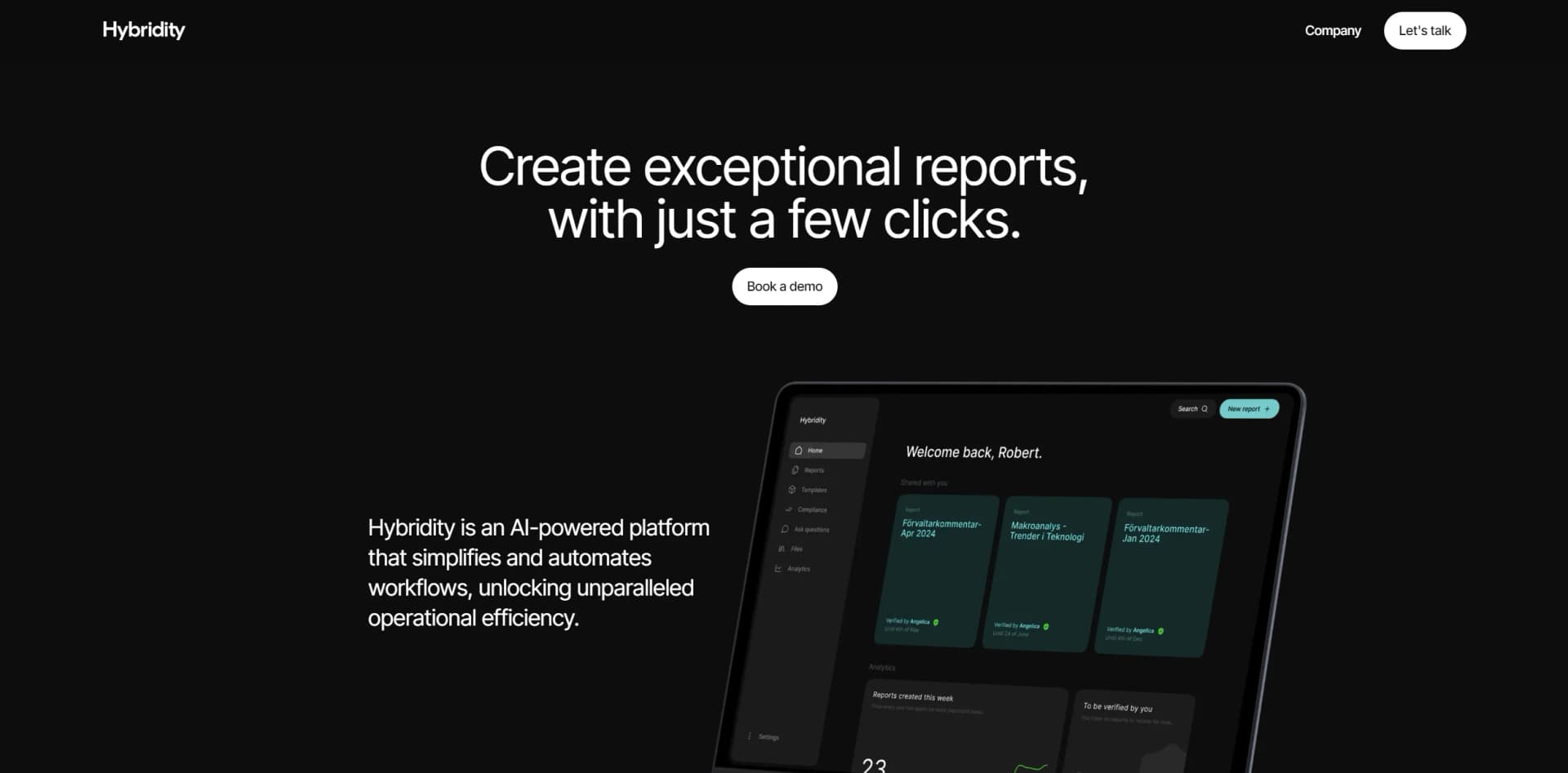
Hybridity is an advanced AI-driven platform designed to transform enterprise report generation. By automating the repetitive and complex tasks associated with creating business reports, Hybridity provides a solution that saves time, enhances accuracy, and streamlines the reporting process for modern businesses.
Hybridity differentiates itself with its robust data integration capabilities and customizable report templates. Its focus on security and compliance, combined with advanced AI functionalities, makes it a reliable choice for enterprises concerned with data privacy.
Hybridity excels in automating and enhancing enterprise report generation with its advanced AI capabilities. Its efficient, user-friendly design and strong focus on data security make it a valuable tool for any data-driven organization. The platform’s ability to save time and resources while delivering high accuracy and customization sets it apart in the report generation market.
Who is Using Hybridity?
Financial Analysts
For generating detailed financial reports and forecasts.
HR Departments
To produce comprehensive employee performance reports.
Marketing Teams
For creating regular marketing performance reports.
Healthcare Administrators
To generate compliance and patient care reports.
Uncommon Use Cases
Non-profits for grant reports; academic researchers for data analysis.
Key Features
Rating Breakdown
Pricing Plans
Free Trial
- Offers a free trial period to explore Hybridity's functionalities
Subscription Plans
- Custom pricing available upon request from the sales team
Hybridity Use Cases
Policy decomposition
Upload organisational policies and convert their clauses into a structured requirement registry.
Outcome: Rules become traceable, reviewable rows.
Regulatory gap analysis
Compare regulations, standards, or contracts against existing organisational controls.
Outcome: Coverage is classified as verified, covered, partial, or a gap.
Guided compliance work
Assign recurring tasks to named owners with instructions, context, and evidence requirements.
Outcome: Compliance work becomes owned and trackable.
AI evidence checking
Submit evidence for AI review against the relevant requirement before a human reviewer evaluates it.
Outcome: Potentially missing or risky evidence is identified earlier.
NIS 2 programme management
Manage gap analysis, risk prioritisation, leadership reporting, and supplier review in one platform.
Outcome: NIS 2 compliance is maintained as an ongoing operational state.
Workflow Ideas with Hybridity
Turn policies into controls
- 1Upload existing policy documents
- 2Review the generated requirement registry
- 3Convert approved requirements into controls and recurring tasks
Run a regulatory gap analysis
- 1Select a regulation, standard, or contract
- 2Compare it row by row with the requirement registry
- 3Review verified, covered, partial, and gap results
Collect and approve evidence
- 1Assign evidence tasks to named owners
- 2Have owners submit the requested proof
- 3Use AI checking and human review before approval
How Hybridity fits into your stack
Data Source Compatibility
Integrates smoothly with various internal data storage systems.
API Availability
Provides API options for custom integrations with other software.
Cloud-Based
Fully cloud-based for remote access and collaboration.
Customizable Templates
Offers extensive customization of report templates to meet specific organizational needs.
Pros
- +Time and Cost Efficiency: Reduces the time and cost of report creation by up to 80%.
- +High Accuracy: Utilizes AI expertise to generate precise and relevant content.
- +User-Friendly Interface: Quick setup process and intuitive design, taking under five minutes to get started.
- +Scalability: Capable of managing large volumes of report production efficiently.
Cons
- −Initial Setup Requirement: Initial integration with existing systems and data sources may require extra effort.
- −Advanced Features Learning Curve: Users may need time to fully leverage advanced features and customization options.
- −Dependency on Data Quality: Output quality is dependent on the quality of data inputs.
Limitations & when to consider alternatives
Known limitations
- Human approval remains required. Hybridity states that all AI outputs require human review and approval before implementation.
- AI only accesses approved documents. The security page says the AI accesses approved documents and nothing more.
- Data export is available on request. Full data export is available on request at contract termination rather than described as a self-service feature.
- Customer data is not used for model training. Customer data is never used to train or fine-tune AI models.
Look elsewhere when
- You need a public developer API.
- You need a native mobile app.
- You need custom model fine-tuning.
- You need named third-party integrations.
How to Use Hybridity
- 1
Access a range of tutorials on the Hybridity website, covering basic setup to advanced report customization techniques.
Who is Hybridity For?
Compliance teams
The platform is designed to structure policies, assign controls, check evidence, and maintain audit-ready operations.
Financial services organisations
Hybridity specifically discusses DORA and describes use by banks and other highly regulated financial organisations.
Organisations subject to NIS 2
Hybridity provides NIS 2 gap analysis, risk prioritisation, leadership reporting, and supplier review workflows.
Critical infrastructure organisations
The site identifies NIS 2 and critical infrastructure as a contact area for its compliance platform.
Organisations handling sensitive regulatory data
The security page positions Hybridity for teams handling sensitive regulatory data.
Frequently Asked Questions
What does Hybridity do?
Hybridity turns existing policies into structured, owned, evidenced, audit-ready compliance operations.
What documents can Hybridity process?
The platform says users can upload documents in any format and any language without cleanup.
How does Hybridity handle compliance checks?
Regulations, standards, or contracts are compared row by row against the organisation's requirement registry.
How are compliance tasks assigned?
Controls issue tasks to named owners on a cadence, with guided instructions and evidence requirements.
Does a person review AI output?
Every AI output requires human review and approval before implementation.
How is customer data protected?
Hybridity states that data is encrypted with AES-256 at rest and TLS 1.2 or higher in transit.
Community reviews
Be the first to share your experience.
Sign in to leave a review for Hybridity.
Hybridity Alternatives
Looking for alternatives to Hybridity? Here are similar tools in the same category:
Learn to Master Hybridity
With Skill Leap courses
Get in-depth training on Hybridity and 50+ other AI tools with our expert-led video courses.
Start 7-Day Free Trial