
Hume AI
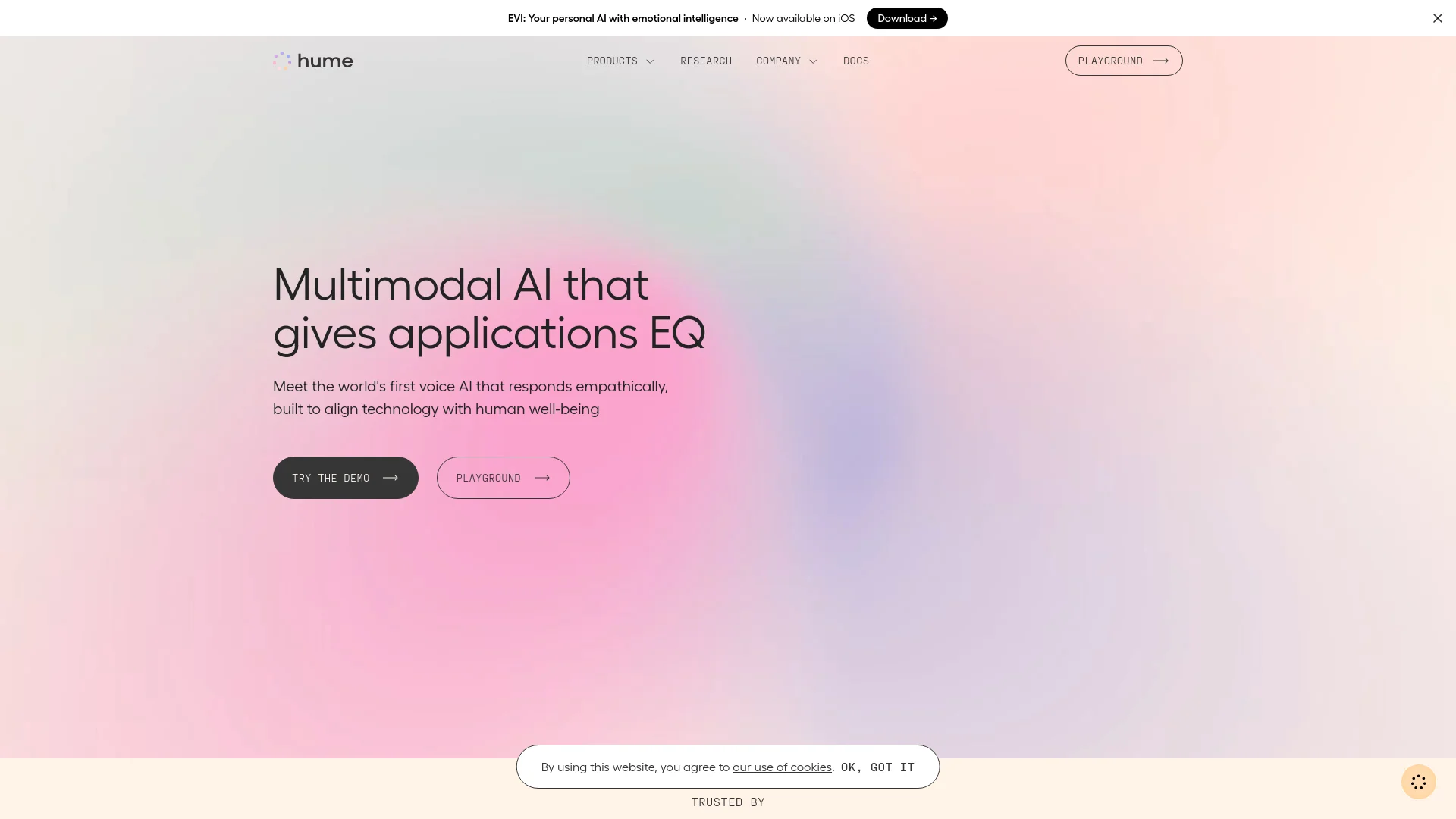
Transforms AI with emotional intelligence for natural, empathetic interactions.
Key Takeaways
- What it is
- Transforms AI with emotional intelligence for natural, empathetic interactions.
- Pricing
- Freemium
- Best for
- Empathic Voice Interface (EVI)
- Expression Measurement API
- Custom Model API
- Rating
- 4.5/5
What is Hume AI?
Hume AI is an advanced platform that enhances human-machine interaction by integrating emotional intelligence into AI technologies. It aims to create more natural and empathetic communication between users and systems, benefiting developers, researchers, and businesses.
Hume AI stands out by incorporating emotional intelligence into AI interactions, offering a more human-centered approach to technology.
Hume AI provides emotionally intelligent AI solutions, enhancing machine interactions and user experiences. Its advanced features and research foundation make it a valuable tool for organizations aiming to improve human-AI interactions.
Who is Using Hume AI?
Tech Companies
For improving customer service with emotional AI.
Healthcare Providers
To understand patient emotions better.
Educational Tools
Tailoring learning experiences based on student emotions.
Customer Service Solutions
Enhancing interaction quality.
Uncommon Use Cases
Researchers studying emotional responses in human-machine interactions.
Key Features
Rating Breakdown
Pricing Plans
Free Tier
Free
- Available to explore basic capabilities
Subscription Plans
- Pricing plans are tailored to usage levels and needs
Which Hume AI plan should you pick?
Start with Free for experimentation and non-commercial prototypes, then upgrade to Creator or a higher plan for commercial use and greater included usage.
Free
Good for trying Hume's voice, EVI, and expression capabilities with $0 monthly cost and included usage.
Starter
Good for small projects needing more included usage while remaining within Hume's lower-cost plans.
Creator
Good for commercial creators and applications that need commercial usage rights and higher included usage.
Pro
Good for production applications requiring substantially more speech and EVI capacity.
Scale
Good for larger deployments with high-volume voice usage.
Business
Good for enterprise-scale usage, higher concurrency needs, and commercial deployments.
Enterprise
Good for organizations needing customized usage, pricing, and contractual arrangements.
Hume AI Use Cases
Build an empathic voice assistant
Integrate EVI into a web, mobile, or desktop application with real-time speech input and output.
Outcome: More natural, emotionally attuned voice conversations.
Create expressive voiceovers
Use Octave text-to-speech with a preset or custom-designed voice.
Outcome: Expressive spoken audio for narration, media, and customer experiences.
Create or clone voices
Design voices from natural-language descriptions or create a voice clone from an authorized recording.
Outcome: Reusable custom voices for Hume-supported products.
Measure expression in media
Submit audio, video, image, or text inputs to Hume models for expression analysis.
Outcome: Expression measurements and annotations for research or applications.
Train a custom expression model
Upload labeled image, video, or audio data, select labels, and start a custom model training job.
Outcome: A deployable model specialized for the customer's prediction task.
Workflow Ideas with Hume AI
Launch an EVI web voice assistant
- 1Install Hume's TypeScript and React SDKs
- 2Generate an access token using the Hume API key and secret
- 3Open an EVI WebSocket, stream microphone audio, and play streamed responses
Create a custom voice
- 1Describe a desired voice or provide an authorized audio sample
- 2Create and save the custom voice in Hume
- 3Configure EVI or Text-to-Speech to use the custom voice
Train a custom expression model
- 1Upload a labeled image, video, or audio dataset
- 2Select labels and choose classification or regression
- 3Start training, evaluate the model, and deploy it through the API
How Hume AI fits into your stack
API Flexibility
Integrates with existing systems through well-documented APIs.
Cross-Platform Compatibility
Works across various platforms.
Data Handling
Ensures secure and efficient data management.
Pros
- +Enhanced User Engagement: Makes applications more engaging by reacting to user emotions.
- +Innovative Technology: Utilizes cutting-edge AI research.
- +Flexibility and Customization: Offers customizable API solutions.
- +Strong Research Foundation: Built on over a decade of research.
Cons
- −Complex Integration: May need significant effort for businesses without AI infrastructure.
- −Steep Learning Curve: Advanced functionalities can be challenging for beginners.
- −Limited Language Support: Primarily supports English, limiting non-English use.
Limitations & when to consider alternatives
Known limitations
- Free and Starter usage is non-commercial. Hume's terms limit free users and Starter-plan users to non-commercial use; commercial use begins with Creator and above.
- EVI language availability differs by version. EVI 3 has narrower language support, while the expanded multilingual list applies to EVI 4-mini.
- Linux audio setup may require manual dependencies. The Python SDK quickstart says Linux users may need to install PortAudio packages manually.
- Batch inference requires accessible media URLs. Batch inference accepts public media URLs or archives rather than directly attaching arbitrary local files to the request.
- EVI is streamed audio, not prerecorded-file chat. EVI continuously sends audio chunks over a WebSocket and depends on microphone, browser, device, and audio-environment behavior.
Look elsewhere when
- You need a dedicated browser extension.
- You need SSO or SAML administration.
- You need documented encryption standards such as AES-256 or TLS.
- You need a coding-focused AI product.
How to Use Hume AI
- 1
Access tutorials on the Hume AI website for guidance from setup to advanced features.
Who is Hume AI For?
AI companion builders
Hume provides expressive voices and emotional range for digital characters, virtual companions, and animated storytellers.
Automotive assistant teams
Hume lists automotive assistants as an industry using its empathic voice technology.
Customer-support teams
EVI supports real-time voice agents for phone support and conversational customer experiences.
Researchers
Hume provides datasets, expression measurements, evaluation frameworks, and research infrastructure for affective computing and human-AI interaction.
Publishers and audio creators
Hume's expressive text-to-speech supports narration, podcasts, audiobooks, and other professional audio applications.
Frequently Asked Questions
Is Hume EVI multilingual?
EVI 4-mini supports English, Japanese, Korean, Spanish, French, Portuguese, Italian, German, Russian, Hindi, and Arabic. EVI 3 supports English and Spanish.
How many concurrent connections does EVI support?
Concurrency limits depend on the subscription plan. Business and Enterprise customers can contact Hume about increasing limits.
What language model does EVI use?
EVI uses Hume's empathic speech-language model and can blend responses from external LLM APIs.
Can I use my own LLM API key?
Yes. EVI supports supplying your own language_model_api_key through WebSocket session settings.
What do Hume's expression labels represent?
They represent model estimates of how vocal and linguistic expressions would be interpreted by human observers, not direct measurements of a person's underlying emotion.
How does Hume authenticate API requests?
Hume supports API-key authentication for server-side requests and temporary access-token authentication for supported client-side requests.
Community reviews
Be the first to share your experience.
Sign in to leave a review for Hume AI.
Hume AI Alternatives
Looking for alternatives to Hume AI? Here are similar tools in the same category:
Learn to Master Hume AI
With Skill Leap courses
Get in-depth training on Hume AI and 50+ other AI tools with our expert-led video courses.
Start 7-Day Free Trial