Hippocratic AI
Patient-facing voice agents for routine healthcare outreach and follow-up.
Key Takeaways
- What it is
- Patient-facing voice agents for routine healthcare outreach and follow-up.
- Best for
- Polaris 6 model family
- Specialist supervisor models
- Human nurse escalation
- Rating
- 4.2/5
What is Hippocratic AI?
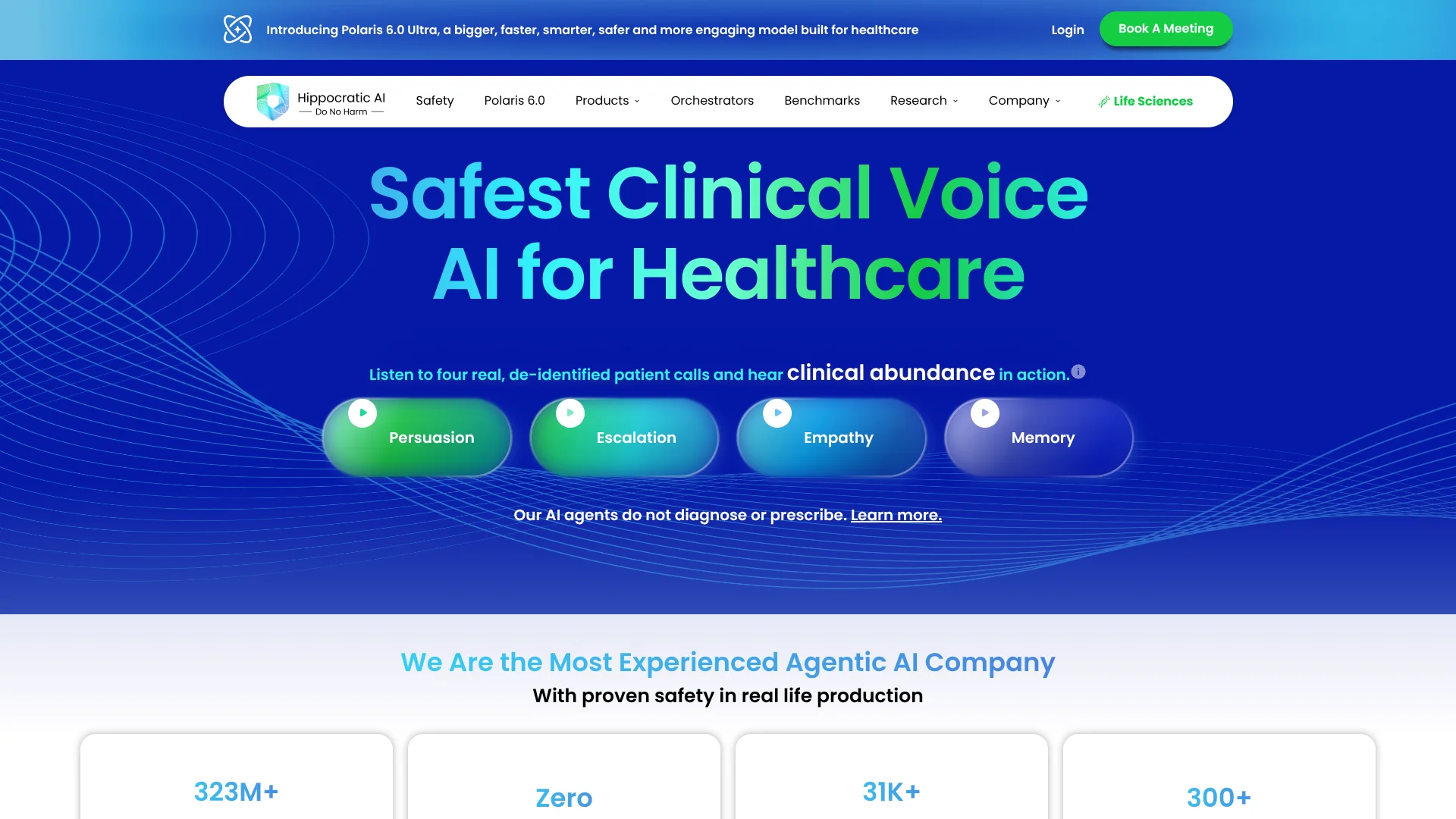
Hippocratic AI builds voice agents that call or speak with patients about tasks such as appointment scheduling, pre-visit intake, and post-discharge follow-up. Health systems, health plans, and life sciences companies can use these agents to handle routine conversations at scale while giving clinicians more time for work that needs their judgment. The agents are designed for support, not diagnosis or prescribing.
Its Polaris system pairs a main healthcare model with specialist supervisor models that monitor conversations for clinical and safety concerns. When a call raises a red flag, the agent can escalate it to a human nurse, rather than treating the conversation as a routine call to finish.
The strongest fit is an organization with high volumes of patient or member calls and a clear workflow to automate, such as care management or trial follow-up. It is not for consumer medical advice, diagnosis, or prescribing, so its value depends on having human care teams ready for cases that need clinical judgment.
Who is Using Hippocratic AI?
Patient access leaders
Appointment and registration agents can take on routine access calls and pre-visit tasks.
Care management nurses
Outreach agents can check on patients after discharge and route concerning responses to nurses.
Health plan quality teams
Screening and wellness visit outreach can help close gaps in member care.
Pharmacovigilance professionals
Adverse event intake agents collect structured information and escalate cases for safety review.
Clinical trial coordinators
Trial support agents can answer protocol questions and direct issues to the study team.
Uncommon Use Cases
Flood preparedness calls to patients; provider directory updates through phone systems
Key Features
Rating Breakdown
Pricing Plans
Test Phase Access
- Available for specialized institutional testing
Subscription Plans
- Pricing details to be announced after the testing phase
Which Hippocratic AI plan should you pick?
Start with Polaris Pro for clinical voice-AI deployments, then discuss a custom enterprise arrangement when volume, integrations, or specialized orchestrators require it.
Polaris Pro
Good for healthcare organizations that need clinical, non-diagnostic voice AI for patient-facing conversations.
Hippocratic AI Use Cases
Post-discharge follow-up
A recovery call can check medication use, symptoms, and care coordination after a hospital stay.
Outcome: Patients can receive timely follow-up, with concerns routed to care teams.
Appointment access
Scheduling agents handle appointment requests, confirmations, and pre-visit paperwork.
Outcome: Routine scheduling and registration work is handled through patient conversations.
Screening outreach
Campaigns can remind eligible patients about flu shots, mammograms, or colorectal cancer screening and help with scheduling.
Outcome: Patients receive outreach and support to complete screening.
Adverse event intake
For life sciences safety programs, an agent captures event details and follows up for missing information.
Outcome: Structured case information is prepared for safety review.
Trial retention and follow-up
Trial agents can collect patient updates and answer routine study questions, escalating issues when needed.
Outcome: Study teams receive patient follow-up information and routed questions.
Workflow Ideas with Hippocratic AI
Post-discharge check-in
- 1Select patients who need a follow-up call.
- 2Have the agent ask about recovery, medication use, and symptoms.
- 3Route red flags to a nurse and record the call outcome.
Screening appointment outreach
- 1Identify patients due for a screening.
- 2Have the agent explain the outreach and help schedule an appointment.
- 3Send completion details to the care team.
Adverse event case follow-up
- 1Start with an adverse event or product complaint report.
- 2Have the agent collect missing case details in a structured conversation.
- 3Escalate the completed information to the pharmacovigilance team.
How Hippocratic AI fits into your stack
Patient and member calls
Voice agents handle inbound or outbound conversations for defined healthcare workflows. AI Front Door also describes voice, SMS, web chat, and app channels.
EHR and CRM workflows
The company says agents can pull target populations from organizational systems and write call outcomes back; the specific integration is scoped with each customer.
Clinical review
Nurse escalation and clinician validation give care teams a path to review situations that should not remain with an automated agent.
Agent building and testing
AI Certified Agent Builder supports drafting, simulation, approvals, and version-controlled workspaces for teams designing agents.
Pros
- +Healthcare-specific voice: Agents are built for patient and member conversations rather than general-purpose chat.
- +Human escalation: Safety concerns can be handed to a nurse during a call.
- +Clinician review: Agent Builder includes simulations and human clinical validation.
- +Broad workflow coverage: The catalog includes provider, payor, life sciences, and med tech use cases.
Cons
- −Enterprise buying process: Organizations need to book a meeting and scope a deployment.
- −Narrow clinical role: Agents do not diagnose or prescribe, so they cannot replace clinical decision-making.
Limitations & when to consider alternatives
Known limitations
- No diagnosis or prescribing. The company says its agents do not diagnose conditions or prescribe medications.
- Excluded care areas. The company says its agents do not handle hospice, mental health disorders, or children under age two.
- Deployment requires scoping. EHR and CRM integration details are mapped during customer scoping rather than selected from a public self-service setup.
Look elsewhere when
- You need an AI tool for personal medical advice, diagnosis, or prescriptions.
- Your workflow is outside patient outreach, care support, or the healthcare and life sciences use cases Hippocratic AI lists.
How to Use Hippocratic AI
- 1
Choose a workflow
Start with a defined patient or member task, such as post-discharge outreach or appointment scheduling.
- 2
Review the matching agent
Explore the available healthcare agents and confirm that the workflow fits the population and your team's process.
- 3
Scope your systems and deployment
Book a meeting to map the EHR or CRM connection, data flow, and rollout requirements.
- 4
Set escalation rules
Decide which patient responses need a nurse or another human team member to take over.
- 5
Test and validate
For custom agents, use the Agent Builder's simulations and clinician validation before deployment.
- 6
Review call outcomes
Track completed conversations, escalations, and workflow results with your operational and clinical teams.
Who is Hippocratic AI For?
Health systems and hospitals
Patient intake, scheduling, and post-discharge agents can support busy clinical and access teams.
Health plans
Member outreach can support quality programs, care management, and benefits navigation.
Pharmaceutical and life sciences companies
Agents can help with trial participation, patient programs, and adverse event intake.
Med tech companies
Patient support and post-procedure follow-up are among the available workflow areas.
Frequently Asked Questions
How much does Hippocratic AI cost?
The company says pricing scales with volume and use case. Its public site directs organizations to book a meeting for scoping rather than listing a standard plan price.
Can Hippocratic AI diagnose or prescribe?
No. The company says its agents do not diagnose conditions or prescribe medications.
Can it connect to an EHR or CRM?
The company says agents can pull target populations from organizational systems and write outcomes back. The integration is mapped during scoping.
Can an agent hand a call to a person?
Yes. The company describes escalation to a human nurse when a conversation raises a safety concern.
Who is Hippocratic AI built for?
Its listed audiences include health systems, health plans, life sciences companies, and med tech organizations.
Community reviews
Be the first to share your experience.
Sign in to leave a review for Hippocratic AI.
Hippocratic AI Alternatives
Looking for alternatives to Hippocratic AI? Here are similar tools in the same category: