
Foundational
Enhance data quality, governance, and privacy seamlessly.
Key Takeaways
- What it is
- Enhance data quality, governance, and privacy seamlessly.
- Pricing
- $50 per month
- Best for
- Automated Data Lineage
- Data Quality Monitoring
- Data Contract Enforcement
- Rating
- 4.5/5
What is Foundational?
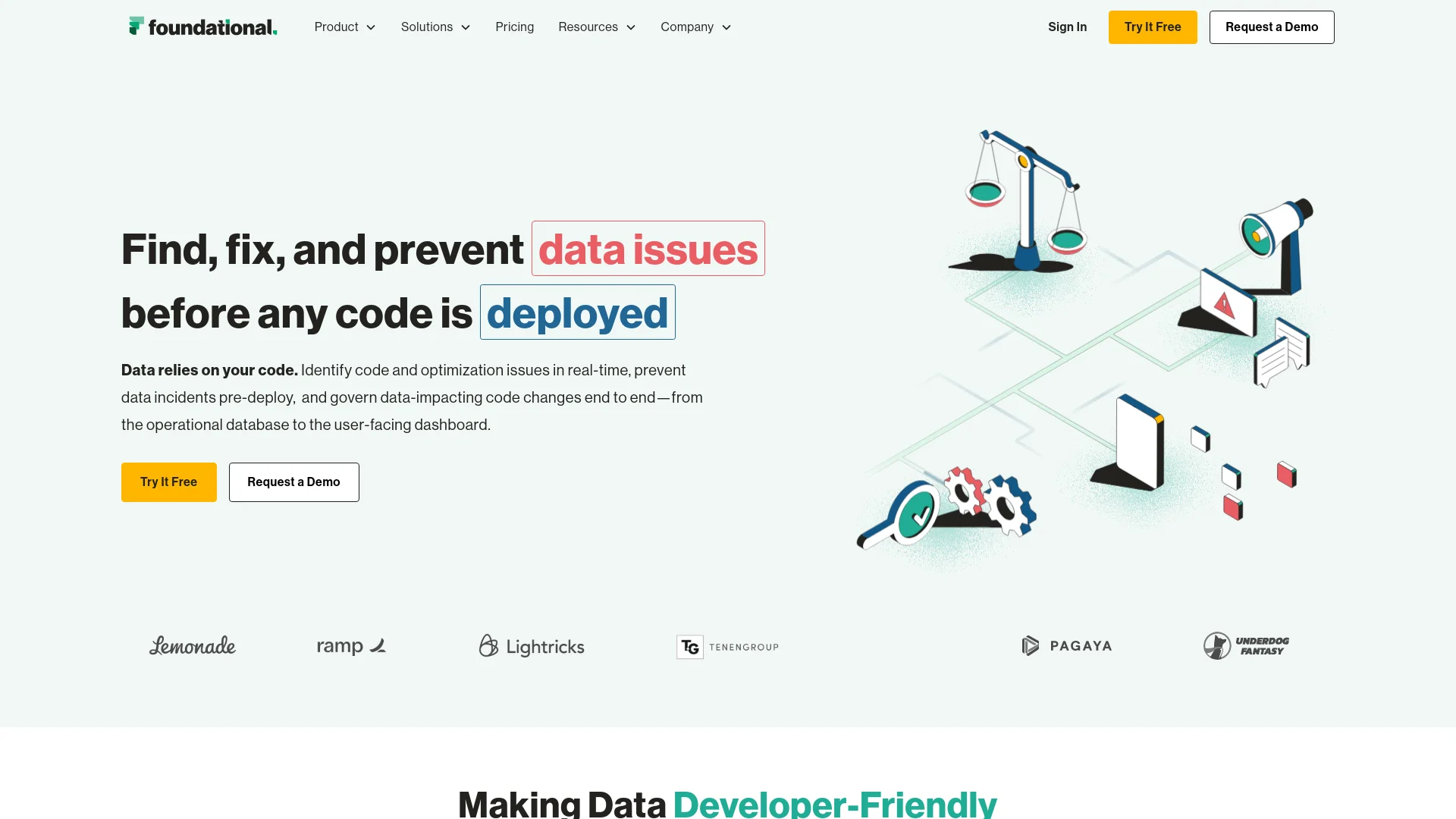
Foundational is a cutting-edge Data Management Platform that seamlessly integrates with developers' workflows to enhance data quality, governance, and privacy across all stages of the data lifecycle. Designed for data-driven organizations, Foundational aims to prevent data incidents before they occur by providing tools for automated data lineage, data quality monitoring, and data contract enforcement.
Foundational sets itself apart by integrating directly with developers' existing tools and workflows, making it incredibly accessible and immediately impactful. Its ability to provide real-time, automated data lineage and quality checks directly from source code makes it a unique asset for any data-focused organization.
Foundational excels in enhancing data management processes, making it an essential tool for organizations prioritizing data integrity and efficiency. Its standout features like automated data lineage and real-time quality monitoring offer significant advantages, ensuring that Foundational is not just a tool but a comprehensive data management solution.
Who is Using Foundational?
Data Engineers
Utilizing the platform to streamline data operations and reduce errors.
BI Analysts
Leveraging automated tools to enhance reporting accuracy and speed.
IT Security Teams
Employing Foundational to enforce data privacy and compliance standards.
Project Managers
Using the tool to monitor and optimize data-related project costs.
Uncommon Use Cases
Educational institutions incorporate Foundational in curriculum to teach data governance; non-profits use it to manage donor data efficiently.
Key Features
Rating Breakdown
Pricing Plans
Free Trial
- Experience Foundational with a robust free trial period
Standard Tier
$50 per month
- Basic data management features
Which Foundational plan should you pick?
Start with the standard sales-scoped plan for your stack; choose Enterprise when you need AWS-based on-premise deployment or strict data residency.
Enterprise
Good for organizations that need on-premise deployment, local processing, strict network boundaries, or data-residency controls.
Foundational Use Cases
Migration and modernization
Map dependencies, migrate only relevant assets, and validate changes across the data stack.
Outcome: De-risked migrations and faster modernization timelines.
Compliance and privacy
Identify sensitive-data flows, apply governance guardrails, and document lineage.
Outcome: Improved compliance readiness for privacy and AI regulations.
AI governance and data access
Trace AI workflows from source data through models and monitor access to governed data.
Outcome: Greater visibility, explainability, and control over AI systems.
Data-stack consolidation
Identify redundant systems and understand dependencies before decommissioning tools.
Outcome: Lower infrastructure costs with reduced migration risk.
Preventing data incidents
Analyze pull requests and ongoing data changes for breaking schemas, quality issues, and downstream impact.
Outcome: Problems are detected before they reach production.
Workflow Ideas with Foundational
Validate a data-engineering pull request
- 1A code change or pull request triggers a Foundational scan
- 2Foundational computes lineage and downstream impact
- 3Foundational reports issues and can block the merge
Automate governance alerts
- 1Define workflow trigger conditions for schema changes, issues, or asset changes
- 2Configure notification and approval actions
- 3Monitor workflow status and resulting actions
Use AI to create a pipeline change
- 1Describe the desired data-engineering change to Foundational IQ
- 2Review the proposed code diff
- 3Approve the change and have Foundational IQ open a draft pull request
How Foundational fits into your stack
GitHub Integration
Seamless integration enhances developer workflows without disruption.
Snowflake Compatibility
Leverages native features for enhanced data quality monitoring.
API Access
Offers extensive API capabilities for custom integrations.
Comprehensive Data Coverage
Supports a wide range of data types and sources for holistic management.
Pros
- +Enhanced Data Integrity: Ensures high standards of data quality and consistency across all platforms.
- +Increased Developer Efficiency: Saves time by automating routine checks and validations.
- +Improved Compliance: Helps organizations meet strict data governance and privacy standards.
- +Scalability: Adapts to growing data needs without requiring additional development work.
Cons
- −Complexity for Beginners: May require a learning curve for teams new to automated data management solutions.
- −Integration Limitations: While extensive, integration capabilities might not cover all potential enterprise tools out-of-the-box.
- −Dependency on Platform Updates: Relies on third-party platform features like Snowflake's DMF, which may affect flexibility.
Limitations & when to consider alternatives
Known limitations
- Manual lineage uploads require XLSX. The manual lineage upload endpoint accepts XLSX workbooks only; XLS, CSV, and other formats are rejected.
- Manual upload processing is asynchronous. Lineage generally loads in about 15 minutes, but processing can occasionally take up to two hours.
- On-premise deployment is Enterprise-only. The documented on-premise deployment options are available exclusively for Enterprise plans.
- AWS-only on-premise deployment. The documented customer-managed deployment method currently supports AWS environments and Terraform.
- Default scope is metadata. Foundational primarily accesses metadata; underlying customer-data access is conditional on enabling observability checks that require it.
Look elsewhere when
- You need a native mobile application.
- You need image-input analysis.
- You need fine-tuning of an AI model on proprietary data.
How to Use Foundational
- 1
Explore the extensive resource library on the Foundational website, including detailed guides and documentation for getting started and maximizing the platform's capabilities.
Who is Foundational For?
Data teams
Foundational is designed to make data teams more resilient and developer-friendly through lineage, governance, and proactive issue detection.
Technology providers
Technology providers can add cross-platform lineage, governance context, and AI guardrails to their data products.
Consulting partners
Consulting firms can use Foundational's lineage and AI-governance capabilities in enterprise data programs.
Cloud partners
Cloud partners can connect Foundational to the data and AI infrastructure their enterprise customers operate.
System integrators
System integrators can deploy Foundational across complex, multi-platform data environments.
Frequently Asked Questions
What does Foundational analyze?
Foundational analyzes source code, metadata, schemas, and logs to build cross-platform lineage and governance views.
Does Foundational access customer data?
By default, Foundational accesses metadata rather than underlying customer data; data access is conditional on enabling observability checks.
What platforms and languages does Foundational support?
Supported sources include GitHub, GitLab, dbt, Airflow, Snowflake, BigQuery, Tableau, Looker, Power BI, Python, SQL, Java, Scala, and many others.
Does Foundational provide an API?
Yes. The Lineage API provides programmatic access to lineage, entities, upstream dependencies, and downstream dependencies.
Does Foundational support SSO?
Yes. Foundational supports SAML 2.0 and OpenID Connect, including providers such as Okta, Azure Active Directory, Google Workspace, Ping Identity, OneLogin, and JumpCloud.
Can Foundational run in an organization's AWS environment?
Enterprise customers can deploy an on-premise agent in AWS using Terraform, including a local-processing option for data residency requirements.
Community reviews
Be the first to share your experience.
Sign in to leave a review for Foundational.
Foundational Alternatives
Looking for alternatives to Foundational? Here are similar tools in the same category:
Learn to Master Foundational
With Skill Leap courses
Get in-depth training on Foundational and 50+ other AI tools with our expert-led video courses.
Start 7-Day Free Trial